There are some places that leave an indelible mark on anyone who visits them. Climbing Creek, a sprawling swamp in Nickerie, Suriname, is one of those special yet threatened sites. Slowly poisoned by encroaching saltwater, this once-thriving ecosystem faces collapse not from natural forces, but from an unplanned man-made canal dug years ago with no oversight. I joined a small team of military personnel on a 20-day expedition into the swamp to document the quiet work of repairing the damage others left behind. This story is not a pretty one, but it is one that demands to be told.
From the team’s base camp, the scale of ecological destruction is immediately visible. Large swathes of the swamp have dried out completely, leaving only parched earth and dying vegetation. Only small pockets flood during high tide, drawing flocks of desperate birds searching for remaining fish, shrimp and crabs to survive. Every day, the team wades into mud that reaches above their knees to plant young native mangrove saplings along the creek’s eroding banks, carefully placing each seedling just above the water line where it has the best chance of taking root. They pull each other out of deep sticky mud when they get stuck, but no amount of discomfort stops them from completing their daily work.
As more trees and native vegetation succumb to salt poisoning, the team presses on. While laughter echoes from the canal as team members cool off between shifts, their camp cook prepares a simple lunch of spiced chicken, rice and smoked fish that I was invited to share. What these few men accomplish here is almost impossible to put into words. If the saplings survive, the site will slowly regenerate into a dense mangrove forest over one to three years. These mangroves will hold freshwater in the swamp, allow silt to build up, and eventually choke and close the unauthorized canal entirely. Ecologists have already seen this successful restoration model work on similar projects along the Nickerie coast.
The bitter irony of this story is hard to miss: one individual’s unregulated decision to dig a casual canal triggered an entire regional ecological disaster, and no authority has ever been held accountable. It falls to this tiny, under-resourced team to prove that repair is possible, working tirelessly for a greater public good with no fanfare and no recognition. Few people will ever see the sacrifices they make or the hardships they endure here, so their story has remained untold — until now.
As the midday heat grows unbearable, the men rest in hammocks strung above dead vegetation, seeking what little relief they can find. When the sun dips lower, they inspect their boat engines, only to discover that two of the three are broken: one has a damaged propeller, and the other has an internal mechanical failure. They make the call to send both broken engines back with me for repair, along with 12 empty water containers and drained fuel tanks to be refilled on the outside.
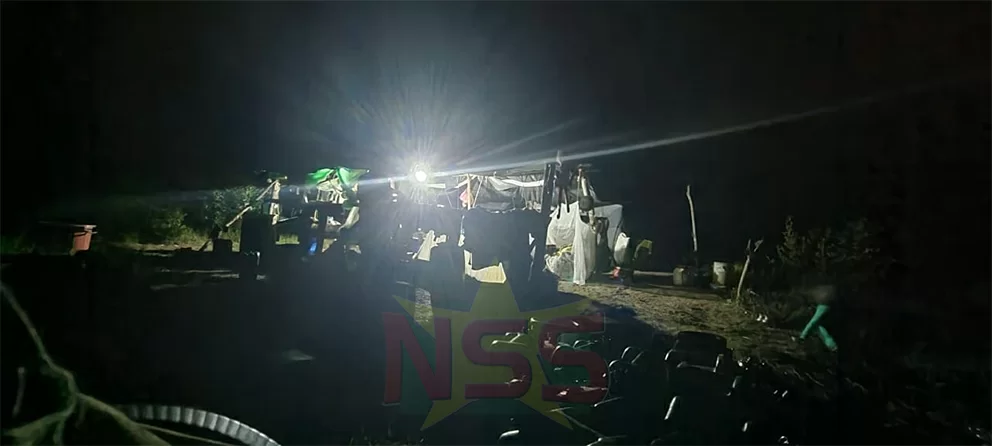
Night falls fast, and the high tide needed to navigate the narrow creek will not turn until around 9 p.m. The team builds a campfire, which immediately draws swarms of venomous horseflies and large black mosquitoes. They place mosquito-repelling candles all around our resting spot on the canal bank. As we wait for the tide, the men share stories of their work, the daily challenges they face, and how much they long to return home to their young families. They have already spent 18 days in the swamp, with just two more left to plant the remaining saplings, and they are determined to hit their planting target before they leave. They plan to launch at 7 a.m. the next day for their final push: the cook will stay behind at base camp, while the rest head three to five kilometers further up the coast to plant the last of the saplings.
When the tide finally comes in, the team rushes to free the stuck boat from the muddy bank and load it for our departure. By the light of the campfire and a single lantern, the world around us is pitch black, save for a brilliant unobscured view of the starry night sky. Before we board, we wrap every inch of exposed skin, leaving only our eyes visible to ward off insect bites. We each get a fresh mosquito candle to hold, and the boat pulls out into the dark canal. The 25-horsepower engine is far more power than the narrow waterway needs, so the captain navigates slowly, weaving carefully through shallow stretches. Within minutes, hundreds of gnats, mosquitoes and other unknown insects swarm around the candle flame. Glittering eyes reflect the captain’s headlamp along both banks: crocodiles drawn to the fish that congregate in the canal. No one feels fear, only quiet awe for the wild natural world unfolding around us under the moonless starry sky. Fish jump around the boat, and we repeatedly toss a small juvenile sea turtle that accidentally landed on board back into the water.
Meter by meter, the boat pushes through the narrow canal. The passengers’ only goal is to avoid getting bitten, but there is still a quiet thrill to this adventurous night journey. We quickly lose count of how many crocodiles we spot: some show only their heads peeking above the water, while others rest on the bank, their glossy brown-black skin glinting in the headlamp’s glow. We are so focused on the landscape around us that we fall quiet, letting the rumble of the engine mix with the calls of night birds, the splash of jumping fish, the rustle of reeds and the soft rush of water.
By the time we reach the dam, the tide is already receding, putting pressure on the two men who will have to make the return trip to camp after dropping us off. Our first mosquito candle has burned down, so we get a fresh one. Two hours later, as we approach the dam, the three men with us jump back into the mud to push and pull the heavily loaded boat meter by meter over the dam. Fish dart through the shallow mud around their feet, grateful for any bit of remaining water, visible only in the beam of the captain’s headlamp — the only light we use to avoid disturbing wildlife.
With the last of their strength, they pull the boat over the dam and launch it into the irrigation channel that will take us to the main road. Once in the wider channel, the captain opens the engine, and the boat speeds across the warm water. A fish the size of a hand leaps right into the boat, and I toss it back to safety. Black silhouettes of dead trees line the banks — a stark reminder of the damage that has been done, but under the starry sky, there is a quiet, heartbreaking beauty to the scene rather than menace. We reach the dock just minutes before midnight, and unload the boat quickly so the two men can head back to camp while the tide still holds. Even without the heavy load, pulling the boat back over the dam through the mud to reach deep enough water for the engine remains a brutal, backbreaking job.
We wave goodbye, and soon only the rumble of the engine and a faint beam of headlight are visible before the dark swallows everything. We climb into a waiting vehicle for the drive to Nieuw Nickerie. The drive is once again through complete darkness: large stretches of the main east-west highway have no streetlights at all, a fact that leaves me wondering why basic infrastructure has never been extended to this remote region. By the time we reach town, fatigue from the day’s heat and work has set in deep. It is 3 a.m. when I step into a hot shower to wash off the swamp mud, and climb into bed, the images of the day still burned clear into my memory.
Back in Nieuw Nickerie, the shower washed away the mud, but it cannot wash away the images I carry with me: the dying fish gasping in dry mud, the soldier singing while he worked chest-deep in mud, the 12,000 young mangrove saplings waiting for the freshwater they need to survive.
No one can say for sure if this restoration project will succeed. It depends on tides, on weather, on continued commitment from people who believe in the work. But one thing I know for certain: these men are showing up, every single day, with no audience, no praise, and no reward. The destructive canal still sits there, and no one in power has ever answered for the damage it caused.
If you ever find yourself near Climbing Creek, take a moment to think of these men. Think of what they do there, working under the burning sun, knee-deep in mud, for a forest that will not even grow for another three years. And think of what this place could have been, if one person had never had that unregulated, destructive idea in the first place.