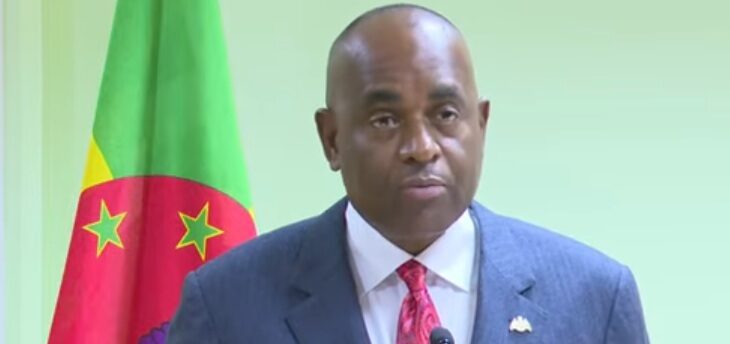
In a formal press briefing this Wednesday, Dominican Prime Minister Roosevelt Skerrit has confirmed the successful conclusion of the first round of transfers under a landmark bilateral third-country national arrangement (TCNA) between the Commonwealth of Dominica and the United States, with all five individuals transferred already returning to their home country of Colombia.
The non-binding agreement, first negotiated earlier this year between the Dominican government and the U.S. government via the U.S. Embassy in Bridgetown, Barbados, outlines a framework under which Dominica may accept third-country nationals that the U.S. is seeking to remove from its territory, with full authority retained by the Dominican side to approve or reject any candidate. Per the terms of the deal, the U.S. is required to disclose full criminal and medical history for all proposed individuals to the extent permitted by U.S. law, grants Dominica the right to reject any candidate with a criminal record, and allows either party to exit the agreement at any time via formal diplomatic notice. All transferred individuals are also guaranteed treatment consistent with Dominica’s constitution, national immigration laws, and all international human rights conventions that Dominica is party to, including the UN Refugee Convention and the Convention Against Torture.
Skerrit detailed the process of the first transfer to reporters, noting that the U.S. initially provided an initial list of candidates that Dominican authorities rejected, as the list failed to meet the information requirements set out in the agreement. After the U.S. submitted a revised second list that included all requested background details, Dominican officials selected five candidates, all Colombian citizens, for transfer. All five cleared background checks, with none holding any prior criminal records.
Upon their arrival in Dominica, the five individuals were housed in a local hotel, provided with meals and basic care, and offered the choice to return to their home country or pursue other resettlement options. All five independently elected to return to Colombia, Skerrit confirmed. The U.S. government provided funding to cover all costs associated with the individuals’ stay in Dominica, and covered the cost of their repatriation flights. The entire process from arrival to departure was completed in an exceptionally short timeline, according to the prime minister, and no third-country nationals currently remain in Dominica under the arrangement.
To ensure impartial and professional management of the process, the Dominican government has contracted the International Organization for Migration (IOM) to administer all logistics related to the TCNA on its behalf. Moving forward, the agreement outlines that Dominica will accept between five and seven third-country nationals per quarter, should the U.S. submit requests aligned with the terms of the deal. Skerrit emphasized that both sides have maintained mutual respect throughout the implementation of the first transfer, and any future U.S. requests will be reviewed in accordance with the existing agreement and agreed-upon conditions.
Framing the arrangement as a humanitarian commitment, Skerrit noted that Dominica’s approach to the agreement is rooted in a broader philosophy of global solidarity. “We have a duty to humanity, and there are so many Dominicans who are living in other people’s countries that we see it beyond just a third-country national issue and a bilateral arrangement between ourselves and United States,” he said. “We have a higher philosophical view on humanity and the right for everybody to survive and to be regarded.”
Work on detailed operating procedures to guide long-term implementation and monitoring of the agreement is currently in its final drafting stage. The forthcoming guidelines will formalize requirements for documentation that the U.S. must provide for each proposed transferee, as well as clarify the scope of U.S. financial and operational support for the arrangement.