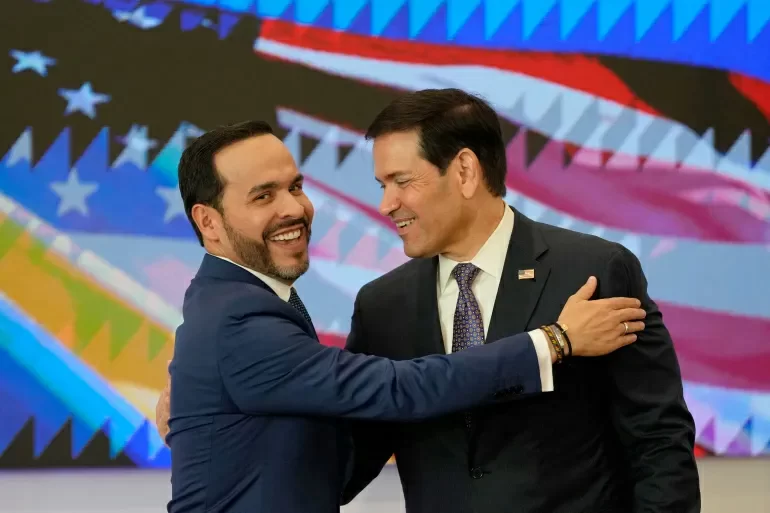
U.S. Secretary of State Marco Rubio arrived in Colombia on Tuesday, marking the first stop of his multi-nation tour across Latin America, a trip designed to strengthen ties with pro-U.S. regional leaders and shore up Washington’s long-standing influence in the Western Hemisphere. The visit comes on the heels of a major political shift in Bogotá, after conservative Colombian President Abelardo de la Espriella — a U.S.-aligned former lawyer — won recent presidential elections, turning a page on the tense relationship between Washington and his left-wing predecessor Gustavo Petro. Since taking office, de la Espriella has pivoted to a hardline crackdown on drug cartels and organized crime, ending peace negotiations with armed rebel groups that defined Petro’s tenure.
During this visit, Rubio and de la Espriella met in Barranquilla, a key Colombian Caribbean port city, for a signing ceremony that highlighted the deepening bilateral partnership. In the weeks since de la Espriella assumed office, Colombia has ramped up aerial counter-narcotics operations and authorized expanded joint military exercises with U.S. forces. The country has also formally joined the Shield of the Americas, a Trump-administration led alliance focused on combating transnational drug trafficking.
While the official core priority of Rubio’s stop is boosting counter-narcoterrorism cooperation, the two leaders are also set to discuss post-disaster reconstruction following the devastating August 10 earthquake that struck Colombia’s major coffee-growing region. The quake killed more than 330 people and leveled critical public and private infrastructure, prompting de la Espriella to formally request U.S. support, including a temporary suspension of Colombian customs duties to lower reconstruction costs and speed up recovery efforts.
Rubio’s three-nation tour, which will also include stops in Ecuador and Peru, comes amid a sweeping conservative wave across Latin America that has followed Donald Trump’s return to the U.S. presidency in January 2025. In recent years, voters across Argentina, Bolivia, Chile, Costa Rica and Honduras have elected right-wing governments aligned with U.S. policy priorities, creating a favorable landscape for Washington to advance its regional agenda.
The Trump administration has openly stated its goal of reasserting U.S. hegemony in South America, building on the 19th-century Monroe Doctrine and rebranding the framework as the “Donroe Doctrine” in a nod to the current U.S. president. Rubio, a Cuban-American politician with long-standing ties to hardline anti-communist and pro-U.S. regional policy, is the primary architect of this new strategy, which is now enshrined in Washington’s updated National Security Strategy.
After wrapping up his meetings in Colombia, Rubio will travel to Ecuador to meet with President Daniel Noboa, where the two sides will discuss ongoing joint operations to disrupt drug trafficking networks, including the notorious criminal group Los Choneros. The U.S. has already led a year-long campaign of airstrikes targeting suspected drug smuggling vessels in the Caribbean and Eastern Pacific, a campaign that has left more than 200 people dead and drawn widespread international criticism over insufficient evidentiary standards and widespread human rights concerns.
The final stop on Rubio’s tour will be Peru, where right-wing pro-U.S. leader Keiko Fujimori has held the presidency since July, cementing another pro-Washington government in the region.