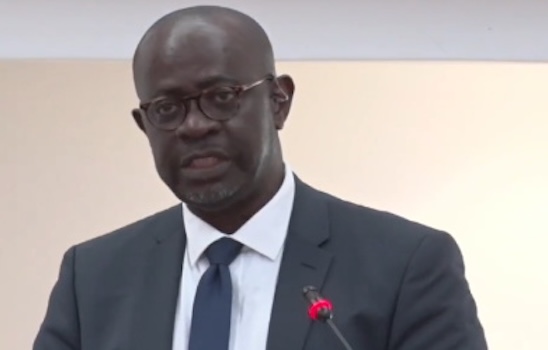
In a landmark address to a joint sitting of Grenada’s Parliament on Tuesday, the chairman of the island nation’s Hydrocarbons Technical Working Group (HTWG) Nazim Burke confirmed that the Dickon Mitchell administration was fully justified in terminating multiple energy exploration agreements with Russian-backed firm Global Petroleum Group (GPG) earlier this year, citing years of unmet contractual obligations and procedural non-compliance. Burke, a former Grenadian prime minister and finance minister, outlined the step-by-step process that led to the July 31 cancellation of GPG’s Development Production Sharing Agreement (PSA), Block Reservation Agreement and development license for four offshore exploration blocks, emphasizing the government went to extraordinary lengths to grant the company due process before taking final action.
Burke detailed the timeline of the termination process: in early June 2026, the government notified GPG of its intent to end the agreements, prompting the firm to issue a response denying any breach of contract on June 2. The government responded on June 10 by inviting GPG representatives to a June 17 hearing to present their case, and requested all supporting documentation to be submitted to the Attorney General by June 15. While GPG confirmed via email on June 12 that it would submit the required materials by the deadline, Burke told lawmakers no documents were ever received, and the scheduled hearing proceeded without any evidence from the company to back up its claims.
Following the hearing, Burke said the government conducted a full review of GPG’s position as required under the Grenada Petroleum and Natural Gas Deposits Act, but found the company failed to provide evidence to support most of its core claims. Critically, GPG did not take any steps to remedy the breaches outlined in the initial termination notice, nor did it offer adequate compensation for missed obligations or provide assurances that future contract violations would not occur. On July 27, the government formally issued the termination notice, with the cancellation taking effect on July 31, and the decision was published in the official government gazette three days later to meet statutory requirements.
Burke stressed that the Mitchell administration treated GPG with transparency and fairness, choosing termination only as a last resort after years of unmet performance targets. “The government considers that termination of the agreement with GPG was a prudent and appropriate course of action,” Burke said, noting that the PSA explicitly allows GPG to pursue international arbitration through the International Chamber of Commerce if it disputes the decision. He confirmed the government is fully prepared to defend its position if arbitration is initiated, and has frozen all activity on the four blocks pending resolution – meaning no new operators will be invited to submit proposals, nor will GPG be allowed to continue any work on the site. Burke added that the government has worked closely with international legal advisors to review the case, and is committed to protecting Grenada’s national energy interests against any potential claims from GPG.
The presentation of the HTWG report was not without controversy, however. Before Burke delivered his 35-minute address, Democratic People’s Movement leader Peter David raised objections to allowing an external body to address the full legislature, questioning the procedural legitimacy of the arrangement. Speaker of the House Leo Cato defended the decision, noting that parliamentary standing orders do not explicitly ban the practice, and government consultation determined that the highly technical nature of the energy review made presentation by expert officials the most appropriate path.
The main opposition New National Party (NNP) went a step further, announcing a boycott of the joint sitting ahead of time over the procedural arrangement. Opposition Leader Emmalin Pierre told reporters that while the NNP supports parliamentary updates on oil and gas exploration, the party objected to what it views as a departure from standard parliamentary protocol that undermines the legislature’s authority. “This matter must not be handled through a process that misuses Parliament and departs from proper parliamentary procedures and practises,” Pierre said.
Beyond the GPG termination, the HTWG – led by internationally recognized petroleum expert Dr. Gibert Yevi, with technical specialists drawn from Trinidad and Tobago, the United States, Scotland, Australia and Spain – presented a broader update on its mandate to assess Grenada’s offshore hydrocarbon potential. If viable commercial reserves are identified, the working group will develop a full strategy to explore, develop and monetize reserves for national economic benefit, alongside a stakeholder engagement plan to involve local communities, civil society and the private sector, and a framework to attract credible international investment.
Burke noted that the oil and gas sector requires massive upfront capital investment and highly specialized technical expertise, meaning Grenada must only partner with firms that meet strict standards of credibility, financial stability and technical proficiency. The HTWG’s mandate requires it to evaluate all existing and prospective operators against these same standards, including GPG, which has held exploration rights in Grenada since the mid-2000s. Burke traced the history of GPG’s presence in Grenada back to 2008, when the company was granted exploration licenses for 11 offshore blocks, followed by a 2013 development license and production sharing agreement for four of those blocks. Critically, Burke explained, GPG never completed exploratory drilling or made a commercial discovery – a required prerequisite for developing a viable production plan, something that never materialized during the firm’s 13 years holding the development license. “In this particular instance, this did not occur with GPG,” Burke said.
Burke added that the HTWG’s review of GPG’s contract also looked at historical disputes involving Grenada’s offshore energy sector, dating back to 2003 arbitration proceedings against another operator, RSM Production Corporation’s Jack Reinburg. The working group’s review confirmed that GPG’s longstanding failure to meet contractual milestones left the government with no other viable option than termination, he said.