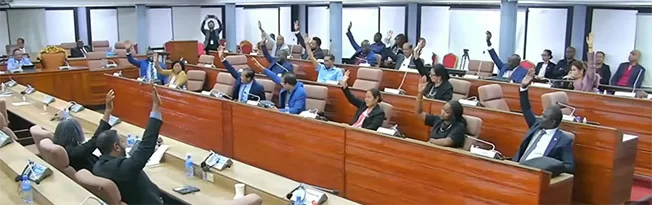
After weeks of polarized, wide-ranging debate, Suriname’s National Assembly (DNA) passed a landmark amendment to the country’s Surinamese Nationality and Residency Act in the early hours of Tuesday, with all 29 present lawmakers casting votes in favor of the revised bill around 1:40 a.m. local time. What began as a deeply divided negotiation between ruling coalition and opposition parties ultimately yielded a cross-party compromise after multiple rounds of closed and open consultations, narrowing the scope of the legislation’s special naturalization pathway to only elite athletes from the global Surinamese diaspora who can represent the country at the international level.
Initiator Ebu Jones expressed relief after the final vote, noting that the prolonged legislative process had concluded successfully. Jones emphasized that the new law removes longstanding barriers to recruiting talented Surinamese athletes who have built their sporting careers outside the country, allowing Suriname to leverage diaspora talent to strengthen its international competitive standing. Multiple lawmakers from across the political aisle highlighted during debate that sport has a unique ability to unite communities across ideological and political divides, a theme that anchored the final compromise negotiations.
The final approved version of the bill represents a significant revision from the original legislative proposal. Initially, drafters had extended the special naturalization pathway to include individuals with exceptional scientific achievements as well, but after factional pushback and cross-party negotiations, leaders agreed to limit the policy to athletes in this first phase. The explanatory memorandum accompanying the bill justifies this narrowing by noting that international sports governing bodies universally require competitors to hold the nationality of the nation they represent, creating an urgent, specific need for this streamlined pathway that does not exist in the same form for scientific professionals.
Under the new framework, eligibility is restricted to individuals who qualify under the PSA (Person of Surinamese Origin) designation and have already demonstrated, or show clear potential to demonstrate, exceptional sporting ability. Athletes must be positioned to add meaningful value to Suriname’s international competitive delegations, and the policy applies across all sports whose national governing bodies are affiliated with the Surinamese Olympic Committee, not just football.
To qualify, athletes must meet either the selection standards set by their national team head coach, or the formal eligibility criteria for continental championships, confederation events, World Cups, or the Olympic Games. National governing bodies may also formally submit a motivated case confirming that an athlete would provide unique value to Suriname during qualification matches or final tournament runs. The Surinamese Football Association, which has already been working to recruit top diaspora talent, will play a central role in implementing the law — a timely change, as the national men’s football team is set to face Honduras in a Concacaf Nations League match as early as September 25.
A key procedural feature of the new law grants the Surinamese president authority to formally grant nationality to eligible athletes, following a nomination from the minister of sports and in consultation with the minister responsible for nationality affairs. Both the relevant national sports federation and the prosecutor general must be consulted before a decision is made. Most notably, the eligible athlete themselves is not required to submit an application, accept the nationality explicitly, sign any formal documentation, or swear an oath or declaration of citizenship. Surinamese nationality is granted automatically by law on the date of the president’s formal decision.
Lawmakers also reached a clear agreement on the National Assembly’s oversight role: the legislature will not vote on individual grants of nationality, but must receive an official copy of the president’s decision and its underlying justifications within 30 days of issuance, allowing parliament to question the government on individual cases if needed.
Co-initiators Steven Reyme and Edgar Sampie both expressed enthusiasm for the final outcome, noting that national interest ultimately prevailed over partisan divides. Reyme specifically highlighted the cooperation of the VHP faction in reaching the compromise. Vice President Gregory Rusland echoed that sentiment after the vote, noting that the National Assembly had demonstrated that national solidarity can overcome political divisions, and expressed satisfaction with the final legislation.
NDP faction leader Rabin Parmessar framed the outcome as a victory for Surinamese democracy in his post-vote remarks, noting that while initial debates were deeply polarized, multiple rounds of negotiation allowed disparate positions to be aligned into a policy that serves the best interests of Suriname’s athletes. VHP faction leader Asiskumar Gajadien similarly emphasized the unifying power of sport, noting that the legislative process had reaffirmed that “sport binds a nation.” Gajadien also highlighted the deep connection between Suriname and its global diaspora, noting that the policy opens new doors for diaspora community members to contribute to the country’s ongoing development. In closing remarks, every faction in the National Assembly reiterated their shared commitment to national interest and celebration of the cross-party consensus reached on the bill.