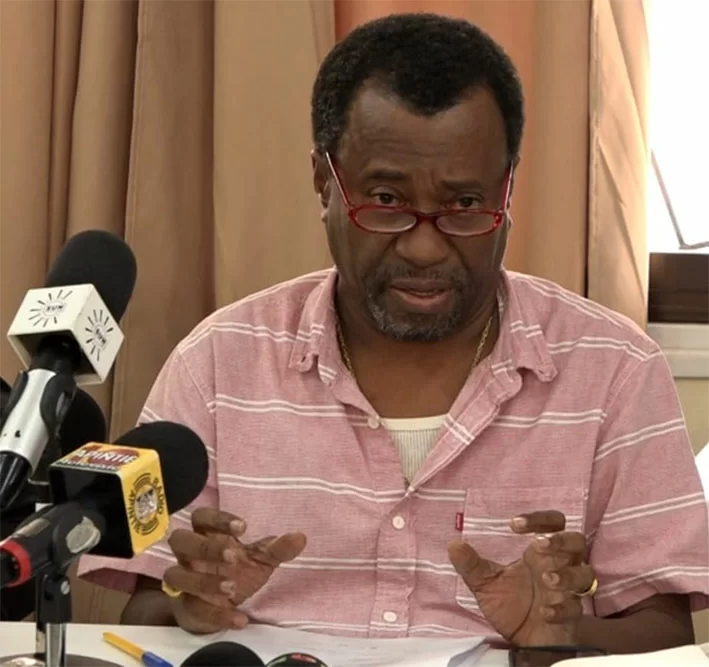
Workers at the Central Bank of Suriname have launched industrial action after bank management tied the full implementation of a binding wage ruling from the national Mediation Council to separate negotiations over employee contributions to pension and healthcare costs, according to Robby Berenstein, chair of the Central Bank Workers’ Organization (CBWO).
Berenstein emphasized that these two issues are completely unrelated. The union is willing to hold discussions on proposed employee contributions, but rejects management’s demand that those discussions conclude before the Mediation Council’s wage adjustment, one-time lump sum payment, and transport allowance increase are implemented. Citing the union’s position, Berenstein told reporters that workers have now paused their work duties, demanding the Mediation Council’s final ruling be followed exactly as written.
The dispute stretches back to earlier this year, when CBWO tabled an initial demand for a 35% wage increase for central bank staff. When negotiations between union representatives and bank leadership hit an impasse, the case was referred to the Mediation Council to resolve the deadlock. The independent body ultimately issued a ruling calling for a tiered structural wage increase, ranging from 14% to 16% depending on an employee’s monthly income bracket.
Under the terms of the ruling, workers earning a monthly salary up to 30,000 Surinamese dollars (SRD) will receive a 16% raise. Staff earning between SRD 30,001 and SRD 90,000 will see increases of 15.5% and 15% in successive income brackets, while employees in the highest earning category (above SRD 90,000) will receive a 14% increase. On average, the overall wage adjustment across all staff sits at approximately 15.1%, per the Mediation Council’s calculations. The ruling also mandates a one-time lump sum payment, with values tied to income brackets: workers in the lowest tier receive one and a half months of salary, which scales down to 1.25 months, one month, and 0.75 months for the highest earning group. Finally, the ruling requires existing transport allowances to be increased by 12%.
During the mediation process, bank management proposed introducing employee contributions for pension and healthcare costs; currently, CBWO says these costs are not deducted from worker salaries. However, the Mediation Council explicitly declined to set any contribution percentages as part of its final ruling, instead stating that this topic must be addressed in separate, future talks between the two parties. CBWO argues this means the discussion over pension and healthcare contributions should not be a precondition to implementing the agreed wage adjustment, and that any negotiations on contributions should take place within the framework of regular collective bargaining already outlined in the existing collective labor agreement (CLA) between the union and the bank.
Berenstein noted that the debate over contributions is not simply a question of how large a percentage workers will pay. If employees are required to contribute to these benefits, the union wants clarity on what improvements or guarantees they will receive in return, particularly around the quality of healthcare coverage and pension benefits. This fundamental disagreement over the sequencing of implementation and negotiations has resulted in the current deadlock.
To date, the central bank has already issued the lump sum payment and increased transport allowances by 12% as required. However, management has only implemented an 11.4% average wage increase, retroactive to January 1, 2026. CBWO rejects this adjustment, saying it does not align with the 14% to 16% tiered increases outlined in the Mediation Council ruling. Berenstein accuses management of deliberately delaying full implementation to force the union to agree to the contribution terms first, saying leadership is attempting to implement the ruling on its own terms rather than following the Mediation Council’s directive.
While management has not publicly stated that it considers the Mediation Council ruling non-binding, and has repeatedly said it intends to implement the ruling, the core of the conflict centers on how implementation should proceed. According to Berenstein, the existing CLA between CBWO and the central bank explicitly states that any final ruling from the Mediation Council is binding on both parties. While legal experts may disagree on the general binding status of such rulings, the union says the CLA explicitly makes this ruling binding in this specific case.
Berenstein warned that allowing employers to unilaterally reinterpret and alter Mediation Council rulings would set a dangerous precedent for labor relations across Suriname. CBWO has called on the national government to intervene and monitor the situation. The union leader stressed that work stoppage is not an end goal for CBWO, but a necessary tactic to force management to honor the terms of the ruling. The Mediation Council has called on both parties to meet and discuss the issue on Monday evening, and CBWO has agreed to attend the meeting.
At that meeting, Berenstein says the union’s core message will be that the ruling must be implemented “to the letter and the spirit.” Following Monday’s talks, the union leadership will present the outcome of the meeting to a general assembly of CBWO members on Tuesday, who will then vote on what further industrial action, if any, will be taken moving forward.