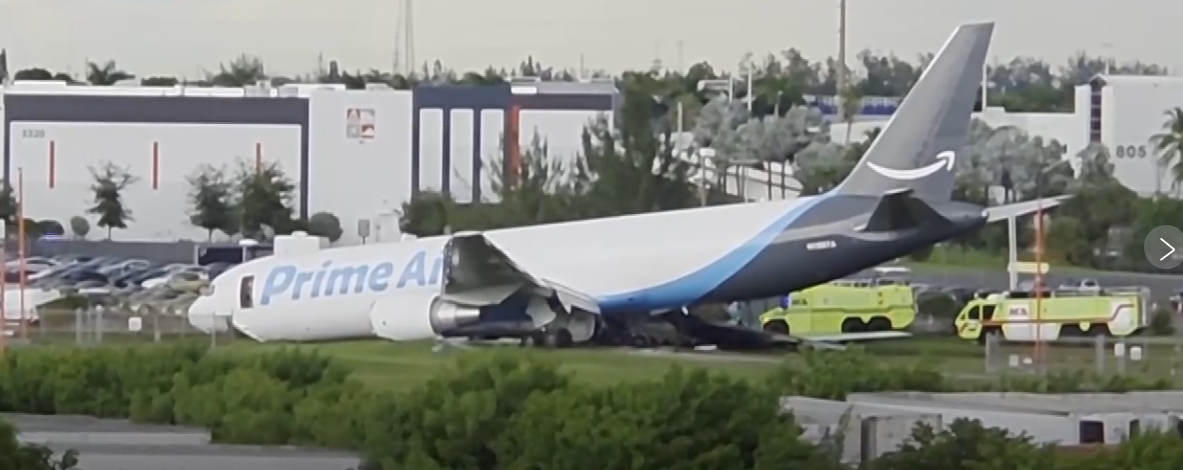
On a Sunday afternoon at one of the United States’ busiest transportation hubs, a devastating aviation incident has shaken the global logistics industry: an Amazon Air cargo flight crashed after overrunning the runway at Miami International Airport, leaving at least five people dead and multiple others with injuries ranging from minor to critical.
The aircraft involved in the accident is a 32-year-old Boeing 767-300, which was originally manufactured to carry commercial passengers before undergoing a conversion to cargo configuration in 2015. Operated by cargo service provider 21 Air under the Amazon Air brand as Flight 7598, the plane had just completed an inbound trip from San Juan, Puerto Rico when the emergency unfolded. Around 2 p.m. local time, the jet failed to stop before reaching the end of the runway, exited the airfield, and crashed into multiple vehicles traveling on a public road that serves adjacent warehouse facilities and local businesses.
Footage captured from the crash site shows thick plumes of black smoke billowing into the sky above the area. The scale of the emergency prompted an immediate large-scale response, with more than 60 Miami-Dade Fire Rescue units deployed to the scene to conduct search, rescue, and fire suppression operations. Miami-Dade Fire Rescue Chief Ray Jadallah confirmed that first responders faced complex challenges: the plane’s pilot and co-pilot were trapped inside the damaged cockpit, multiple other people were trapped inside crushed vehicles, and one person had to be extricated after being pinned underneath a vehicle. As of the initial reporting, it remained unconfirmed whether the flight’s two pilots are among the fatalities.
Official casualty reports from AP News confirm five fatalities, three people with critical injuries requiring urgent hospitalization, and two additional patients with less severe injuries who are also receiving medical care.
Early investigative leads point to one key area of focus: whether the aircraft touched down too far along the runway to allow enough distance for a safe stop. Preliminary analysis of amateur video from the area suggests the plane remained airborne far past the standard touchdown zone for arriving flights at the airport. The U.S. National Transportation Safety Board (NTSB), led by Chairwoman Jennifer Homendy, has taken charge of the official probe. Investigators will examine a full range of potential contributing factors, including the jet’s landing speed, performance of its braking systems, local weather and wind conditions at the time of landing, any potential mechanical failures, and the aircraft’s full maintenance history. Public records also show that prior to its current cargo operation, the plane was once owned by a Russian company, a detail that has been noted in initial reporting but has not been linked to the crash to date.
In the immediate aftermath of the crash, Miami International Airport implemented a full ground stop that disrupted flight operations across the facility for the majority of Sunday afternoon, impacting thousands of passengers traveling through the major hub. In an official statement following the incident, Amazon confirmed that it is cooperating fully with local investigating authorities and is prioritizing safety and support for all individuals impacted by the tragedy.