As rescue operations for survivors of catastrophic cross-border glacier outburst floods enter their 12th day, search teams from Nepal and China are working around the clock to locate thousands of people still missing following the disaster that struck the shared border region between the two nations.
Preliminary data traces the disaster to a glacier collapse that occurred in late August, which unleashed destructive flash floods across the Himalayan border area. As of current updates, the disaster has claimed at least 1,384 confirmed lives and left more than 5,500 people unaccounted for, including roughly 800 foreign nationals. Nepal’s national disaster management authority reports that 1,341 bodies have been recovered within the country’s territory, with 4,996 people still actively searched for. On the Chinese side in the Tibet Autonomous Region, state news agency Xinhua confirms 43 fatalities and 519 missing persons.
In a small glimmer of hope in the grim search effort, four people have been pulled alive from debris since Friday, three of whom were trapped in tunnels attached to local hydropower facilities. Initially, Nepalese officials estimated that as many as 100 people could still be alive in these tunnel structures, but daunting obstacles have slowed progress. “Rescue teams are facing enormous challenges, from the rugged mountain geography to unpredictable bad weather and persistent communication blackouts in the disaster zone,” explained Nepal’s Energy Minister Biraj Bhakta Shrestha.
On the Chinese side of the border, deep mudslides, unstable weather conditions and constant risks of secondary landslides continue to hamper search efforts in the narrow gorge that was hit hardest. In Gyirong, the major land border crossing between China and Nepal, the five-story customs facility that once anchored local trade was completely wiped off the map by the flood. Rescue teams have deployed heavy excavators and life-detection radar to comb through debris for any sign of survivors. The only paved access road to the disaster zone was reopened on Wednesday, clearing the way for heavy equipment to reach the hardest-hit areas.
In the wake of the disaster, Nepal has made a historic request for international aid, turning to the UN-backed Loss and Damage Fund, a climate emergency mechanism that has never before been activated for a disaster of this type. Established in 2022, the fund is designed explicitly to support climate-vulnerable developing nations cover catastrophic costs from climate-driven disasters. Kathmandu is seeking funding from the mechanism to cover a portion of the massive reconstruction and response costs triggered by the floods. The United Nations has also launched a $50 million emergency appeal to provide food, shelter and medical care to more than 84,000 people displaced by the disaster.
Nepal’s Foreign Minister Shisir Khanal has underscored that major greenhouse gas-emitting nations bear a moral and practical responsibility to compensate climate-vulnerable countries like Nepal for climate-driven disaster losses. The country has formally submitted an official climate compensation claim to the international community in response to the disaster.
While the exact trigger of the specific glacier collapse is still under formal investigation, climate scientists universally agree that rising global average temperatures have driven a sharp increase in both the frequency and severity of glacial outburst flood events globally. A United Nations research assessment found that glacial outburst floods have become almost five times more common since 1950, a trend directly linked to anthropogenic climate change that is accelerating ice melt in high-mountain regions like the Himalayas.
Manjeet Dhakal, a climate advisor to the UN for least developed countries, emphasized that the international community bears responsibility for covering climate disaster costs in vulnerable developing nations. Dhakal noted that impacted low-income countries are often forced to divert critical budget allocations away from healthcare, education and long-term development to cover emergency response and reconstruction, creating a vicious cycle of climate vulnerability. “This flood was not caused by Nepal’s own emissions,” Dhakal pointed out. “The global community must step up and take accountability for the harm its emissions have caused.”
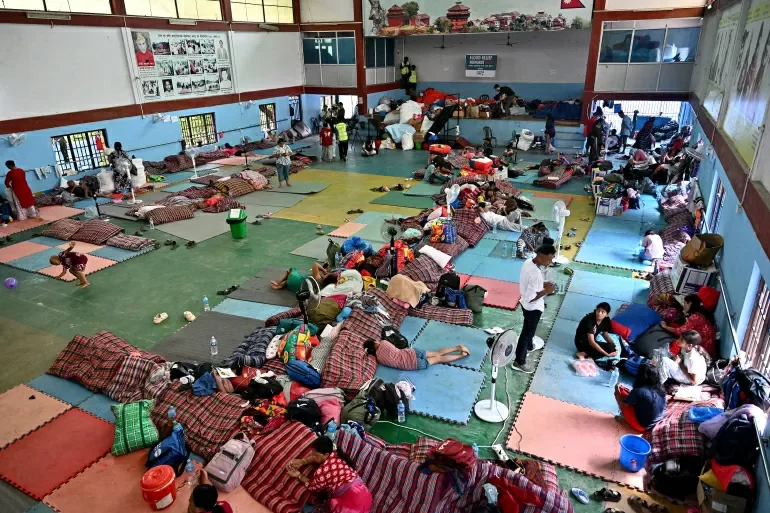
In the disaster-struck region, hundreds of survivors are now recovering in temporary emergency shelters, including a Buddhist monastery in Nuwakot district’s Devighat that has opened its doors to displaced families. Al Jazeera reporting from Kathmandu finds that many survivors, especially children who lost their entire families and homes in the flood, are still in the early stages of processing the trauma they experienced. Volunteer mental health workers are working to create safe spaces for survivors to express their grief, but many people have suppressed their emotions in the immediate aftermath of the disaster — a pattern that experts warn could lead to severe mental health challenges in the coming months.