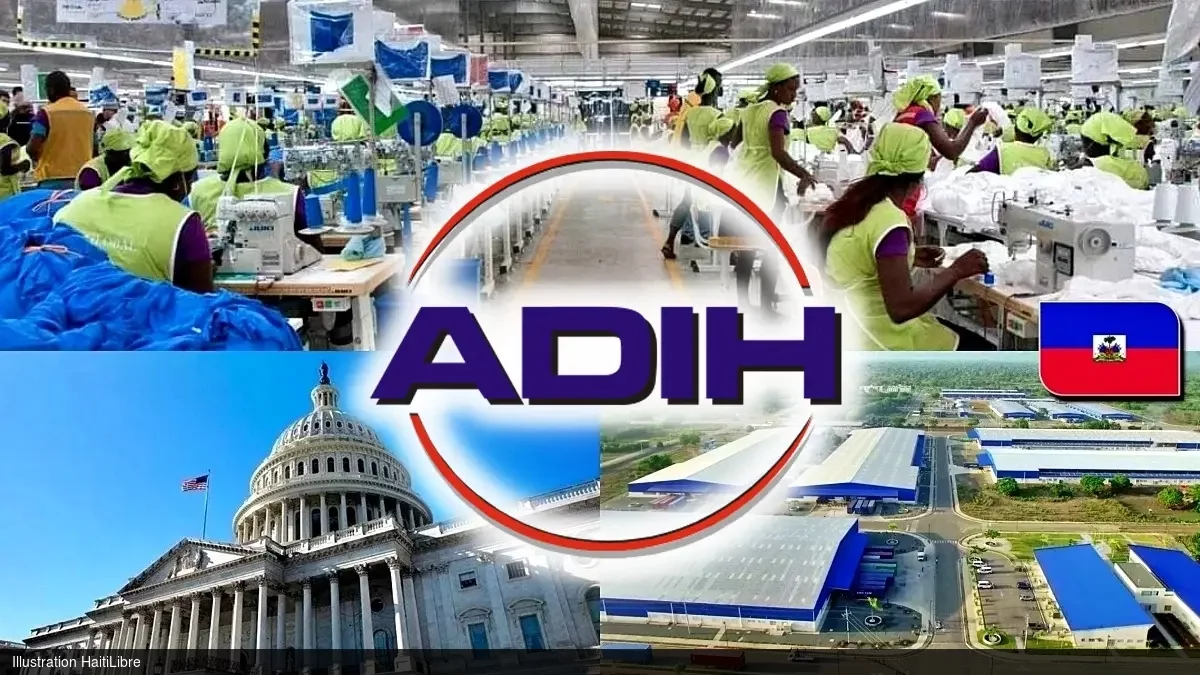
After more than five years of coordinated advocacy, dozens of stakeholder missions, and sustained pressure on U.S. policymakers, a critical win has been secured for Haiti’s apparel manufacturing sector: the HOPE/HELP Act, which allows qualifying Haitian garment products to enter the U.S. market duty-free, has been formally extended through December 31, 2028.
The Association of Haitian Industries (ADIH) has publicly welcomed the September 2, 2026 promulgation of the extension by U.S. President Donald Trump, capping a months-long legislative journey through the U.S. Congress. The bill first cleared the U.S. Senate in August 2026, passed the House of Representatives on September 1, and was transmitted to the White House for final approval shortly after.
ADIH first launched its full-scale advocacy campaign for the act’s renewal back in April 2021, years ahead of the previous legislation’s scheduled expiration. For Haiti, the trade preferences granted by HOPE/HELP are far more than a tariff reduction policy: they underpin the country’s entire apparel export sector, supporting millions of livelihoods, sustaining local businesses, attracting foreign investment, and allowing Haiti to retain its foothold in global and regional supply chains.
In 2021, the Haitian apparel sector supported nearly 61,000 direct jobs. However, repeated cascading political and economic crises across Haiti, paired with persistent uncertainty over the future of HOPE/HELP, triggered a sharp contraction of the sector. Over the past five years, an estimated 40,000 jobs have been lost – positions that supported roughly 200,000 Haitian people total.
Against this backdrop, the two-and-a-half-year extension offers a vital lifeline. ADIH says the extension will create a much-needed window of stability to shore up the sector, reassure international buyers, protect remaining jobs, and lay the groundwork for a gradual recovery of lost employment.
The industry group emphasized that the successful extension is the outcome of a years-long collective public-private partnership. ADIH extended gratitude to a wide range of supporting stakeholders, including the Haitian national government, the Investment Facilitation Center (CFI), the Ministry of Economy and Finance (MEF), the Bank of the Republic of Haiti (BRH), the Ministry of Commerce and Industry (MCI), the Office of the Special Labor Mediator (BMST), the Inter-American Development Bank (IDB), and national labor unions that backed the campaign at every stage.
Special recognition went to Sorini Samet & Associates LLC, a U.S.-based firm that has partnered with ADIH on trade preference issues since the original HOPE Act was adopted in 2006. Across nearly 20 years, from the passage of HOPE II in 2008 and HELP in 2010 to renewals in 2015, 2020, and 2026, the firm has supported ADIH in building cross-sector alliances, raising awareness of the sector’s needs, and advocating with members of Congress and other U.S. decision-makers.
Despite celebrating the extension, ADIH cautioned that the progress achieved is not a final solution. A extension through 2028 does not provide enough long-term certainty to rebuild the sector sustainably, attract large-scale new investment, convince international prime contractors to enter long-term contracts, and restore the sector to its full productive potential.
ADIH’s core long-term objective remains unchanged: securing a multi-decade, permanent renewal of the HOPE/HELP Act to deliver the stable policy environment Haiti needs. The association says it will continue working with the Haitian government, its own members, domestic and international partners, and U.S. policymakers to secure the long-term visibility required to position Haiti as a competitive industrial export destination, drive new investment, and create tens of thousands of new jobs for Haitian workers.