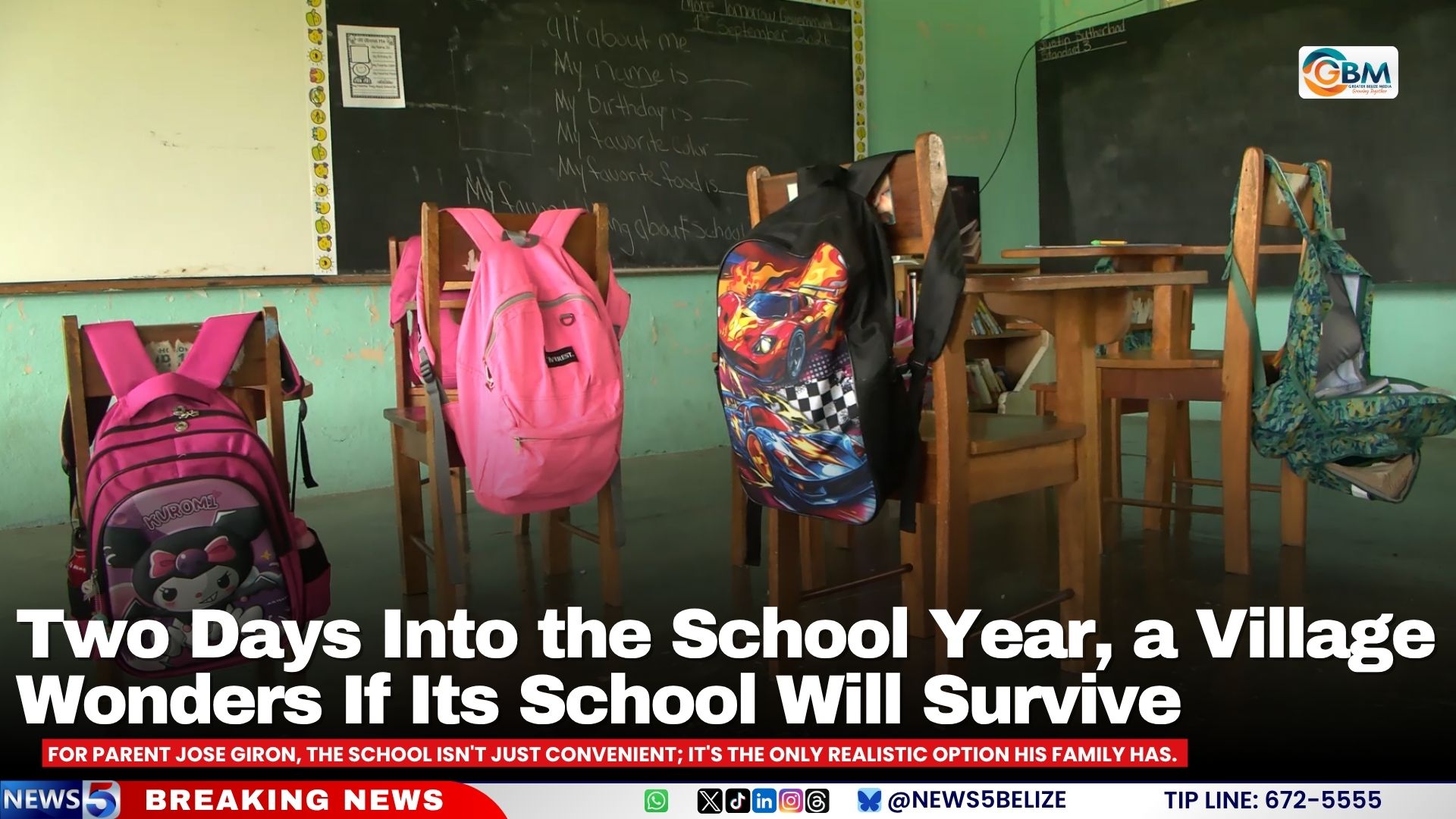
It is only 48 hours into the new 2026 school year in Belize’s Cayo District, but a quiet rural community is already grappling with an existential crisis that puts its only local primary school at risk of closure. What was supposed to be a fresh start for students at More Tomorrow Primary has quickly turned into uncertainty, as the campus currently operates with just two educators responsible for teaching more than 30 children spanning eight grade levels, leaving parents fearing the school will not be able to continue operating.
At the heart of the understaffed campus is Elizabeth Tush, one of the two remaining staff members who relocated from the capital city of Belmopan to take up a teaching post in the remote village. Tush, who has committed to staying to support the underserved student body, says she was drawn to the role by the clear need for improved literacy and writing instruction among local children. “I like the place. It’s more peaceful, and the kids need more education. Especially on reading. Especially on writing. I saw that they need a lot of help with that. That’s why I said I was going to stay and help these kids,” Tush explained.
The structural challenges of the understaffed school are impossible to ignore. With students ranging from the earliest Infant One year through Standard Six, Tush and school principal Dominina Pop — who is scheduled to retire next year — have been forced to merge all eight grades into just three broad multi-age groups: lower, middle, and upper. Pop currently handles the entire lower division of two grade groups on her own, while Tush manages three separate grade groups. Tush says she already struggles to cover her own workload and questions how the principal manages her expanded responsibilities with no additional support.
For local families, the potential loss of More Tomorrow Primary is far more than an inconvenience: it is the only accessible education option available. Jose Giron, a local parent with multiple children enrolled at the school, notes that the campus allows children to return home for meals and rest during school breaks, a benefit impossible at distant schools. “All my children study right here, and that’s a great opportunity for the children, because we can see them go to school and come back, and they can come eat and get a little rest in the break time,” Giron said. He added that families already invested in school uniforms and paid tuition for the new year, leaving them frustrated and uncertain about sudden closure plans.
Rumors of an impending government shutdown spread rapidly through the village last week, prompting Belize’s Education Minister Francis Fonseca to issue an immediate clarification. While Fonseca confirmed that no final decision to close the school has been made, he openly acknowledged the persistent staffing challenges that have plagued the remote campus for years. “Nobody wants to go to teach there. They say the conditions are too harsh. You have to understand, we’ve been trying. I know last year we made accommodations to try and improve everything. We facilitated even a mother and daughter, both living together, both teaching there. But even they have gotten frustrated. So it’s a difficult situation,” Fonseca said. The minister added that one option under consideration is reallocating students to larger nearby schools and providing free transportation for village children, but no final agreement has been reached, and discussions with the community are ongoing.
The root of the staffing shortage stems from basic cost-of-living pressures that make remote postings unappealing for most educators. Skyrocketing rent, rising transportation costs, and the common expectation that teachers cover the cost of their own classroom supplies have pushed most applicants away from the role. Additionally, the village becomes completely cut off during periods of bad weather, when flooding renders the only access road impassable, forcing teachers to stay stranded off-campus and leaving students without instruction.
Village leaders believe they have a targeted solution that could reverse the staffing trend: building on-site housing for teachers within the village boundaries. Michael Myvette, chairman of More Tomorrow Village, says permanent local housing would eliminate the transportation and accessibility barriers that have deterred educators for years. “Sometimes when the weather is bad, then the road gets flooded, and then nobody can pass. So if we have teachers in the community, then it will be better for the students,” Myvette explained.
As the community waits for a path forward, the Ministry of Education has scheduled an urgent meeting with parents and village leaders on September 3, 2026 — the first formal collaborative step to resolve the crisis. The outcome of the meeting will determine whether the small rural school can secure the staffing it needs to continue operating, or whether it will be forced to close its doors permanently.