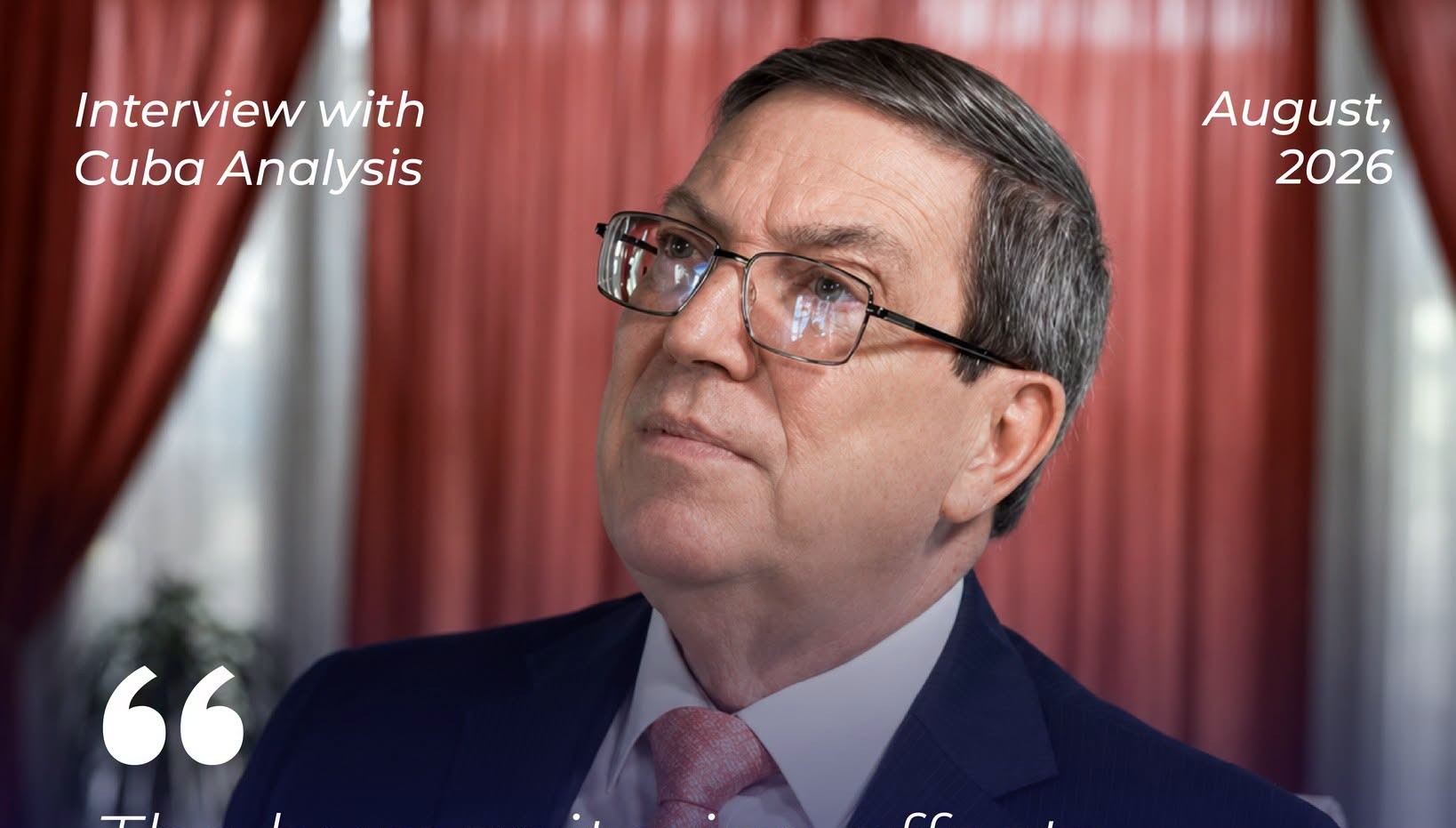
In a recent wide-ranging interview with the Cuba Analysis Podcast, co-hosted by researchers Helen Yaffe and Nina Blodau, Cuba’s top diplomat Bruno Rodríguez Parrilla pulled back the curtain on the cumulative harm of decades-long U.S. sanctions, pushed back against misleading narratives about Cuba’s economic struggles, and outlined Cuba’s stance on future diplomatic engagement with Washington. The interview was later highlighted in an official press release from the Cuban Embassy.
Rodríguez, who has lived his entire life under U.S. economic restrictions, emphasized that multiple generations of Cubans have grown up amid the unrelenting pressure of these measures. “The suffering experienced by our people—by every Cuban—the hardships and anguish, are extreme,” he stated, noting that the punitive measures qualify as collective punishment against the Cuban public. He added that the impact of sanctions has grown dramatically worse since 2019, with the most severe escalation coming from new restrictive measures rolled out in 2026.
Rejecting widespread external claims that Cuba’s domestic economic challenges stem primarily from the country’s political system or local policy decisions, Rodríguez pushed back firmly: “They’re lying; they’re lying systematically.” He directly attributed widespread supply shortages and sustained economic strain to U.S. restrictions on Cuban trade, access to global finance, and energy imports.
To back up his arguments, Rodríguez shared on-the-ground data illustrating the tangible harm of the sanctions. He noted that more than 7,000 shipping containers loaded with critical food, prescription medicine, and life-saving medical equipment have been blocked from entering Cuban ports, after U.S. pressure forced international shipping companies to halt service to the island. He also connected the recent uptick in Cuban infant mortality rates directly to gaps in medical supplies and infrastructure caused by the restrictions.
Energy access emerged as one of the most pressing pain points from the 2026 measures. Rodríguez compared the new restrictions to a de facto naval blockade, saying they have crippled Cuba’s ability to import sufficient fuel for daily operations. “If Cuba were able to acquire even minimal amounts of fuel today, power outages could be reduced to two or three hours a day,” he explained, adding that increased fuel supplies would also resolve widespread disruptions to public water access and domestic food distribution networks. He also debunked unsubstantiated claims that Cuba has received free fuel from external partners, calling the assertion “completely false; it’s a lie.” All hydrocarbon imports, he clarified, have been completed through legitimate commercial transactions, structured barter arrangements, and purchases carried out under exceptionally difficult market conditions.
Beyond economic pressure, Rodríguez also addressed persistent U.S. military threats toward Cuba, describing them as a major threat to regional stability. “It is a threat that we take seriously—very seriously—and it is of the utmost gravity,” he said, warning that any escalation would lead to widespread civilian casualties and deepen instability across the Caribbean and Gulf of Mexico. While he confirmed that Cuba is actively preparing to defend its territory and sovereignty, he emphasized that the country remains committed to preventing conflict. “Our people would undoubtedly defend their independence, their sovereignty, and the territorial integrity of our homeland to the very end,” he stated.
Rodríguez also addressed the issue of promised U.S. humanitarian assistance to Cuba, noting that of previously announced aid packages totaling $3 million, $9 million, and $6 million, only a small fraction has actually been delivered. Even the high-profile $100 million aid initiative, he added, has only reached roughly 700 Cuban families to date.
Turning to Cuba’s global health engagement, Rodríguez defended the country’s longstanding international medical cooperation programs, noting that Cuba remains one of the largest providers of South-South medical assistance globally. He added that U.S. sanctions also limit global access to Cuban-developed medicines and medical technologies that treat a range of serious conditions, including cancer, diabetes, diabetic foot complications, and neurodegenerative diseases.
Looking at the long arc of U.S. policy toward Cuba, Rodríguez noted that decades of restrictive measures have failed to achieve Washington’s stated political goals on the island. “No matter how extreme its measures may be, it’s not going to work,” he said.
He pointed to past periods of improved bilateral relations between the two nations as proof that constructive engagement is possible. Rodríguez confirmed that Cuba remains fully open to bilateral negotiation with the U.S., but only under clear terms: “on the basis of international law, sovereign equality, on an equal footing, mutual respect, and mutual benefit,” with no interference in Cuba’s internal affairs and no preconditions placed on the dialogue.
In closing, Rodríguez expressed long-term confidence in the future of U.S.-Cuba relations: “In the end, a civilized, productive, and respectful relationship between our two peoples will prevail.” The full version of the interview is available for public viewing on YouTube.