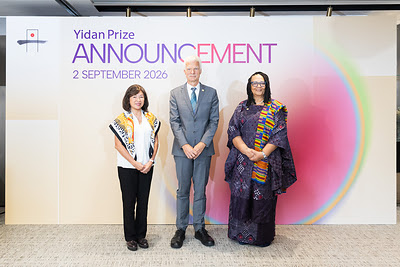
On Monday, the Yidan Prize Foundation, a leading global philanthropic organization focused on education advancement, named four trailblazing academics the 2026 Yidan Prize laureates during a Hong Kong press conference. The announcement marks a decade of the foundation elevating game-changing education innovators from across the globe, delivering targeted resources to expand their transformative work.
Chaired by Andreas Schleicher, OECD Director for Education and Skills, the prize’s independent judging panel selected two cohorts of winners across the Yidan Prize’s two core awards: Education Research and Education Development. University of Minnesota Regents Professor Paul W. Glewwe took home the 2026 Yidan Prize for Education Research, recognized for four decades of rigorous, field-shaping work that has reoriented education policy to break systemic barriers to learning for children in marginalized, low-income communities.
A second cohort of three experts, Professor Susan P. Walker, Professor Sally Grantham-McGregor, and Dr Susan M. Chang-Lopez, claimed the 2026 Yidan Prize for Education Development. The trio was honored for developing the ground-breaking, evidence-based Reach Up early childhood development intervention, which has reshaped life trajectories for children growing up in low-resource, displaced, and Indigenous communities worldwide.
Each of the two Yidan Prizes comes with a total award of HK$30 million, roughly equivalent to US$3.8 million. The funding is split evenly between a HK$15 million unrestricted cash prize and a HK$15 million project grant, giving laureates full flexibility to scale their work and reach more communities in need. Since the prize launched in 2017, the foundation has distributed a total of HK$600 million (approximately $77 million USD) to 25 laureates, supporting education initiatives across nearly 60 countries and regions.
Reflecting on the 10-year milestone, Yidan Prize founder Dr Charles Chen Yidan framed the award as a guiding beacon for global education progress. “Over the past decade, the collective impact of our laureates has turned the Yidan Prize into a lighthouse that illuminates pathways forward for global education,” Chen said. “Every new laureate strengthens our shared commitment, brings transformative new ideas, and expands the ways we shape the future of learning worldwide.”
Glewwe, an applied economics professor at the University of Minnesota, earned the research prize for his pioneering work unpacking how non-school factors – including socioeconomic status, health, and nutrition – shape long-term learning outcomes for children. He revolutionized global education data collection by integrating literacy, numeracy, and abstract reasoning metrics for children and parents into the World Bank’s standard household surveys, a shift that has helped policymakers worldwide better map the connections between poverty, inequality, and educational gaps. He also pioneered the widespread use of randomized controlled trials (RCTs) to test the effectiveness of education programs and policies, enabling governments and global development organizations to direct limited resources to approaches proven to boost learning outcomes. Beyond these contributions, Glewwe was among the first economists to integrate social-emotional skill development into economic analyses of education and global development. His work, spanning more than 15 developing nations, has reshaped education policy and on-the-ground practice across every inhabited continent.
Elizabeth M. King, head of the Yidan Prize for Education Research judging panel, emphasized the outsized real-world impact of Glewwe’s decades of work. “Transforming education systems and outcomes only happens when uncompromising scientific rigor is paired with a fierce commitment to improving people’s lives,” King explained. “For nearly 40 years, Paul Glewwe has delivered exactly that rigor. He has given governments the evidence they need to allocate public spending wisely, given teachers the tools they need to instruct effectively, and opened the door of opportunity for millions of vulnerable children to learn, thrive, and break the cycle of intergenerational poverty.”
For the education development prize, Walker, Grantham-McGregor, and Chang-Lopez earned the honor for their decades of work building the Reach Up early childhood intervention, a low-cost, scalable model that empowers caregivers to support healthy early development from birth to age four. Walker is an emeritus professor of nutrition at the University of the West Indies’ Caribbean Institute for Health Research, Grantham-McGregor is emeritus professor of International Child Health and Development at University College London, and Chang-Lopez is a senior lecturer at the University of the West Indies’ Caribbean Institute for Health Research. The trio began their careers researching early childhood health and nutrition, where they uncovered the outsized long-term impact of early stimulation and consistent quality caregiver-child interaction on lifelong development. Leveraging this foundational evidence, they designed a practical, adaptable intervention that builds caregivers’ capacity to nurture cognitive growth through simple, low-cost activities integrated into daily routines. Unlike costly specialized early childhood programs, Reach Up is rooted in local cultural contexts and delivered through existing public health, social protection, education, and humanitarian systems, making it easy to scale in low-resource settings. Today, the program operates in more than 21 countries across the Caribbean, Latin America, Asia, Africa, and the Middle East, and all of Reach Up’s curricula and training materials are available for free globally, with continuous iterative updates based on real-world outcome data.
Dorothy K. Gordon, head of the Yidan Prize for Education Development judging panel, praised the trio’s approachable, high-impact innovation. “Reach Up gives millions of children a far better chance at an equal start in learning, education, and life,” Gordon said. “The laureates have proven that lasting, large-scale change can be achieved through a combination of rigorous evidence, cross-sector partnership, and local leadership. The immense global impact of their work grows from the rigor of their pathbreaking interdisciplinary research, paired with a practical, well-designed toolbox of interventions that meet communities where they are.”
To mark the 2026 awards, the new laureates will gather in Hong Kong for the annual Yidan Prize Summit, held from 3 to 5 December 2026. The three-day event will feature collaborative conversations around the theme of reimagining education for the AI age, building on 2025’s discussion of global education at a crossroads. This year’s summit will center on a paradigm shift: framing education not as a contained physical space, but as a dynamic driving force for inclusive, interconnected ecosystems rooted in human connection, creativity, and deep learning. The 2026 Yidan Prize formal awards ceremony will cap off the summit on its final day, where the laureates will receive their gold medals and official awards.
Looking ahead, the Yidan Prize Foundation has opened the nomination window for the 2027 prize, which will run from 27 October 2026 through 2 March 2027. As the world’s highest-profile education award, the Yidan Prize continues to center future-oriented, innovative, sustainable work that delivers transformative impact for communities globally. Founded in 2016, the foundation’s core mission is to build a better world through education, bringing together a global network of education changemakers – including researchers, practitioners, policymakers, and philanthropists – to exchange knowledge, raise standards for the field, shape global education agendas, and accelerate large-scale progress.