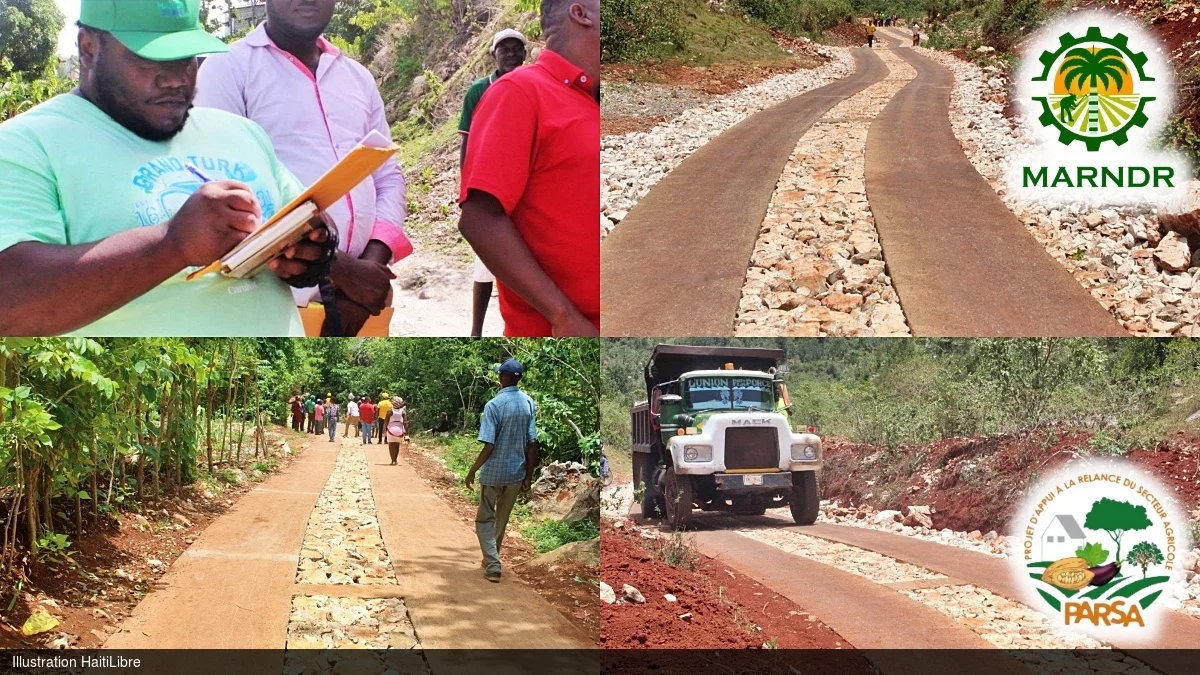
Haiti’s Ministry of Agriculture is wrapping up a key rural infrastructure initiative in the Grand’Anse department, where rehabilitation works on multiple critical rural road segments in the municipalities of Beaumont and Pestel have passed preliminary compliance checks and received provisional acceptance as of August 26, 2026. The project is a core component of the national Resilient Agriculture for Food Security Project (PARSA), a broader development push focused on unlocking agricultural potential across underserved rural regions of the country.
In total, the initiative delivered upgrades to 1,200 meters of rural roadway: 600 meters of reinforced concrete strip roads and an equal length of graded dirt roads. Broken down across the project sites, the works in Beaumont’s Chardonnette second communal section included 150 meters of concrete strip rehabilitation and 200 meters of dirt road improvements, while the nearby Dumois locality received an identical 150 meters of concrete work and 200 meters of dirt track upgrades. In Pestel’s Clément fourth communal section, along the key route linking the Desriveaux intersection to Macochon, crews completed 300 meters of concrete strip road rehabilitation and 200 meters of dirt road repairs.
The provisional acceptance process was led by Ralph Wendy Despeignes, agricultural engineer and Departmental Director of Agriculture for Grand’Anse, working in collaboration with PARSA’s regional coordination office for Haiti’s Grand Sud region. Local government leaders and community representatives from the beneficiary populations were also in attendance to observe the compliance verification.
The upgraded road segments were selected specifically for their outsize impact on both daily community life and agricultural activity. For local residents, the improved roadways will dramatically change access to critical essential services, including healthcare clinics, primary and secondary schools, and other public resources that many have long struggled to reach due to impassable or poorly maintained routes.
For the region’s large community of smallholder and commercial agricultural producers, the upgrades address one of the most persistent barriers to livelihood growth: poor transportation connectivity. By smoothing routes between remote production zones and major urban consumption markets, the project is expected to cut down on product spoilage and post-harvest losses that have eroded producer incomes for decades. It will also reduce overall transportation costs, creating more favorable conditions for farmers to market their output at fair prices and invest in adding value to their products before they reach consumers. Beyond individual producer benefits, the improved connectivity is projected to stimulate stronger commercial exchange between rural production hubs and urban centers, laying the groundwork for long-term economic growth in one of Haiti’s key agricultural regions.