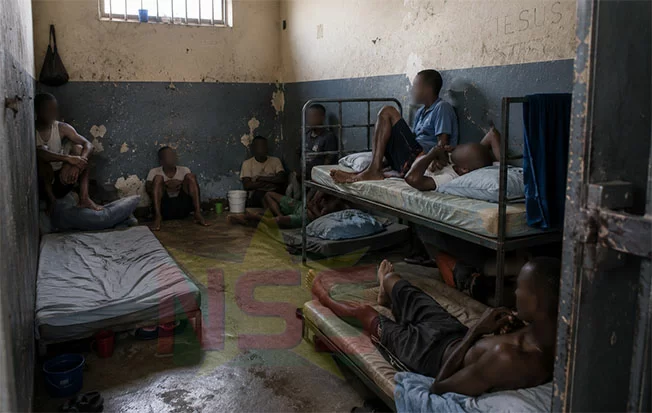
When a state deprives an individual of their liberty, it simultaneously assumes an enormous moral and legal responsibility. A person in detention cannot independently access a general practitioner, dentist, cardiologist, psychologist or psychiatrist. They cannot arrange their own transportation, schedule a medical appointment, or make the decision to seek emergency care when their health declines. In the most literal sense, the state holds the key to their cell door — and from the moment that door locks, the state bears an unconditional obligation to ensure all necessary medical care is provided. But deep, persistent failures plague Suriname’s detention centers and prisons, according to a critical assessment by human rights analyst Nita Ramcharan. Complaints from detainees, their family members, and legal representatives about denied or drastically delayed essential medical care have become widespread. This is not an isolated series of accidental oversights; the pattern that emerges is systemic, deeply distressing, and entirely preventable. Detainees referred for specialist care ranging from internal medicine and orthopedics to mental health treatment are repeatedly denied transport to their scheduled appointments. The excuses offered for these failures have become depressingly predictable: no available transportation, insufficient staffing, no dedicated court escort, and no capacity to wait for hours alongside a detainee during a specialist consultation. These administrative hurdles are treated as a sufficient reason to abandon a detainee’s medical needs entirely. In some cases, a detainee is eventually transported to an appointment only after the consultation window has already closed, after which they are returned to their cell to restart the months-long waiting process. Even when a judge explicitly orders medical treatment during a court proceeding, there is no guarantee that the order will be followed. Ramcharan cites one common example: two months after a judge orders dental care for a detainee reporting severe tooth pain, the treatment still has not been delivered. Legal representatives, who repeatedly call, write formal requests, and escalate demands for care on their clients’ behalf, report growing increasingly hopeless in the face of systemic inaction. This widespread institutional indifference should be a source of profound public concern, Ramcharan argues. When the legal professionals who are tasked with upholding detainees’ rights can only get silence or excuses in return, the problem can no longer be dismissed as a small, unintended organizational flaw. Instead, the country is facing a systemic failure that leaves the fundamental rights of incarcerated people insufficiently protected behind closed doors. Crucially, access to medical care for detainees is not a discretionary favor granted by the state — it is a non-negotiable human right. The current pattern of neglect amounts to a serious violation of core international human rights standards. Suriname is a signatory to multiple international human rights agreements that enshrine these obligations. The American Convention on Human Rights guarantees the physical, mental, and moral integrity of all people, and explicitly requires that individuals deprived of liberty be treated with respect for their inherent human dignity. The United Nations Standard Minimum Rules for the Treatment of Prisoners, widely known as the Nelson Mandela Rules, are equally unambiguous: the provision of health care to incarcerated people is an unconditional responsibility of the state. There is no room for negotiation on this obligation. Lack of transportation does not excuse a violation of human rights. Understaffing does not eliminate the need for medical diagnoses, nor does it absolve the state of its legal and moral duty of care. When necessary medical care is systematically withheld due to long-known, persistent staffing and resource shortages, responsibility extends far beyond the local management of individual detention centers. Accountability rests with police leadership, the Public Prosecution Service, the Ministry of Justice and Police, and ultimately the national government. The state cannot hide behind its own organizational failures to avoid its responsibility to vulnerable detained citizens. The crisis is even more severe when it comes to mental health care, Ramcharan notes. Physical injuries such as broken bones or open wounds are immediately visible, but people with severe psychiatric conditions often show no obvious outward signs of illness. This invisibility does nothing to reduce the urgency of their need for treatment. When a detainee with serious mental illness is repeatedly denied access to a mental health professional, the waiting period can become life-threatening. The question Ramcharan poses is urgent: must Suriname wait until a detainee harms themselves, experiences a full psychiatric breakdown, or reaches a life-threatening medical crisis before their need for care is taken seriously? A prison sentence or pre-trial detention should never be supplemented with an extra punishment of medical neglect. It is critical to emphasize that the majority of people held in pre-trial detention centers are still only suspects, not convicted criminals. Under Suriname’s rule of law, they are presumed innocent until proven guilty. But even the most severely convicted criminals retain their fundamental human dignity and their right to necessary health care. This is the core principle of human rights: they apply to all people, not only those the public deems sympathetic or worthy. To address this ongoing crisis, Ramcharan calls for immediate, concrete action. First, a full public investigation must be launched to document how often detainees’ medical appointments are canceled or missed, identify the root causes of these failures, and map the harm that has resulted from systemic neglect. Second, a centralized mandatory registration system must be established to track every medical referral, scheduled appointment, cancellation, and assessment of medical urgency, with regular independent oversight. Finally, a clear individual or body must be assigned formal accountability for these processes, so failures can be addressed and rectified quickly. Behind a locked cell door, the state cannot look away. When the state deprives someone of liberty, it takes on greater responsibility for that person’s well-being, not less. Whoever turns the key and deprives a person of freedom assumes full responsibility for their health and safety. When the state fails to organize even the most basic necessary medical care, this is not a mere logistical inconvenience — it is a deliberate violation of the human rights of people who cannot advocate for themselves. This systemic violation must end immediately.