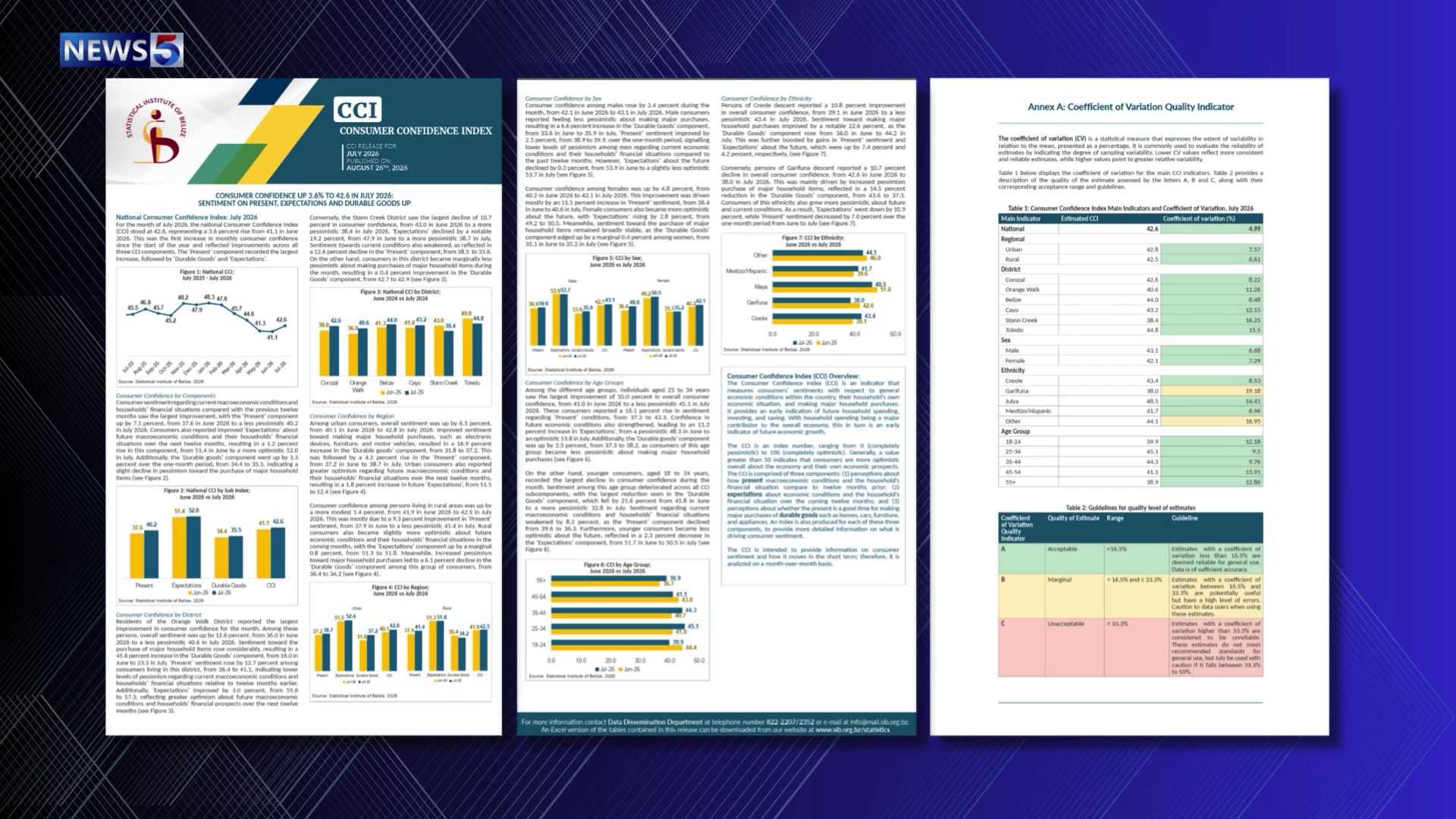
On August 31, 2026, a new development around Belize’s monthly Consumer Confidence Index sparked public discussion after the Statistical Institute of Belize (SIB) published its July 2026 results. While the official report recorded a small uptick in consumer confidence compared to the previous month, many Belizean residents have pushed back on the finding, questioning the survey’s methodology and whether it accurately reflects public sentiment around the national economy.
In response to widespread public skepticism, SIB Manager Jacqueline Sabal has clarified the details of the index calculation and data collection process to clear up common misconceptions. Sabal explained that the consumer confidence index uses a baseline score of 50 to split optimistic and pessimistic public sentiment: any reading above 50 signals that most consumers hold positive views on economic conditions, while a score below 50 confirms an overall pessimistic outlook.
For July 2026, the index landed at 42.6, which marks a 3.6% increase (or a 5.1 point gain) from June’s reading. This small uptick was the first upward movement recorded since the start of 2026, after several months of steady downward trends in consumer sentiment. Even with this minor improvement, Sabal emphasized that the index remains firmly in negative, pessimistic territory – a trend that has persisted across the entire year so far.
Sabal also noted that a single month of growth is not enough to confirm a lasting shift in how Belizeans feel about the economy. To determine whether this small increase signals a sustained turnaround in consumer confidence, the institute will need to track trends over multiple consecutive months, rather than drawing conclusions from one month’s data.
Addressing public questions about how SIB gathers its data, Sabal confirmed that the institute conducts monthly surveys via telephone interviews, using closed-ended questions to keep surveys brief and avoid creating an unnecessary burden on participating members of the public.