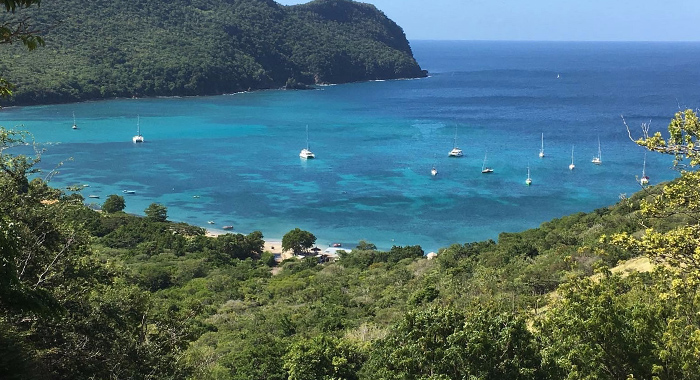
Nine months after taking office in November, the ruling New Democratic Party (NDP) of St. Vincent and the Grenadines has publicly confirmed its full support for a government land deal: the sale of roughly 100 acres of coastal land at Chatham Bay, Union Island, for a total sum of approximately EC$54 million. The transaction, which has emerged as a central point of fiscal and political debate in the country’s parliament, frames itself as a dual win for national fiscal health and ecological protection, though opposition leaders have raised sharp questions over pricing and transparency.
During a parliamentary sitting Thursday, Prime Minister Godwin Friday first tied the land sale directly to a dramatic improvement in the country’s fiscal position for the April to July period of 2026. Data presented by the Prime Minister showed the government recorded an overall deficit of EC$57.78 million for the four-month window, a sharp reduction from the EC$125.23 million deficit reported in the same period of 2025. Friday told the legislative body that the improvement stemmed largely from elevated capital revenue and trimmed capital spending, particularly after the wrap-up of major public infrastructure projects. Of the 2026 capital revenue, the Prime Minister confirmed that EC$52.7 million came directly from the Chatham Bay land transaction, a detail that had previously been referenced to parliament, though it remains unclear when the initial disclosure was made.
The land at the center of the debate has a complex recent ownership history. Decades ago, the previous Unity Labour Party (ULP) administration, led by current Opposition Leader Ralph Gonsalves, reclaimed the Chatham Bay property after a private foreign investor failed to follow through on proposed tourism development, acquiring the land back for less than EC$700,000 in compensation. Under the new sale agreement, NDP officials confirmed Saturday that the land will be held by a private conservation-focused company, with legally binding conservation covenants written into the contract to permanently protect the area’s unique ecosystem. Chatham Bay sits adjacent to four critical forest reserves — Water Rock Reserve, Large Forest Reserve, Colin Campbell Reserve, and Jack O’Dan Reserve — and is a core habitat for the endangered Union Island Gecko, a lizard species found nowhere else on Earth outside St. Vincent and the Grenadines. The NDP statement notes that the protected status formalized through the sale will bring enhanced conservation measures to the region in the coming months.
Beyond conservation, the ruling party frames the sale as a key step in addressing the severe fiscal legacy inherited from the previous ULP administration. The NDP argues that years of mismanagement under the prior government pushed the country’s national debt to roughly 113% of GDP, a debt level that has severely constrained the government’s ability to fund core public priorities including healthcare, national development programming, and public sector reform. All proceeds from the transaction will be directed to pre-defined national priorities: capitalization of the National Development Bank, resourcing for the newly created Ministry of Fisheries, Land and Sea Conservation and Climate Resilience, debt reduction initiatives, and projects designed to improve government operational efficiency. In a critical public interest safeguard added to the agreement, the government retains the option to repurchase the full 100-acre parcel within two years at the exact sale price.
For the young NDP administration, which has governed for just nine months amid a challenging fiscal climate marked by high existing debt and limited access to low-interest concessional financing, the land sale is part of a broader economic strategy. Prime Minister Friday has positioned asset monetization as an alternative to immediate broad-based new taxes, arguing that unlocking capital from underutilized state assets will help stabilize national finances without placing new burdens on households. The Prime Minister has also framed the transaction as a reflection of the government’s broader policy agenda: liberalizing private investment, rolling back what he calls overly burdensome regulation and punitive fines that have deterred foreign and domestic investment, and upholding commitments to transparency, environmental stewardship, and responsible fiscal management.
“The transaction reflects responsible Government: protecting our natural heritage, reducing debt, and investing in the future of our people. The public interest is protected through conservation covenants,” Friday said in comments cited by the NDP’s press statement. The party emphasized that the sale delivers a substantial capital gain for the people of St. Vincent and the Grenadines, even as it prioritizes long-term conservation of the ecologically sensitive site.
Political opposition has pushed back against the government’s framing, however. Gonsalves, the former prime minister who has questioned the status of the sale for months, raised concerns during Thursday’s parliamentary debate over the sale price, arguing that the government sold the ecologically valuable “crown jewel” property for less than half of its assessed valuation from 15 years prior. He argued that the deal fits into a broader pattern of the NDP relying on one-off asset sales and external borrowing to mask deep-rooted structural weaknesses in the national economy.
Gonsalves had first outlined his concerns about the property months before the formal disclosure, using his weekly radio program to walk through the land’s history of foreign ownership, the original investor’s failure to meet development commitments, and the multi-year legal process that returned the land to state ownership. He argues that the significant public investment that has increased land values across the Grenadines in recent years, paired with the legal and political effort invested in reclaiming the bay years ago, should have resulted in a far higher sale price.
While Gonsalves had previously submitted a written parliamentary question requesting full details of the sale — including confirmation that the transaction was completed, the sale price, planned development, and information on the purchaser — it remains unclear whether the prime minister has formally responded to that request. Notably, when Friday referenced the sale during Thursday’s sitting, Gonsalves did not raise accusations that the government had intentionally concealed the transaction or failed to meet disclosure requirements.