A severe environmental crisis has emerged along Suriname’s Saramacca River, where dangerous levels of toxic chemicals, heavy metals and cyanide have been confirmed in river water and local fish populations, prompting the Surinamese government to roll out a multi-pronged response plan developed in collaboration with affected Indigenous and local communities. The contamination, linked to unregulated gold mining activity in the region, has already resulted in widespread fish die-offs, forcing authorities to issue an urgent public health warning advising local residents against using river water for daily needs, consuming fish from the affected stretch, or swimming in the river.
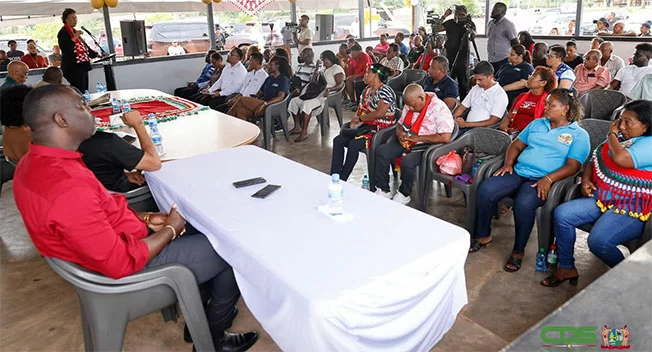
During an official visit to the Pikin Saron community on Friday, President Jennifer Simons held in-depth discussions with traditional community leaders on the finalized findings of an independent water quality investigation. The meeting was attended by representatives from six hard-hit communities along the river including Pikin Saron, Bigi Poika, Tibiti, Harlem and Santigron, alongside technical experts from the National Environmental Authority (NEA) which led the sampling work. Per a statement from the Communication Service of Suriname (CDS), all participating traditional leaders received full printed copies of the official investigation report, which cost the Surinamese government more than $50,000 USD to complete, with additional technical and logistical support from the Pan American Health Organization. Due to limited local testing capacity, a portion of the sample analysis had to be carried out in neighboring French Guiana.
The investigation’s results left no room for doubt: water and fish samples collected from the Saramacca River contained toxic concentrations of hazardous substances that pose severe risks to human and ecosystem health. President Simons emphasized that full, transparent communication with frontline communities is a non-negotiable priority, noting that residents deserve clear information about the contamination findings and potential long-term health impacts of exposure.
To prevent this crisis from spreading to other gold mining regions across the country, the Surinamese government has announced it will expand its water quality testing program to cover every active gold mining area in the nation. “In the short term, we will conduct testing in all regions where gold mining takes place. We cannot allow this to happen again, and we have no intention of poisoning all of our water resources,” President Simons stated during the meeting, calling on local communities across the country to partner with authorities to carry out the expanded investigations.
In the immediate term, a dedicated core working group will be established to map the specific social, economic and health impacts of the contamination on each affected village, develop targeted solutions and coordinate the government’s response. The working group will include representatives from impacted communities, the Para District Commissioner’s Office, the Ministry of Agriculture, Livestock and Fisheries (LVV), and the Ministry of Public Health, Welfare and Labor. Discussions during the meeting also addressed two additional emerging risks tied to the crisis: the upcoming dry season, which will lower river levels and potentially exacerbate contamination concentrations for communities that rely on the river for daily activities, and disruptions to regional energy supplies that depend on consistent river water levels.
To support affected households who have lost access to wild fish, a primary local food source and source of income, the LVV will help communities develop alternative food and livelihood programs. Initial plans focus on supporting inland chicken farming and controlled aquaculture operations, with support including technical training, ongoing guidance and targeted financial grants for participating households.
Beyond addressing the immediate crisis, the contamination event has pushed the Surinamese government to advance long-term reform of the country’s gold mining sector. Authorities have already suspended the issuance of all new gold mining concessions, and existing concession holders will be required to disclose their operational areas publicly to increase transparency. The government also plans to open formal negotiations with concession holders to advance broader regulatory reform that will move the sector toward more sustainable, environmentally responsible operations.