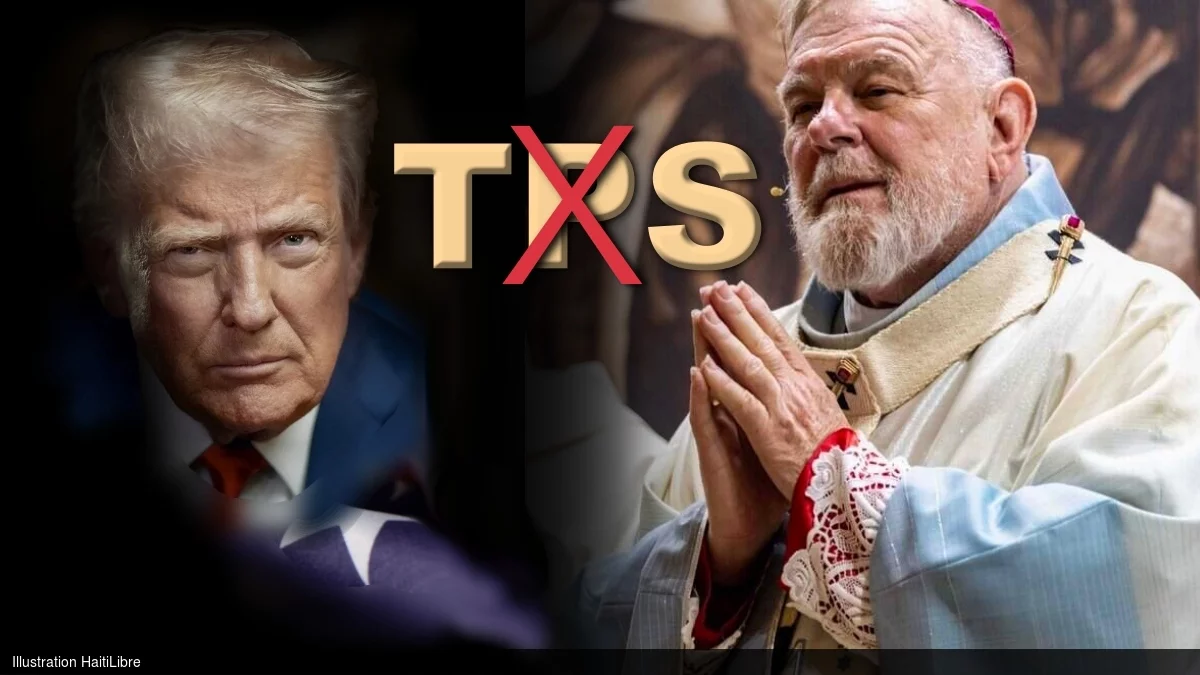
In the wake of a horrific mass killing carried out by a terrorist gang in Haiti’s Kenskoff that claimed at least 47 lives — including 22 people murdered inside a local church — left dozens more injured, and saw roughly 50 residents abducted to be used as human shields, a leading U.S. Catholic prelate is demanding the Trump administration reverse its decision to end deportation protections for hundreds of thousands of Haitians residing in the United States.
Archbishop Thomas Wenski of Miami argued that the brutal August 23 attack makes clear Haiti remains trapped in unrelenting chaos, a nation “still a house on fire” that cannot safely absorb deportees. “This should cause our administration to rethink its decision to send back into Haiti over 300,000 Haitians” currently stripped of Temporary Protected Status, or TPS, he said.
Created by Congress in the 1990 Immigration Act, TPS is a formal protection from deportation reserved for nationals of countries facing ongoing catastrophic crises, from armed conflict to large-scale environmental disaster. The designation is granted by the U.S. Department of Homeland Security, and in 2025, more than 330,000 Haitians living in the U.S. relied on this status to avoid forced removal. That protection has since been revoked, leaving the entire community vulnerable to deportation.
Wenski pointed to a bipartisan Senate bill currently under consideration that would extend TPS protections for Haitian nationals through the start of 2029. The archbishop noted the legislation would pass smoothly if the Trump administration threw its weight behind the proposal. He also called out the clear contradiction in U.S. policy: the State Department strongly warns all U.S. citizens against traveling to Haiti due to rampant crime, widespread kidnapping, terrorist activity, and a collapsed healthcare system, yet the government is actively deporting Haitian nationals back to the same deadly environment.
“ Haiti is a tragedy, and what we’re doing is compounding it by trying to send these people back,” Wenski explained. Deporting the entire TPS-eligible community would take years even if the government carries out multiple deportation flights weekly, he noted. In the interim, thousands of Haitians have already lost their work permits and most have had their driver’s licenses revoked. Without legal authorization to work, many cannot cover basic costs like rent and groceries, plunging them into economic precarity.
The harm of ending TPS extends far beyond the Haitian community in the U.S., the archbishop added. Remittances sent by Haitian migrants to family members back home are a critical lifeline for millions of Haitians, funding everything from children’s school fees to basic healthcare. Cutting off these migrants’ ability to work will deprive thousands of vulnerable Haitian households of this essential income.
Wenski also shared that his own Archdiocese of Miami has already been forced to lay off 45 employees who held TPS status, since the revocation of their work permits makes it illegal for the institution to keep them on staff. “The idea is to make it miserable for them so that they go back to Haiti,” he said. “But there’s really nothing there right now to go back to, except chaos and more pain and more suffering.”
Following the Kenskoff massacre, Wenski spoke with his counterpart, Archbishop Max Leroy Mésidor of Port-au-Prince, who also serves as president of the Haitian Episcopal Conference. Mésidor confirmed that the majority of Haiti’s violent gangs operate within the territory of the Archdiocese of Port-au-Prince, but reaffirmed that the Catholic Church in Haiti would continue its humanitarian and pastoral mission regardless of the risks.