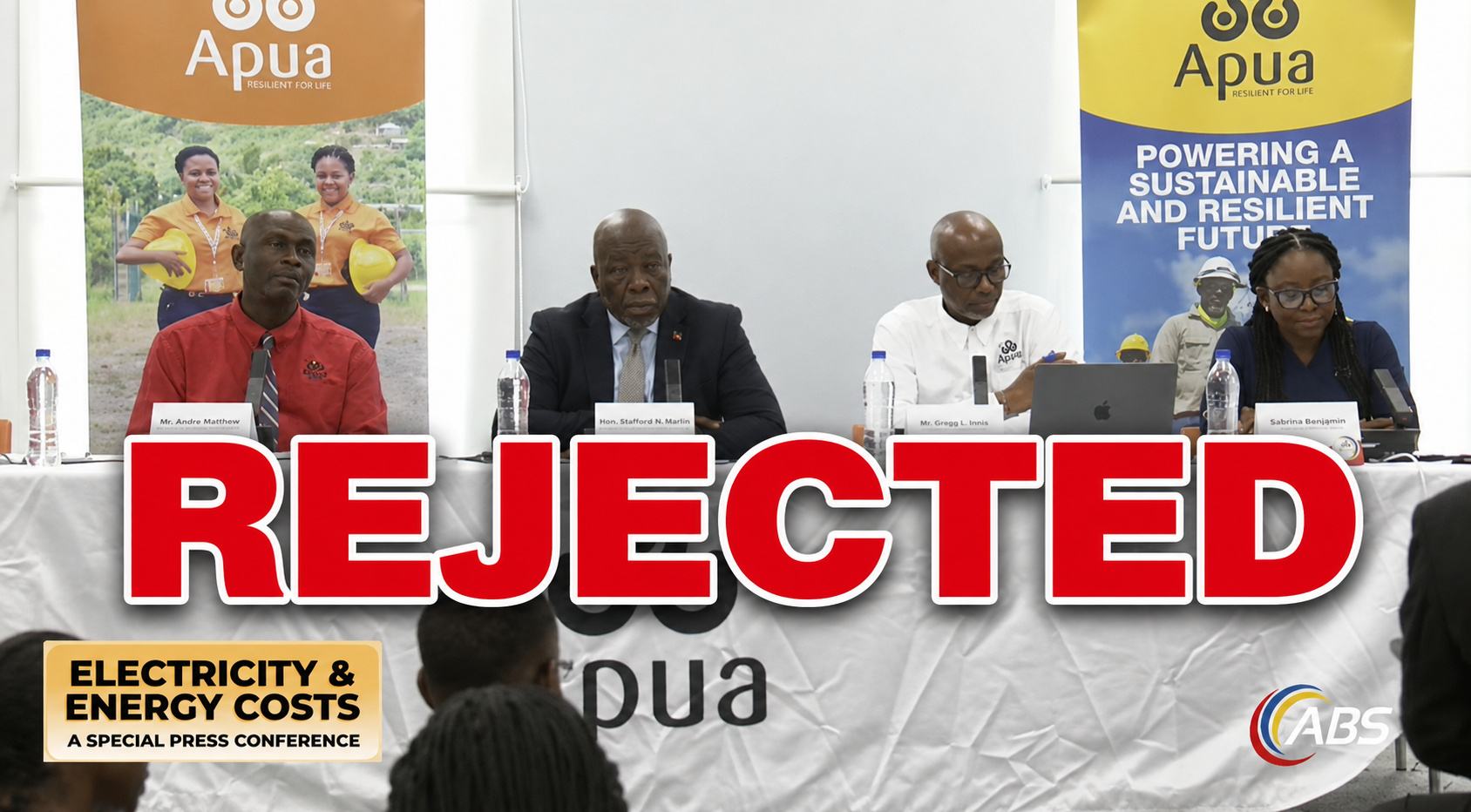
A recent informal online poll of Antiguan residents has laid bare deep public anger over unexplained soaring electricity bills, with an overwhelming majority of respondents rejecting official explanations from the Antigua Public Utilities Authority (APUA) for the unexpected cost hikes.
The poll, which invited locals to share whether they accepted APUA’s reasoning for rising energy charges, captured widespread discontent: dozens of participants pushed back against the authority’s key arguments, while many others said they had never received a clear, coherent explanation for their increased bills in the first place.
APUA officials have pinned higher bills on a combination of factors: unseasonably hot weather driving increased air conditioner use, spiking global fuel costs that are passed to consumers via variable fuel charges, extended billing cycles from delayed meter readings, and widespread faulty metering infrastructure. But many residents say their personal household circumstances directly contradict the authority’s core claim that higher AC use is to blame.
Erica Williams, for example, reported paying over $500 for monthly power despite owning neither an air conditioning unit nor a washing machine. Treci Tonge added that she was away from her home for an extended period, with only a refrigerator and home security system running, and still no AC — yet her bill still jumped dramatically. Etsu Jeffers Patterson echoed that frustration, noting all working-age members of her household are out of the home during the day, and the property has no AC at all, yet her bill remains far higher than expected. Francis Dinard also pushed back on the consumption narrative, pointing out that most working Antiguans are out of their homes during daylight hours when energy use would theoretically be highest.
Beyond disputing the causes of higher bills, many respondents questioned the basic math behind their statements. Some noted their bills were far higher than those of neighboring households with similar energy use, while others warned that the sustained price hikes are pushing low-income families to a breaking point. “Soon from now we go haffu [have to] choose between food and keeping the lights on,” local resident Albert Benjamin wrote.
Confusion over the official explanation was another common theme: multiple respondents said they had never received a consistent, clear reason for the hikes, with some joking that APUA has offered a different new reason every day of the year. “Which of the explanations are you referring to?” Vanroy Carr asked. “They’ve given at least one for every day of the year.”
In response to the growing public outcry, APUA has acknowledged widespread concern over billing issues, and noted that customers who believe their charges are incorrect can request a formal investigation into their accounts. Officials confirmed that between 10% and 15% of the authority’s existing electricity meters are faulty, meaning bills for affected customers are currently estimated based on past consumption patterns rather than actual use. The authority added that delayed readings from inaccessible properties, manual billing entries, and broken meters all contribute to systemic billing errors.
To address long-standing infrastructure issues, APUA is moving forward with a $25 million plan to roll out an automated metering system that will transmit real-time usage data directly to the authority. The new system will allow customers to track their energy use hour by hour, while enabling APUA to detect outages, tampering, and faulty meters remotely without requiring on-site readings.
While the online consultation is not a representative scientific survey of all APUA customers, it captures the deep, widespread frustration among participants, with nearly all respondents either rejecting the authority’s explanations outright or demanding far greater transparency around how bills are calculated.