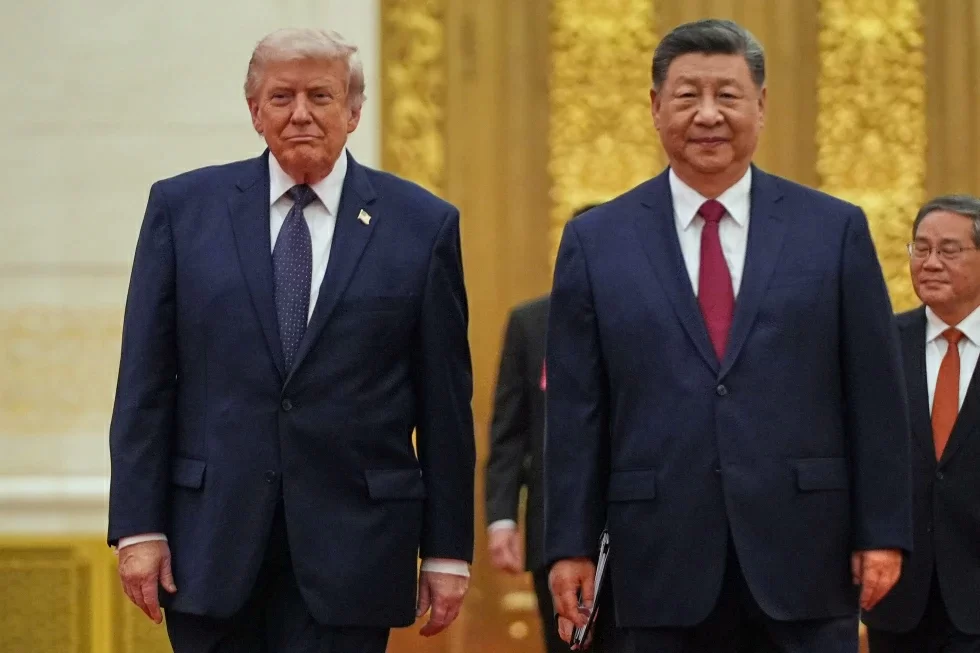
A new US campaign of economic pressure targeting Iran’s global financial ties has a major limiting factor that Washington cannot ignore: China, the Islamic Republic’s largest trading partner and the top buyer of its crude oil. As the United States pushes to isolate Tehran from its remaining economic partners, US President Donald Trump is preparing to host Chinese President Xi Jinping in Washington next month, with the core goal of preserving a fragile bilateral trade truce that has calmed tensions after years of friction.
When US Treasury Secretary Scott Bessent unveiled what the administration has dubbed “Operation Economic Outcast”, he offered no specific details on how the Trump White House would address China’s ongoing extensive economic engagement with Iran. That lack of clarity has fueled growing questions about just how effective the new sanctions campaign can ultimately be, as Washington faces a delicate balancing act: it needs to ramp up maximum pressure on Iran without triggering a major escalation with Beijing that would damage the already fragile US economy.
Edgard Kagan, senior advisor for China studies at the Center for Strategic and International Studies, noted the intentionally vague language in Bessent’s announcement was a calculated choice to avoid disrupting the planned high-level summit. Both sides view the upcoming meeting, which will mark Xi’s official state visit to Washington, as critically important to their respective policy goals.
This balancing act leaves Washington and Beijing navigating what Kagan described as a “delicate dance”. The core open question remains: is there any room to convince China to scale back its trade with Iran, without Beijing rejecting the request as unreasonable and pulling back from even limited cooperation?
Analysts broadly expect China will adopt a stance of minimal compliance with US demands. In its official response to the new US sanctions campaign, Beijing reiterated that all of its economic cooperation with Iran has always been conducted “within the framework of international law”. Currently, China receives more than 80 percent of Iran’s total oil exports, most of which flow through indirect trading channels to avoid existing US restrictions.
A spokesperson for China’s Ministry of Foreign Affairs stressed that China’s normal cooperation with Iran “should not be disrupted or undermined”, and added that Beijing will “take all necessary measures to resolutely protect its own legitimate rights and interests”. China has repeatedly made clear its opposition to what it calls “illegal unilateral sanctions” imposed by the United States on other nations.
Kagan characterized China’s official response as a calculated holding position, saying Beijing will do the absolute minimum to meet US demands while stopping short of openly confronting Washington. He added that existing evasion practices, such as ship-to-ship oil transfers designed to hide the origin of Iranian crude, will almost certainly continue uninterrupted.
Sun Yun, a China analyst at the Stimson Center, projected that China will only show limited cooperation if the US campaign’s goal is to pressure Iran into making concessions on issues like security in the Strait of Hormuz, rather than demanding a full break in economic ties. In that scenario, Sun noted, China could slightly reduce its imports of Iranian oil to signal a willingness to compromise without severing long-standing economic links.
With the Trump-Xi summit fast approaching, both sides have made clear they want to avoid a major escalation of bilateral tensions. Analysts agree that China will need to offer Washington some small concession to keep talks on track, while the US will have to accept that it will not achieve all of its demands regarding Iran-China trade.
So far, the Trump administration has declined to impose sanctions on major Chinese banks and corporations that are connected to the US financial system, leaving them vulnerable to US punitive measures. While Bessent announced penalties on nearly 60 Iran-linked entities tied to Tehran’s nuclear and missile programs, cyber activities, and oil trade – including a small number of companies and individuals based in mainland China and Hong Kong – no major Chinese financial or industrial institutions were targeted.
Analysts say that with Xi’s visit just weeks away, Trump has little incentive to take a hard line against Beijing. The US president is keen to preserve the existing bilateral trade truce and has emphasized his positive personal relationship with Xi, making it unlikely he will seek a direct confrontation on the eve of the high-profile state visit.
Xi’s upcoming visit also paves the way for Trump to travel to China in November for the APEC Economic Leaders’ Meeting. In his second term, Trump has adopted a far less confrontational stance toward China than he did in his first term, regularly praising his strong relationship with Xi following the intense trade war that rattled global markets last year.
The US business community has broadly welcomed Xi’s upcoming visit as a positive sign for bilateral relations, even as many acknowledge that sweeping new trade deals are unlikely to be finalized during the meeting.
Craig Singleton, a senior analyst at the Foundation for Defense of Democracies, noted that Beijing is betting that Washington will not risk the positive dynamic of the upcoming summit by targeting major Chinese entities with new sanctions before the meeting even begins.