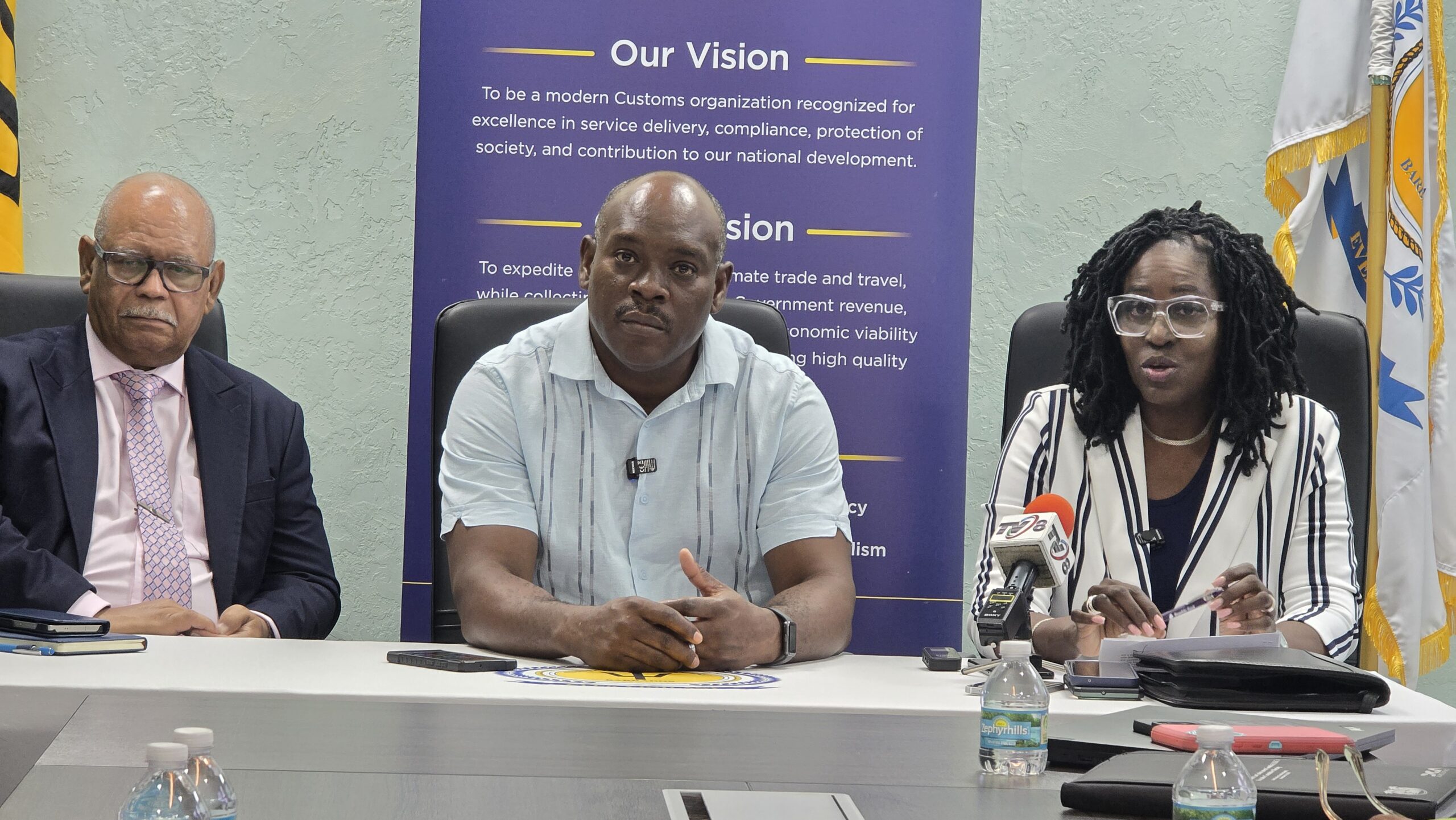
Barbados is stepping up its efforts to counter increasingly advanced smuggling operations targeting its borders, as the country’s Customs Service works to block the entry of illegal firearms, narcotics and other contraband that threaten public safety and economic order. Finance Minister Ryan Straughn outlined the government’s priorities during a Tuesday press briefing held at the Barbados Customs and Excise Department to mark the agency’s 121 years of operation. During his address, Straughn emphasized that border protection stands as one of the three core mandates of the Customs Service, alongside collecting critical state revenue and enabling the smooth flow of legally authorized cross-border trade. The minister acknowledged that the agency is facing growing, more complex challenges, as smuggling networks continuously develop new, undetectable methods to move prohibited goods into the country. “While we have already rolled out the most advanced detection technology currently available and will continue investing in new tools to upgrade our capabilities, human expertise remains irreplaceable in the fight against smuggling,” Straughn told attendees. “That is why we are pairing ongoing technology investments with continuous skills training for our frontline officers, to strike the right balance between tightening border security and keeping legitimate trade moving efficiently.” Straughn also clarified the strict legal framework governing firearm imports into Barbados, noting that no weapons are produced domestically in the country, nor are any manufactured across the wider Caribbean region. All firearms entering the country require official authorization, he added, which is exclusively issued by the Commissioner of Police. Any unlicensed firearm import is automatically classified as an illegal act, on par with smuggling controlled narcotics including cocaine and crystal meth—substances that have seen a dramatic surge in trafficking across the Americas in recent years. The Finance Minister’s remarks came just one day after newly appointed Comptroller of Customs Lynette Padmore announced the agency’s latest major contraband seizure: 12 unlicensed firearms, 15 ammunition magazines, approximately 900 rounds of ammunition, plus large quantities of cocaine, methamphetamine and other banned items. Straughn also warned that smuggling activities impose broad collateral costs on legitimate business, particularly at the country’s commercial port facilities. He used a hypothetical example to illustrate the disruption: if an illicit weapons shipment is hidden inside a legal cargo consignment at a port shed, law enforcement must halt all adjacent operations to respond, delaying clearances for hundreds of law-abiding traders waiting to process their goods. “This is why these enforcement efforts matter so much,” Straughn explained. “All law enforcement agencies, from Customs to police, must carry out their full duties to ensure every shipment adheres to national regulations, and that protects the vast majority of actors who follow the rules.” The minister also highlighted the critical need for full compliance with import declaration rules, stressing that inaccurate or intentionally misleading filings carry consequences that go far beyond lost government revenue. For example, he noted, hiding crystal meth inside a shipment declared as over-the-counter vitamins creates cascading harms: it risks bringing dangerous illicit substances into local communities, fueling addiction rates, and creating urgent public health crises across the island. “Compliance is non-negotiable, because we refuse to see our communities face a growing addiction crisis driven by illegal drug trafficking. This is a top priority for our country, and proper declaration protocols are the first line of defense against these threats,” he said. In closing, Straughn reaffirmed that the Barbados Customs Service will maintain its balanced approach, continuing to invest in both technology and officer training to improve contraband detection while working to keep regulatory burdens low for legitimate traders moving goods across the border. The agency will also continue its close partnership with other law enforcement bodies to coordinate counter-smuggling operations and stem the flow of banned goods into the country.