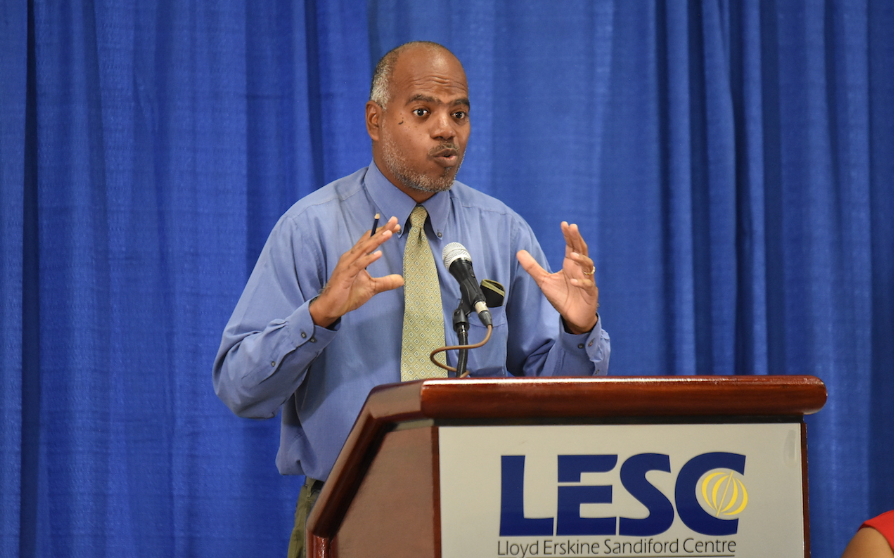
Barbados is moving forward with an ambitious, full-scale reimagining of the former Roseville Halfway House, replacing the shuttered legacy facility with a modern, community-focused mental health program designed to smooth the transition from long-term institutional care to independent living. Health officials detailed the transformative plan during a public consultation held Monday evening at the Lloyd Erskine Sandiford Centre, emphasizing that the new St Peter-based facility is far more than a simple reopening of a closed site.
“This is not a rebuilding and just a reopening of something that has been closed, but it is a reimagining, a redesign, and a new programme that will be in a new facility,” explained Acting Chief Medical Officer Dr Arthur Phillips, noting that while the project occupies the original Roseville location, every aspect of the facility and its programming has been rethought from the ground up. The original Roseville halfway house closed its doors in 2015, leaving a critical gap in Barbados’ mental healthcare system that officials have long prioritized filling. Currently, a quarter-way house operates on the grounds of the country’s Psychiatric Hospital, but no fully functional halfway facility has been available for years.
Permanent Secretary Francine Blackman of the Ministry of Health and Wellness framed the initiative as a cornerstone of the government’s push to update Barbados’ approach to mental healthcare, shifting away from centralized institutional care toward a model that centers patient dignity, autonomy, and lasting recovery. The new Roseville facility will act as what Blackman called a “safe, structured bridge” for people living with addiction and other mental health challenges, supporting their reintegration into broader society while helping them build the skills needed for self-sufficiency.
Beyond core clinical care, the program will create practical opportunities for residents, including training and access to subsistence farming, formal employment, and self-employment. “The construction and operationalisation of this facility is therefore not solely an infrastructure project. It represents an investment in people, recovery, inclusion, and human dignity,” Blackman added.
Dr Phillips explained that the transitional support provided by a halfway house fills an unmet need for people who have spent years in institutional care. For many, jumping directly from 24/7 institutional care to full independent living is an overwhelming leap, and the structured support of a halfway house dramatically improves outcomes for long-term recovery. While basic treatment, life skills training, and occupational therapy are already available through existing services, Roseville will add the critical intermediate step that has been missing from the care continuum.
Rehabilitative care will sit at the heart of the new facility’s service model, according to mental health professional Dr Joy Sue. The program will offer a range of evidence-based therapies including occupational therapy, recreational therapy, and psychotherapy, all delivered in a community setting rather than a closed institutional campus — an approach that aligns with the Ministry of Health and Wellness’ long-term vision for mental healthcare reform. Dr Sue did note one key challenge the project must address: current staffing levels are insufficient to support the expanded slate of services, so workforce expansion will be a core priority as the project moves forward.
To break down isolation and foster connection between residents and the surrounding community, planners are integrating community-facing amenities and activities. Proposed additions include a public basketball court and small-scale livestock rearing projects such as chicken raising, which will not only provide practical work experience for residents but also create natural opportunities for interaction with local neighbors.
Despite the widespread support for the initiative among health leaders, the project still must navigate two key sets of challenges: social concerns and environmental risks. Consultant Lisa Perch, who is leading social and environmental impact assessments for the project, noted that persistent stigma around mental illness remains a significant social risk that must be proactively addressed throughout development and operation. Perch acknowledged that early community engagement has been limited due to tight project timelines, but outlined plans to ramp up outreach as planning advances. A dedicated community liaison officer will be appointed during construction to maintain open lines of communication between contractors, project leaders, and nearby residents.
The facility’s coastal location near Six Men’s also brings a unique set of environmental considerations that planners must address. The site is located close to sensitive ecosystems that support turtle nesting, wild land and marine species, and nearby fishing grounds, alongside a local gully system that requires protection. The existing abandoned building on the property is in a state of severe disrepair, with potential hazards including mould and asbestos that will require full assessment and safe remediation before construction can begin. Planners are also accounting for climate-related risks including hurricane-force winds, storm surge, coastal flooding, and wastewater management, as well as the cumulative impact of other recent development activity in the area.
Currently, the full environmental and social impact assessment remains in draft form, with project leaders soliciting feedback from stakeholders and local community members to refine plans and address outstanding concerns before moving into the construction phase.