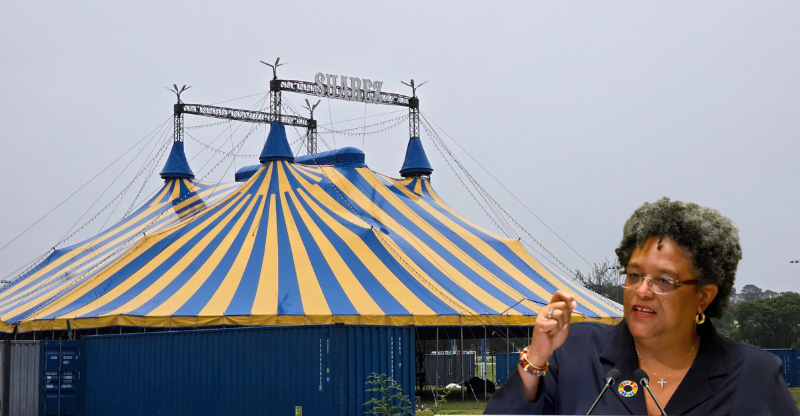
In a public update delivered Tuesday from the Alleynedale Pumping Station, Barbados Prime Minister Mia Mottley has openly acknowledged a critical misstep by the nation’s Ministry of Environment: granting approval for the Suarez Brothers Circus to host operations at the protected International Botanical Gardens without mandatory consultation with the Barbados Water Authority (BWA). In plain terms, Mottley did not mince words about the mistake, stating, “I am not going to fool you and tell you that the botanical garden was wrong when they gave permission, because they were wrong.”
She went on to emphasize that the agency in charge of the site had a clear obligation to coordinate with the BWA before signing off on any activity at the location, given its status in the country’s drinking water protection network. “They should have known that they should not have given permission for anything to operate on the site there without talking to the water authority,” Mottley added.
While the Prime Minister conceded that an error had occurred, she moved quickly to defend Barbados’ broader regulatory system designed to safeguard the nation’s critical water supply. Mottley argued that the BWA’s timely intervention to reverse the incorrect approval demonstrated that the system of checks and balances built into the framework functioned exactly as intended. “We want to find out where the mistake was made and what it is. I cannot tell you where the mistakes were made just so without telling you that the system worked,” she explained. “We have checks and balances in our regulatory system in this country, and when one or two of them do not function, the others must still be able to function, and this is exactly what happened here.”
Mottley also revealed new details about the timeline of the miscommunication that preceded the planned circus opening. Four full days before the circus was scheduled to open its gates, the BWA sent a formal email to organizers explicitly stating that permission to operate at the site had not been granted, with the rejection written in all capital letters for emphasis. This official rejection came just two hours after organizers had received preliminary informal approval to move forward, Mottley said. When the BWA recognized the earlier misstep, it moved immediately to correct the record, even notifying organizers that the organization would not supply water service to the site. At the time of that notification, the BWA was not yet aware that the circus planned to have staff and performers sleep on the property, a detail that Mottley said only worsened the violation of site rules.
Against this backdrop, Mottley questioned the judgment of circus organizers, who ultimately moved forward with opening the attraction despite the clear rejection from the water authority. “Why they would have opened on a Saturday when the Barbados Water Authority made it absolutely clear four days before that they could not get water is beyond my comprehension or understanding,” she said.
Beyond addressing the circus controversy, Mottley used the briefing to push back against widespread public speculation and misinformation surrounding two other high-profile government projects: the new Geriatric Hospital and a development in the Vineyard area of St. Philip. Responding to claims that the Geriatric Hospital had been sited in the nation’s most restricted water protection zone, Mottley rejected the claims as factually incorrect, noting that the facility has always been located in Zone C, not the fully restricted Zone A. Technical officials in attendance at the briefing confirmed this assertion, noting that the zoning classification for the hospital site has remained consistent under both past and current government zoning frameworks.
Mottley also addressed unfounded claims about the Vineyard development in St. Philip, noting that the vast majority of the parish falls within the less restricted Zone D classification. Dismissing the claims as deliberate misinformation meant to sow public confusion, she said, “For those who want to create mischief, I can only say that they may feel that they have reasons to want to create mischief. I do not know what they are, but I will stick to the facts. The government is not bad, and the government would never have chosen a Zone A area to build a hospital.”
To clear up lingering public confusion about the country’s water protection zoning system, Mottley walked through the classification structure in detail. She explained that Zone A is a strict exclusion zone that prohibits all high-impact development, while Zone B functions as a pathogen exclusion zone and critical groundwater recharge area. Zone C is designated as a chemical exclusion zone, Zone E covers non-contributing recharge areas, and Zone F applies to desalination facility zones. Mottley noted that carefully controlled development is allowed in zones B and C as long as projects meet strict environmental criteria, but no non-conservation activities are permitted in Zone A.
She tied this explanation back to the circus controversy, noting that the government specifically designated the International Botanical Gardens site as a protected green space precisely because of its strict water protection restrictions, which rule out most commercial activities. “Am I clear that there could have been no circus activity or any type of that activity at the belt? That is why this government chose to make that the International Botanical Gardens, because we know that we cannot put certain things there,” Mottley said. “That is why for the last 18 months we have been keeping it clean and flat so that it does not become a public nuisance.”
Closing out her remarks, Mottley dismissed the claims swirling around the Vineyard development as nothing more than political posturing, noting that baseless speculation tends to spike ahead of party conferences and general election cycles. “I am not sure where that rumour came from, but I suppose there are certain times of the year that we see politics, one before annual conferences and one before an election,” she said. “I am not going to get into the silly season or the miniature silly seasons that take place on an annual basis.”