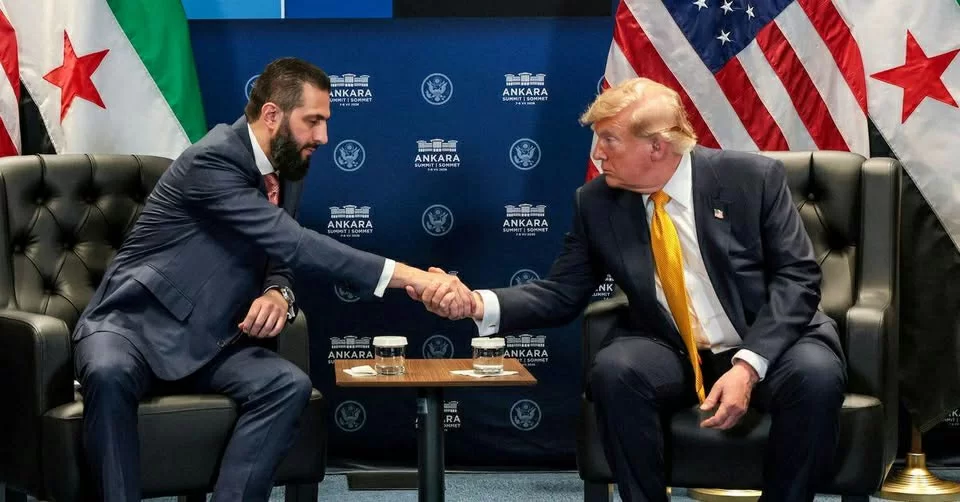
After 47 years of continuous designation, the United States has formally removed Syria from its list of State Sponsors of Terrorism, a landmark policy shift that went into effect on Monday following a mandatory 45-day congressional review period. The development has been hailed by Syrian President Ahmed al-Sharaa as a historic turning point that will accelerate the war-torn nation’s recovery after 14 years of brutal civil conflict.
The process to lift the decades-old designation was launched in early July, when U.S. President Donald Trump formally notified Congress of his administration’s intent to rescind the labeling. Syria first appeared on the U.S. blacklist back in 1979, when the government of then-president Hafez al-Assad was accused of supporting armed militant groups. The designation remained in place throughout the rule of Hafez’s son, Bashar al-Assad, who was ousted from power in December 2024 by a rebel coalition led by the current president al-Sharaa.
For nearly half a century, the terrorism sponsor designation imposed crippling restrictions on Syria. These included a full ban on U.S. foreign assistance, prohibitions on weapons exports, restrictions on sales of dual-use civilian-military technologies, and sweeping curbs on cross-border financial transactions. Even after broader U.S. and international sanctions on Syria were relaxed in recent months, the blacklisting effectively blocked most global banks and private investors from engaging with the Syrian market, creating a major barrier to post-conflict recovery.
The delisting marks a significant breakthrough in ending Syria’s long international isolation. It clears the way for cross-border commercial investment, U.S. financial assistance, and even regulated defense trade with Damascus, opening new pathways for Syria to rebuild its shattered economy and reintegrate into the global economic system.
Beyond recognizing political changes under al-Sharaa’s new administration, U.S. officials frame the move as a calculated strategic step to shift Syria away from the geopolitical influence of Iran and Russia, two powers that embedded deep influence in Syria over decades of alliance with the former Assad regime. The policy shift is also designed to encourage Syria’s full participation in global counterterrorism efforts. As part of the broader changes, the U.S. has also lifted the terrorist designation for Hayat Tahrir al-Sham (HTS), the group previously known as al-Nusrah Front that was long labeled al-Qaeda’s Syrian affiliate.
Al-Sharaa celebrated the U.S. decision as the opening of a “new chapter” for his country, saying Syria can now turn its full focus to national development, post-war reconstruction, and long-term stability. Syria’s finance minister and central bank governor echoed that assessment, calling the delisting a historic step that will return Syria to the global economic framework and unlock access to much-needed foreign investment and modern technology.
U.S. Treasury Secretary Scott Bessent emphasized that the decision aligns with the Trump administration’s pledge to deliver targeted sanctions relief to foster political and economic stability in conflict-affected regions. Analysts broadly expect the delisting to drive an increase in foreign direct investment into Syria, a critical requirement for rebuilding shattered infrastructure and reviving an economy gutted by 14 years of war. Beyond Syria’s borders, the shift is expected to strengthen regional stability by addressing the root causes of refugee flows and cross-border security challenges that have plagued neighboring countries for years.
Even with the landmark policy change, significant uncertainties remain. Russia and Iran retain deep economic and security ties within Syria, meaning the trajectory of the country’s new political independence and planned reforms will continue to be closely watched by the international community. Globally, the delisting is widely seen as a clear signal of shifting regional power dynamics, and a potential opening for full diplomatic and economic normalization between Syria and the wider international community.