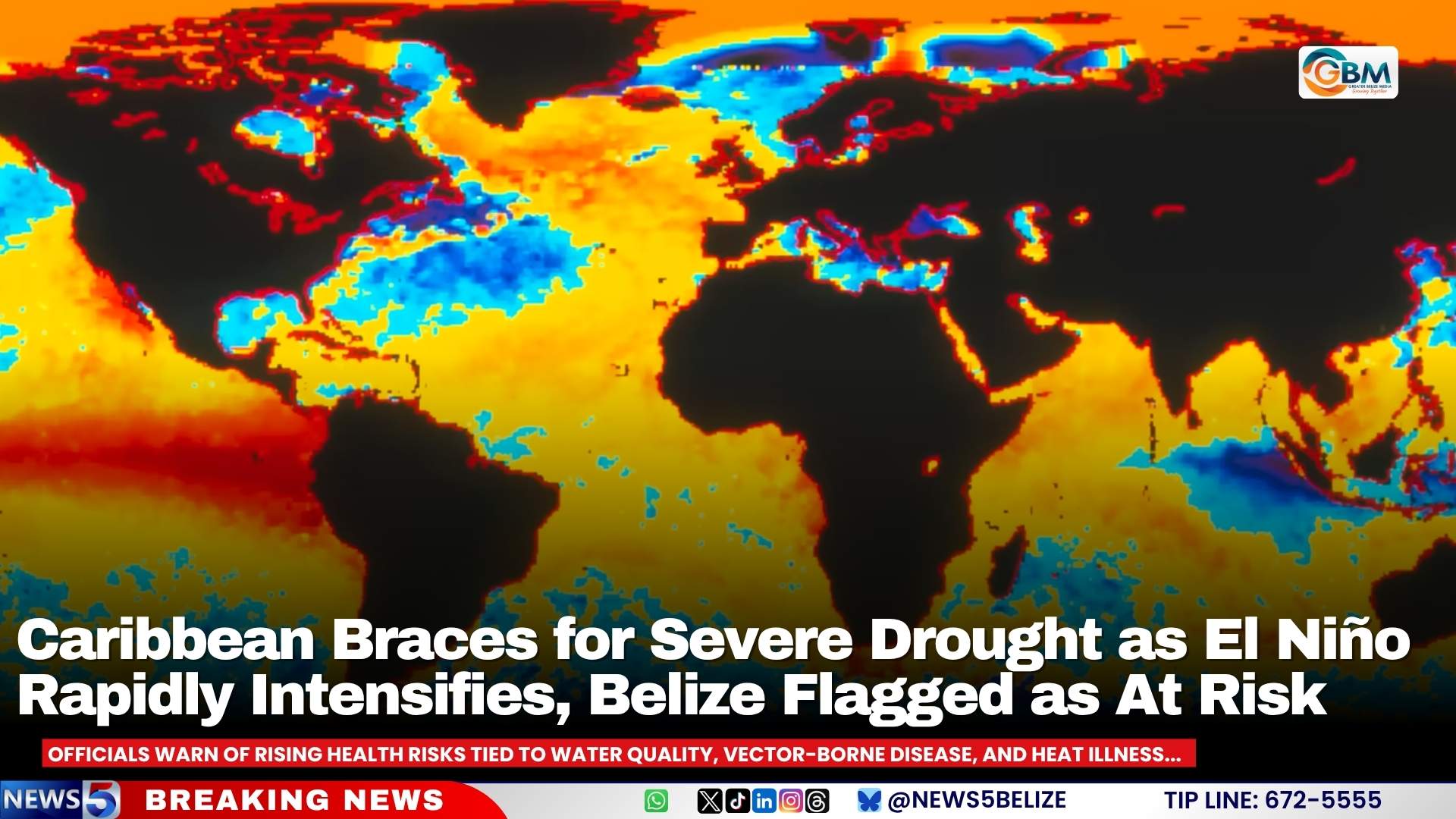
As the El Niño weather phenomenon strengthens far more rapidly than regional climate scientists initially projected, the entire Caribbean basin is now bracing for a prolonged severe drought that threatens to disrupt agriculture, strain critical infrastructure, and endanger vulnerable communities through 2027, with Belize and Jamaica singled out as particularly high-risk areas.
The Caribbean Institute of Meteorology and Hydrology (CIMH) has tracked a striking acceleration of El Niño conditions: the event shifted from a weak to moderate intensity by July this year, and current projections indicate it will reach *very strong* strength between October and December 2026, lingering well into the region’s peak Dry Season, which runs through March 2027.
Dr. Cedric Van Meerbeeck, a senior climatologist at CIMH, emphasized that the timeline of this intensification is uniquely concerning. The period between August and October is already the Caribbean’s annual Heat Season, meaning pre-existing high temperatures will amplify developing dry conditions that could stretch into the first half of 2027. Looking to historical precedent, Van Meerbeeck pointed to devastating El Niño-driven droughts in 2009–2010 and 2014–2016, paired with the record-breaking heat recorded across the region in 2010, 2023, and 2024, as clear indicators of the danger this event poses.
By October or November 2026, drought conditions are expected to take hold across a wide swathe of the Caribbean, including the Windward Islands, Leeward Islands, ABC Islands (Aruba, Bonaire, Curaçao), portions of Jamaica and Hispaniola, and the entire Bahamian archipelago. For nations reliant on rainfed agriculture—specifically Belize and Jamaica, the report’s named priority areas of concern—the combination of plummeting rainfall and steadily climbing temperatures puts food security for thousands of small-scale subsistence farmers at direct risk.
Professor Michael Taylor, Co-Director of the University of the West Indies’ Climate Studies Group Mona, noted that the forecast risks are already beginning to unfold, describing the event as a slow-burning emerging climate disaster. “Unlike a hurricane, whose impacts hit suddenly and recede after the storm passes, the effects of this event will continue to build gradually over months,” Taylor explained, highlighting that the crisis combines overlapping threats: extreme heat, prolonged drought, and simultaneous marine heat extremes.
Beyond agricultural losses, regional officials have warned of a cascade of secondary risks: deteriorating water quality that drives public health concerns, increased transmission of vector-borne diseases, higher rates of heat-related illness, additional strain on already stretched public water and energy distribution systems, and disruption to the Caribbean’s tourism sector, which forms the backbone of many national economies across the region.
CIMH Principal Dr. David Farrell stressed that delayed action would only exacerbate harm, making proactive early intervention non-negotiable for protecting vulnerable groups. “Proactive measures are vital for mitigating the impacts of extreme weather events on climate-sensitive sectors, local communities, and national economies,” Farrell said.
As the region prepares for the approaching Dry Season, officials are urging residents and stakeholders to follow the monthly climate updates published by the Caribbean Climate Outlook Forum to stay informed of changing conditions. Separately, the news comes as Belize recently passed its first-ever national climate change legislation focused on carbon credit regulation, marking a milestone in the nation’s climate action even as it faces imminent drought risk.