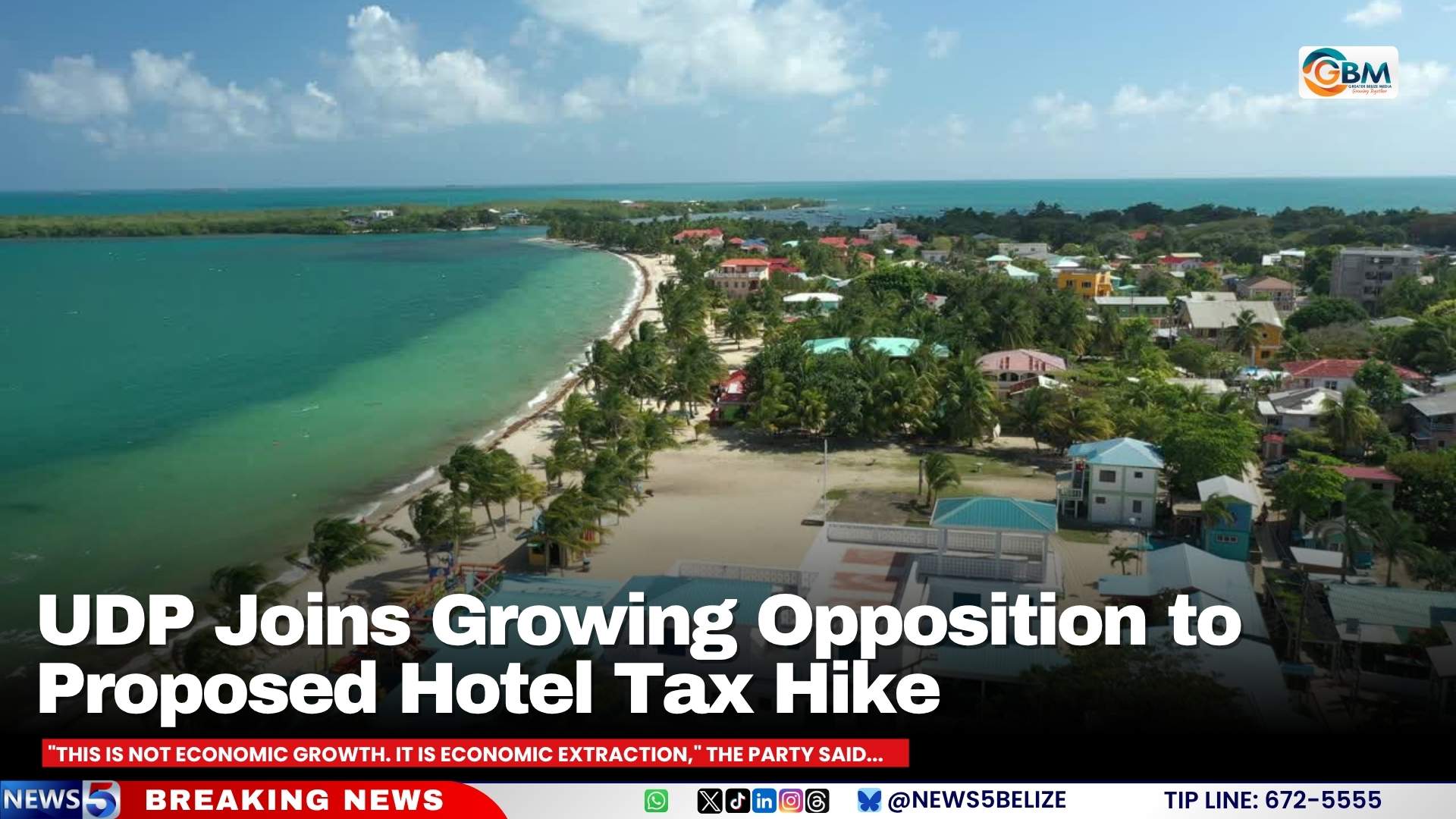
As Belize’s government considers raising the national hotel accommodation tax from 9% to 12% — a 33% percentage jump — a growing coalition of industry stakeholders and political actors is lining up to oppose the measure, with the United Democratic Party (UDP) the latest to add its voice to the pushback.
The UDP has emerged as a prominent critic of the proposal, arguing that the tax increase amounts to harmful economic extraction rather than sustainable growth, at a moment when global travelers increasingly prioritize affordable destination choices. Instead of placing additional fiscal pressure on an existing core industry, the party contends that the government should prioritize expanding the overall national tax base to generate new revenue without endangering Belize’s critical tourism sector.
Warned that the fallout of the tax hike would be devastating, the UDP emphasized that tourism supports thousands of livelihoods across Belize, with ripple effects extending far beyond accommodation providers. Hotels, private tour operators, local restaurants, independent tour guides, road and water taxi services, domestic airlines, local artisans, small-scale agricultural producers and hundreds of small, community-focused businesses all rely on discretionary spending from incoming visitors. A drop in tourism demand triggered by higher hotel rates would put all of these interconnected economic actors at risk, the party said.
The UDP’s opposition aligns it with two of the country’s leading tourism industry groups: the Belize Hotel Association (BHA) and the Belize Tourism Industry Association (BTIA). BHA President Reynaldo Malik pointed out that hoteliers are already grappling with a 30% surge in fuel costs that has significantly squeezed already thin operating margins, leaving the sector with no capacity to absorb additional cost increases that would likely be passed on to consumers.
BTIA President Efren echoed calls for fiscal reform alternatives, arguing that the government should prioritize closing costly public expenditure leaks instead of targeting tourism for new tax revenue. If the government moves forward with the hike despite widespread opposition, Perez confirmed that BTIA will push for a policy mandate requiring 2% of all new tax revenue generated from the increase to be allocated to a national climate adaptation fund, which supports tourism infrastructure resilience to climate impacts.
Across all opposing groups, a core demand has emerged for full transparency from the Belize Tourism Board. The UDP has formally called on the board to publicly release all supporting economic analysis for the proposal, including detailed projections for how the tax change will impact key tourism metrics: inbound visitor arrivals, average hotel occupancy rates, average length of visitor stay, and total annual visitor spending. Before any final decision is made, the board must publicly justify the need for the increase and answer questions about its projected long-term impacts on Belize’s economy.