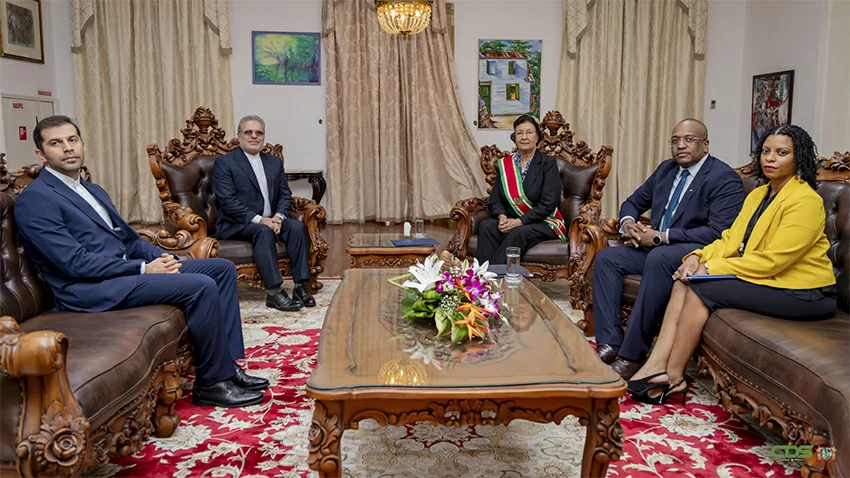
On Thursday, August 20, 2026, a landmark diplomatic ceremony was held at Suriname’s Presidential Palace, where seven new ambassadors formally presented their credentials to President Jennifer Simons. The event marked a significant step forward in Suriname’s efforts to expand and deepen its international partnerships, according to senior government officials.
Of the seven envoys participating in the ceremony, six are non-resident ambassadors accredited to Suriname from their base postings in regional capitals. Patrick John Hilado of the Philippines, Sitali Dennis Alibuzwi of Zambia, Appuhamillage Chaminda Inoka Colonne of Sri Lanka, and Sharif Essa Mohammed Al Dabbas Al Suwaidi of the United Arab Emirates all maintain their primary offices in Brasilia, Brazil. Rounding out the group of non-resident ambassadors are Ali Chegeni of Iran, based in Caracas, Venezuela, and Joseph Guy Fisher of the United Kingdom, based in Georgetown, Guyana. The seventh envoy, Martine Jacoba Busstra, ambassador of the Netherlands, had submitted her credentials in an earlier formal procedure.
Addressing the gathering following the credential presentation, Suriname’s Minister of Foreign Affairs, International Trade and Cooperation Melvin Bouva underlined the South American nation’s clear ambition to establish itself as a reliable, strategically positioned partner in global diplomatic relations. He emphasized that the arrival of these new ambassadors represents a meaningful strengthening of bilateral ties between Suriname and each of their respective home countries.
Bouva outlined Suriname’s core diplomatic and development priorities, noting that the country is actively focused on building targeted strategic partnerships to drive broad-based economic growth. While Suriname’s oil and gas sector continues to expand, the government has made economic diversification a central policy goal, targeting key emerging sectors for investment and collaboration.
These priority areas include agriculture, sustainable tourism, information technology, renewable energy development, and large-scale infrastructure projects such as road, bridge, airport, and seaport upgrades. The government also maintains its commitment to social investment, with public health and education remaining top policy priorities, Bouva added.