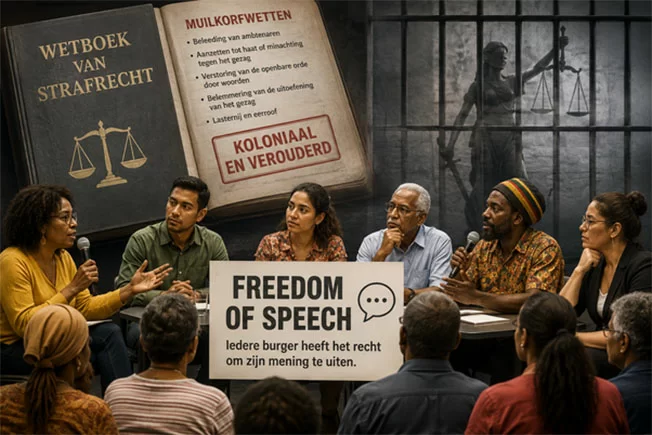
Freedom of expression sounds like a simple concept—until someone utters a view we fundamentally disagree with, one that irritates and angers us. That is exactly the moment when the true meaning of this fundamental right begins to take shape. This week, at the invitation of the Surinamese Association of Journalists, two Inter-American Commission on Human Rights (IACHR) experts are visiting the South American nation: Pedro Vaca Villarreal, IACHR Special Rapporteur on Freedom of Expression, and Daniel Corredor Llorente, human rights specialist with the Office of the Special Rapporteur. Over the course of their visit, the pair will hold discussions with journalists, university students, human rights organizations and other civil society groups on the current state of free speech in Suriname. These talks form part of a broader regional process to develop hemisphere-wide free speech guidelines that reflect the perspectives and needs of diverse stakeholder groups across the Americas.
Suriname is a small but exceptionally pluralistic society, home to a tapestry of overlapping ethnic communities, religious beliefs, languages, political ideologies and cultural traditions. This diversity is one of the nation’s greatest strengths, but it also poses a core democratic challenge: can we truly accept that people from other groups hold different perspectives on society? Today, a critical comment about a politician is quickly interpreted as an attack on their entire party or voter base. Criticism of an individual from a specific community is often extrapolated to condemnation of the whole group. Dissenting voices are frequently labeled along political, ethnic or other identity lines within minutes of speaking out. In these cases, free speech stops being about what a person says—and becomes entirely about who they are, or what group we assume they belong to.
The rise of social media has only complicated this landscape. Never before have ordinary citizens had so many opportunities to share their views instantly with thousands of people across the globe. But this same technology has also made intimidation, personal harassment, disinformation and digital threats far easier to carry out. This reality makes clear that freedom of expression does not mean all speech is permissible. Threats and incitement to violence contribute nothing to constructive public debate, and legal limits can rightly be placed on expression that harms the rights and safety of others. At the same time, we must be cautious about framing legitimate dissent as insult, disrespect or inappropriate criticism as a tactic to silence opposing views.
In recent years, Suriname has seen multiple cases of individuals being arrested and temporarily detained by law enforcement over statements made, particularly on social media platforms. It is true that freedom of expression can never act as a free pass for criminal conduct. When someone crosses the boundaries of what is legally permitted, action must be taken to hold them accountable. But the key question remains: who ultimately gets to define where those boundaries lie?
The answer is not political leaders, nor does the Public Prosecution Service hold final authority over whether a citizen’s statement constitutes a criminal offense. Ultimately, it is an independent judiciary that must rule on this question, grounded in national law, the constitution, and the international human rights obligations Suriname has committed to uphold. When a person is arrested for their words, held in custody for days, and then released without a court ever ruling that their expression was criminal, the harm extends far beyond the individual affected. The implicit message sent to the public is clear: watch what you say, because you can be detained for days even without a conviction. This creates a chilling effect that pushes citizens to self-censor, not because a court has ruled their criticism illegal, but out of fear of what could happen to them if they speak out. When this becomes normalized, it is not just one individual’s freedom that is undermined—it shrinks the entire space for public debate in a democracy.
This reality makes a compelling case for critical review of the provisions in Suriname’s Criminal Code widely referred to as “gag laws”. These statutes date back to the colonial era, when protecting the authority of ruling powers was prioritized over citizens’ right to sharply criticize that authority. The colonial origin of these laws is not, on its own, reason enough to scrap them. The decisive factor is that many of these provisions are no longer compatible with the freedom of expression protected by Suriname’s constitution and modern international and Inter-American human rights standards. When outdated criminal provisions can be used to deprive citizens of their liberty for critical or inconvenient speech, even when no judicial conviction follows, lawmakers must ask whether these provisions still have any place in a modern democracy.
These so-called gag laws deserve a thorough overhaul. Any provisions that cannot be aligned with contemporary human rights standards should be removed from the Criminal Code entirely. A democracy does not protect its authority by frightening citizens into silence. It protects itself by giving citizens space to criticize power, and by letting independent judges oversee the boundaries of criminal conduct.
A democratic society cannot function when only agreeable opinions are granted protection. In fact, opinions that nearly everyone agrees with hardly need this protection at all. The fundamental right to free speech is only truly tested when someone says something that makes the majority ask: how could anyone say that?
Protecting freedom of expression requires more than just updated legislation. It requires a cultural shift: a culture where a minister can face sharp criticism without the critic being labeled an enemy of the state. Where a journalist can ask tough questions without their political views immediately becoming the focus of discussion. Where citizens can criticize both the ruling government and the opposition. Where a person of faith can defend their beliefs, and others have the right to question those beliefs. Where young people can challenge long-held older perspectives, and minorities do not need majority approval to have their voices heard.
Building public awareness of these principles is therefore essential. The Inter-American approach to freedom of expression goes far beyond just guaranteeing the right to speak. It also recognizes that people must be able to seek, receive and disseminate information freely. Journalists must be able to carry out their work independently. Citizens must have access to the information they need to hold power to account and make informed choices about their society.
This last component is often underestimated. A citizen may have full formal freedom of expression on paper, but that right is significantly diminished in practice if government information remains inaccessible, critical journalists are intimidated, or people self-censor out of fear of repercussions. That is why press freedom, access to public information and freedom of expression are inseparable. This is not because journalists are special citizens, but because journalism is one of the core ways societies collect the information that allows ordinary people to form their own independent judgments.
The example of veteran Caribbean journalist Rickey Singh, whose legacy is being highlighted during the IACHR experts’ visit, perfectly illustrates this principle. Singh’s career was defined by independence, rigorous preparation, courage, and a commitment to holding political power to account through critical reporting. His work makes clear that freedom of expression is not only about the right to publish. It is also about the responsibility to inform society fairly and force power to answer for its actions.
Ultimately, a commitment to free speech starts not with journalists, governments, courts or international organizations—it starts with each of us. It starts with our willingness to let others speak. It depends on our ability to distinguish between criticism and enmity. It requires the discipline to counter an opposing argument with another argument, rather than with insults, threats or identity labeling. For a country as diverse as Suriname, this distinction is essential. We do not have to agree with one another—that is never the goal of a democratic society. What we must learn to do is fundamentally disagree with each other, without denying one another the right to be part of the conversation.