Suriname’s National Assembly is set to debate a transformative overhaul of the country’s freedom of information regime, after a unified amendment to the draft Open Government Act (Wet Openbaarheid van Bestuur, WOB) was submitted this week. The proposal, which reverses decades of default secrecy in public administration, represents a major push for greater government accountability demanded by journalists and civil society groups for years.
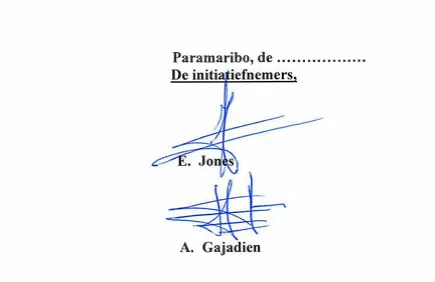
The road to this unified bill began with two separate private member’s bills, tabled independently by Ebu Jones of the National Democratic Party (NDP) and Asis Gajadien of the Progressive People’s Party (VHP). Following input from civil society organizations, the two lawmakers agreed to merge their proposals into a single unified amendment, a compromise championed by NDP lawmaker Rossellie Cotino, who leads the committee of rapporteurs for the legislation.
At the core of the reform is a radical paradigm shift: the bill enshrines open government as the default rule, with secrecy only permitted in narrow, exceptional cases. The explanatory memorandum explicitly notes that existing legislation no longer meets the standards of a modern democratic constitutional state, nor does it accommodate the ongoing digitalization of public administration.
Article 4 of the draft codifies a universal right to access government information, eliminating outdated requirements that requesters demonstrate a specific legal or personal interest in the information they seek, or explain their reason for requesting it. All requests must be processed without discrimination based on nationality, residence, occupation, political belief, or social status. Critically, the bill stipulates that in any case of doubt over disclosure, the public interest in openness will prevail.
One of the most impactful changes is the introduction of a mandatory active disclosure obligation. All public administrative bodies are required to proactively publish a wide range of documents that affect public policy, carry significant social importance, or are necessary for independent public oversight of government. The list of mandatory proactively disclosed documents is extensive, including government budgets, annual financial statements, audit reports, subsidy allocations, public tender documents, award decisions, government contracts and contract amendments, concessions, public-private partnership agreements, state guarantees, foreign and multilateral loans, external advisory reports, research findings, policy impact assessments, information on state-owned enterprise holdings and dividend payments, and data on environmental quality including climate, water, and air metrics.
This reform is expected to reshape investigative journalism and public oversight of public spending. Currently, journalists, civil society groups, and ordinary citizens must submit individual requests for most of this information to separate ministries and agencies; if the law is implemented, these documents will be available as a matter of routine.
The bill also strengthens procedural rules for individual information requests. Requests may be submitted in writing, electronically, orally, or through a centralized digital portal. Receipt of a request must be confirmed within five working days, and a final decision must be issued within 14 days of receipt, with a single maximum extension of 14 days allowed only for unusually large or complex requests. For urgent requests tied to major public interest matters, a decision must be issued within five working days wherever possible.
Large requests cannot be automatically rejected under the new rules. Public bodies must enter into consultation with the requester, and with the requester’s consent, may narrow the scope of the request or process it in phases. If only a small portion of a document falls under an exception to disclosure, the entire document cannot be withheld: only the protected section may be redacted, with the remainder released. The bill also requires agencies to consider anonymization of protected data as an alternative to full denial of access.
To ensure compliance, the legislation establishes the independent Suriname Open Government Commission, a legal entity that operates free from interference by the executive and other public bodies. The commission’s core mandate includes overseeing compliance with the law, investigating public complaints, facilitating mediation between requesters and agencies, issuing guidance on transparency practices, and improving government information management.
The commission is granted robust enforcement powers: it can compel the production of documents and information (even confidential records), summon witnesses for questioning, access government facilities and inspect information management systems, issue binding instructions and remedial measures, and ultimately impose coercive daily fines for non-compliance.
The five commission members are appointed by the president, but are nominated by the National Assembly, requiring a two-thirds majority vote of all sitting assembly members to confirm a nomination. The selection process is required to be fully public, with candidates evaluated on the basis of professional expertise, independence, integrity, and public trust.
The bill also expands legal recourse for requesters. Appeals against disclosure decisions or administrative inaction may be filed within 30 days, and requesters may also file complaints with the Open Government Commission over denial of access, partial disclosure, or delayed decisions. Following the internal appeal process or a binding ruling from the commission, requesters may bring their case to the competent court. In urgent cases, courts may grant interim relief and order full or partial disclosure immediately.
Notably, the bill shifts the burden of proof for non-disclosure onto the public body. When an agency denies access, it must demonstrate that a valid exception applies, that disclosure would cause specific concrete harm, that the public interest in secrecy outweighs the public interest in openness, and that partial disclosure is not feasible.
The legislation includes meaningful enforcement mechanisms to ensure compliance. For violations, the Open Government Commission can set a remediation deadline, issue binding instructions, or impose coercive fines. For serious or repeated violations, administrative fines may also be imposed.
The intentional destruction, falsification, manipulation, or concealment of documents with the goal of preventing disclosure or oversight is explicitly prohibited. Such violations must be reported to the Public Prosecutor’s Office and can result in disciplinary, civil, or criminal penalties. Whistleblowers who report violations of the law in good faith are protected from retaliation.
A central pillar of the new transparency regime is the planned National Digital Open Government Portal, a centralized online platform where all public bodies will publish their proactively disclosed information. The portal is required to be free of charge, permanently accessible, fully searchable, and machine-readable to facilitate reuse by the public and media.
Implementation of the reform will be rolled out in phases. Within six months of the law entering into force, every public body must appoint a dedicated transparency coordinator. Within 12 months, each body must adopt a public transparency and information management plan. The Open Government Portal must be operational within 18 months, and all active disclosure obligations must be fully implemented within 24 months.
The explanatory memorandum emphasizes that the reform is designed to drive a fundamental cultural shift within government: rather than focusing on which information can be withheld, agencies will now be required to prioritize disclosure of all information that should be public. If the bill is approved and fully implemented, it will not only expand public access to government information: it will embed a legal obligation for the state to proactively show how decisions are made, how public funds are spent, and what agreements are made on behalf of the Surinamese people.