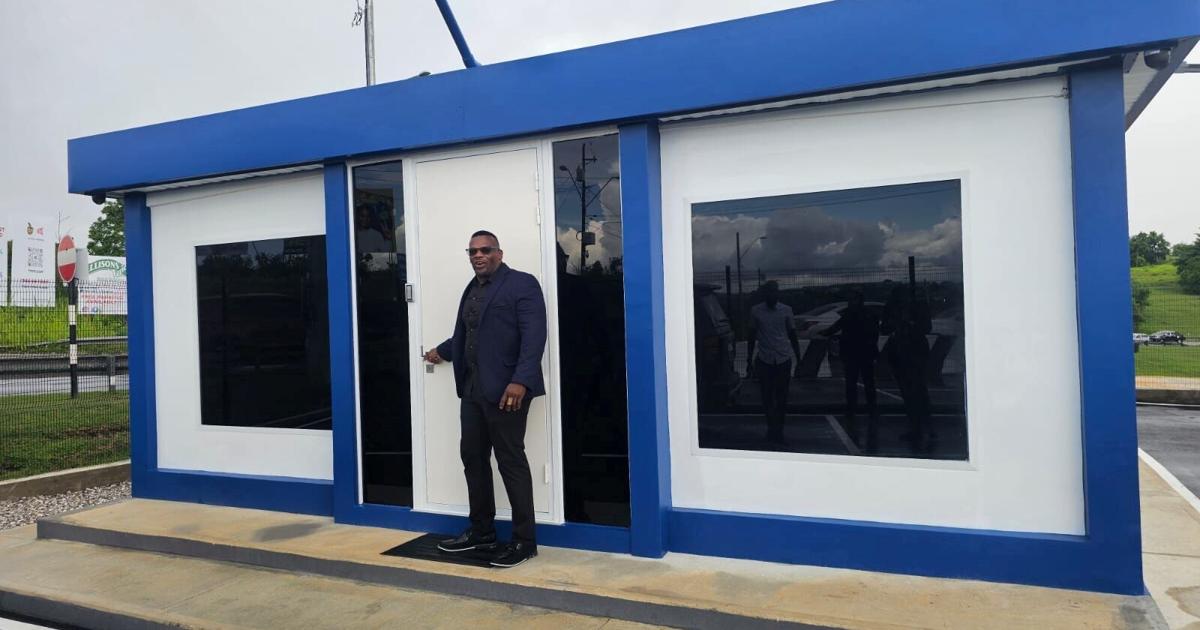
Trinidad and Tobago’s national crime-reduction strategy is set to retain a key new security infrastructure beyond the country’s current state of emergency (SoE), with Homeland Security Minister Roger Alexander confirming that a portion of the newly built joint army-police fortified posts will become permanent fixtures across the islands.
Alexander made this official announcement during an exclusive tour of a completed bullet-proof post at the Tarouba flyover in San Fernando, organized for local newspaper the Express on Tuesday. The fully enclosed, air-conditioned facility features a suite of functional amenities tailored for ongoing officer use: a dedicated front reception area, a compact kitchen space, a full washroom with toilet and shower, and two flexible interview rooms that can be reconfigured for alternate operational needs. Mounted surveillance cameras on the roof feed real-time footage of surrounding areas directly to on-site officers, enabling constant monitoring of nearby activity, including northbound and southbound traffic on the adjacent Sir Solomon Hochoy Highway.
Highlighting the strategic value of the Tarouba location, Alexander explained that the post’s elevated position allows for rapid intervention in developing situations, from high-speed vehicle chases to routine traffic incidents. “It’s in a strategic position that could be used for operational speed and support to other police officers,” he noted. “Take, for instance, if there is a high-speed chase. Officers can emerge from here and become part of that chase or do an interception at short notice.”
The initiative, first unveiled by Prime Minister Kamla Persad-Bissessar on August 3, calls for 30 of these specialized posts to be rolled out across communities across Trinidad and Tobago over a four-month period. Unlike temporary security deployments implemented during the current SoE, which is scheduled to expire on September 17, 2026, the permanent posts are designed as a sustained solution to rising community safety concerns.
Alexander emphasized that the project is not a hasty policy response, but the outcome of months of detailed strategic planning to improve law enforcement effectiveness. “We thought about the response. We thought about how best this could serve Trinidad and Tobago in the crime-fighting effort,” he said. Beyond crime prevention and rapid response, the posts are also intended to serve as community engagement hubs, bridging the gap between law enforcement and local residents to build public trust. Pointing to early activity at the already completed post at Eddie Hart Grounds in Tacarigua, Alexander noted that the accessible locations encourage foot traffic from community members, creating regular opportunities for interaction. “We want the public to have trust in the police, we want police officers to go in the communities, talk to the persons in the church, the schools, the businesspeople… neighbourhood… We want that kind of communication,” he added.
In line with the Prime Minister’s earlier announcement, Alexander reaffirmed that the initiative directly responds to longstanding community requests for increased visible security, empowering residents to reclaim public spaces that have been impacted by criminal activity. Operational details, including the full scope of CCTV coverage across the network of posts, remain undisclosed for national security reasons. “I can only tell you this much. We can see enough to respond, defend and protect,” Alexander said.
Staffing for each post will be determined jointly by the Commissioner of Police and the Chief of Defence Staff, with posts manned by combined teams of Trinidad and Tobago Police Service officers and Trinidad and Tobago Defence Force members. The government is currently working to assign dedicated patrol vehicles to each post to boost rapid response capabilities, and the National Operations Centre will provide intelligence support to the network, aligning the initiative with a broader data-driven security strategy. The timeline for rolling out the remaining uncompleted posts will be set by the Prime Minister, who chairs the National Security Council.
Addressing public criticism of the project and questions around construction costs and contracted vendors, Alexander pushed back against concerns, stating there is “nothing to hide” and full cost and procurement details will be released to the public at a later date. He dismissed critics as uninformed, noting that similar security infrastructure models have delivered successful crime reduction outcomes in other countries. “We are thinking advanced policing. And again, some persons will have issues with it. They don’t understand. They don’t read. They don’t look at the nations that are successful in some of the operations because of what they are implementing,” he said.
Confident that the permanent posts will deliver meaningful improvements to national safety, Alexander framed the initiative as a holistic, long-term approach to crime fighting that combines tactical deployment, rapid response capabilities and intentional community engagement. “The strategy used, as I said before, is one that is tactical, responsive, and communicative,” he said, adding that the permanent infrastructure will strengthen law enforcement capacity long after the current state of emergency expires.