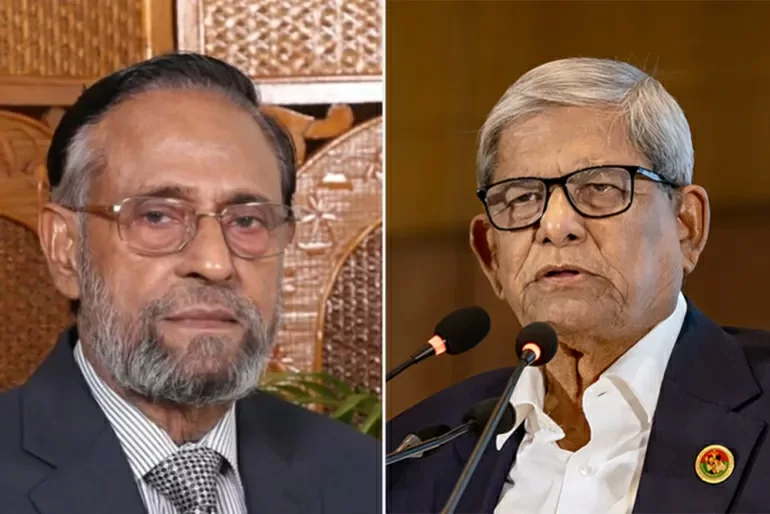
Bangladesh is making a notable mark in its modern political history on Thursday, as the country holds its first contested presidential election with multiple candidates since 1991. The vote, cast by 349 sitting members of parliament, is expected to deliver a final result within hours of polling closing, according to the country’s election commission.
The election was triggered by the mid-term resignation of former President Mohammed Shahabuddin last month. Shahabuddin, an Awami League (AL) nominee elected in 2023 when ousted Prime Minister Sheikh Hasina still held power, stepped down after Hasina was removed from office in August 2024, an interim government led by Nobel laureate Muhammad Yunus took office, and the Bangladesh Nationalist Party (BNP) returned to power in February this year, cutting short what was meant to be a five-year presidential term.
Thursday’s vote marks the first time Bangladeshi parliamentarians have had a choice of presidential candidates in 35 years. The last competitive presidential election took place in October 1991, when BNP candidate Abdur Rahman Biswas defeated AL nominee Badrul Haider Chowdhury 172 votes to 92. Every presidential vote held after that contest went uncontested, with no opposition candidates putting their names forward.
While the outcome of Thursday’s vote is widely seen as a foregone conclusion due to the BNP’s parliamentary majority, the election carries heavy symbolic weight for a country still rebuilding and reforming its state institutions two years after the 2024 pro-democracy uprising that upended the country’s political order.
The two candidates on the ballot bring decades of Bangladeshi political experience to the race. The ruling BNP’s nominee, 78-year-old Mirza Fakhrul Islam Alamgir, is one of the party’s most recognizable and long-serving leaders. He became acting secretary-general of the BNP in 2011 before being officially confirmed to the post in 2016, and emerged as one of the party’s most prominent public faces during its years in opposition to Hasina’s government. Following the BNP’s electoral victory earlier this year, Alamgir was appointed Minister of Local Government, Rural Development and Cooperatives.
Speaking at a party rally on the eve of the vote, Alamgir thanked Prime Minister Tarique Rahman for his nomination and pledged to uphold Bangladesh’s independence and national sovereignty if elected. Rahman, in turn, formally urged all BNP members of parliament to cast their ballots for Alamgir.
Alamgir’s challenger is 85-year-old retired army colonel Oli Ahmad, a 1971 Bangladesh Liberation War veteran who is running as the candidate for an 11-party opposition coalition led by Jamaat-e-Islami. Ahmad, who currently chairs the Liberal Democratic Party (LDP) and has served six terms as a member of parliament, first entered politics after leaving the army in 1979, joining the BNP in 1980. He served as a communications minister under former BNP Prime Minister Khaleda Zia before splitting from the party to found the LDP in 2006. He was once a close ally of Ziaur Rahman, the founder of the BNP and father of current Prime Minister Tarique Rahman.
Ahmad’s nomination is a politically notable one: his main backer, Jamaat-e-Islami, infamously sided with Pakistan and opposed Bangladesh’s independence during the 1971 Liberation War, while Ahmad himself fought on the pro-independence side. Though Ahmad is widely considered an underdog with little chance of winning, the opposition coalition has framed his candidacy as a way to force a contested vote, ending more than three decades of unopposed presidential appointments.
Public opinion on the two candidates is deeply divided among Bangladeshis. Anwarul Islam, a former Bangladesh Bank employee, praised Alamgir for his personal integrity, saying, “I visited Mirza Fakhrul’s constituency. People across all castes and religions hold deep affection for him. His integrity is rare among Bangladeshi politicians.” By contrast, Abdul Baten, a construction site manager in the capital Dhaka, said he favored Ahmad, noting, “I definitely prefer Oli because he is a seasoned politician. His opponent Fakhrul and the BNP have failed to keep their promises on state restructuring.”
In terms of the office’s actual political weight, Bangladesh’s constitution designates the president as a ceremonial head of state with very limited independent executive power. Article 48(3) of the constitution requires the president to follow the advice of the prime minister on all matters except the appointment of the prime minister and the chief justice.
Ali Riaz, a political scientist who contributed to state reform efforts under Yunus’s interim government, welcomed the return of a contested election but warned against overstating its practical impact. “It is good to see someone who led the democratic movement and fought against a fascist regime become president,” Riaz explained. “But because of the limited powers of the presidency, the election is less significant politically.”
Riaz pointed out that the National Charter on State Reform, approved by referendum in July, already outlines a plan to have future presidents elected by a bicameral parliament, but the creation of a powerful upper house to improve checks and balances has not yet been implemented. He also questioned how meaningful a contested vote can be when the ruling party already holds a clear parliamentary majority: “The election is more of a ritual than a substantive political event.”
For families of the more than 1,400 people killed during the 2024 uprising, Shahabuddin’s resignation and this new presidential vote is a necessary step forward, but many still hold concerns about the integrity of the process. “It should have happened much earlier, but it is good that it is happening now,” said Sanjida Khan Deepti, whose 17-year-old son Shahriar Khan Anas was killed during the uprising. However, she raised questions about the impact of party discipline on free voting: “If a member of parliament cannot vote for who they think is best for the country, what is the point of voting? Our children gave their lives for democracy.”
The election has also reignited long-running debates over Article 70 of the Bangladeshi constitution, which strips parliamentarians of their seats if they vote against their party’s line, and whether this rule should apply to presidential voting.
Despite its inherent limitations and widely expected outcome, Thursday’s vote marks a historic turning point for Bangladesh: for the first time in more than three decades, voters in parliament have a choice between two candidates for the country’s highest office.