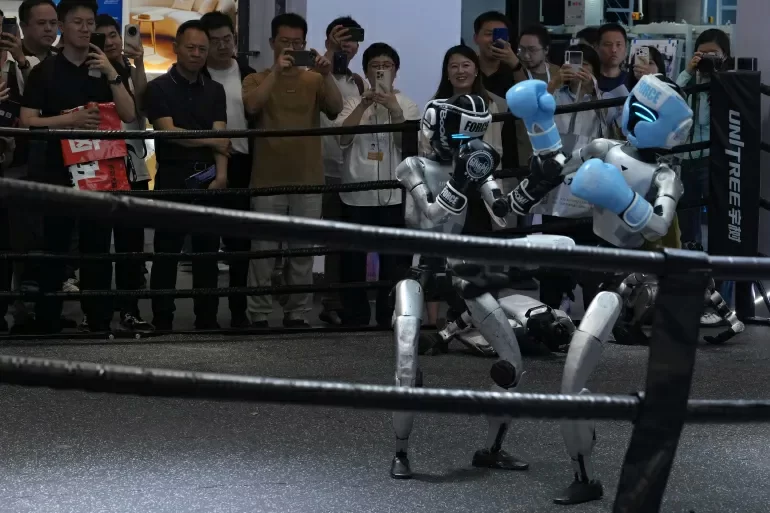
On a watershed Wednesday for the global humanoid robotics industry, leading Chinese commercial humanoid robot developer Unitree Robotics made a blockbuster debut on Shanghai’s STAR Market, with its share price surging more than 620% from its initial offering price. The spectacular opening rally sent the Hangzhou-based firm’s market capitalization soaring to a peak of 445 billion yuan, equivalent to roughly $66 billion — a seven-fold jump from its pre-IPO valuation of around 61 billion yuan ($9 billion), which was set at an initial offering price of 50.8 yuan per share.
Founded in 2016 by engineer Wang Xingxing, Unitree Robotics has emerged as one of China’s most high-profile and commercially successful humanoid robotics manufacturers. The company first gained global attention through viral demonstrations of its humanoid robots performing dynamic dances and martial arts routines, showcasing the firm’s advanced motion control technology. Last year alone, Unitree delivered more than 5,500 humanoid robots to customers across the world, cementing its status as a leading player in the early commercialization of this cutting-edge technology. Most recently, the company unveiled its latest flagship model, dubbed the ‘Superman’, which the firm says is capable of jumping up to two meters in height and reaching a top speed of 12.66 meters per second.
Industry analysts note that the overwhelming investor enthusiasm for Unitree’s IPO reflects the company’s unique strong position in a nascent market with few established, scalable competitors. “Unitree is one of the only humanoid robotics companies in the world that actually generates real revenue, is profitable, and operates large-scale production,” explained Rinat Mirzaitov, founder of industry research firm Humanoid Analytics. Even so, Mirzaitov cautioned that Unitree does not yet hold a dominant position across the full humanoid robotics market, and faces the key challenge of translating its current hardware innovation lead into widespread, practical commercial applications across different sectors.
The rapid growth of China’s humanoid robotics sector comes as the industry has become a key focal point of technological competition between the United States and China. Last month, the U.S. administration under President Donald Trump issued an import ban on Chinese-manufactured humanoid robots, citing vague national security concerns. According to financial services firm JPMorgan, China already controls roughly three-quarters of the global market for humanoid robots and autonomous vehicles. Industry projections forecast explosive growth for the sector over the coming decade: global annual humanoid robot sales are expected to skyrocket from $2 billion in 2025 to as much as $300 billion by 2035.
Unitree’s blockbuster debut underscores both China’s expanding leading role in this high-growth advanced technology sector and the extremely high expectations that global investors hold for the future commercial development of humanoid robotics.