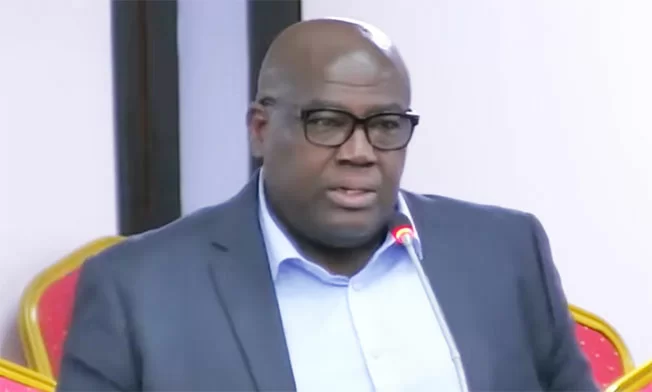
A sweeping forensic audit into the operations of cross-border ferry service Canawaima has been ordered by Suriname’s Minister of Transport, Communication and Tourism (TCT) Raymond Landveld, capping off a tense day of intense parliamentary questioning over persistent operational, financial and governance failures at the bi-national Surinamese-Guyanese entity.
Landveld confirmed in an address to the National Assembly Tuesday that the probe will cover all financial and administrative activities at the ferry service dating back over the past five years, running parallel to a separate ongoing administrative review already underway. The minister made clear that the issues plaguing Canawaima extend far beyond the well-publicized recent service disruptions that have stranded passengers and disrupted cross-border travel. According to Landveld, every core area of the operator’s work requires fresh review, including corporate governance structures, executive leadership, financial and internal oversight, procurement processes, ticketing systems, technical maintenance protocols, safety management, human resources policies, and institutional reporting practices.
Canawaima operates under a unique dual-entity structure agreed by the governments of Suriname and Guyana: Canawaima Ferry Services (CFS) is registered under Guyanese law, acting as the formal owner of assets and financial holding vehicle, while the Canawaima Management Company is incorporated under Surinamese law and manages all day-to-day operational activities. This structure itself became a major point of contention during Tuesday’s parliamentary debate, with lawmakers raising sharp questions about unmet transparency standards and unclear cost- and revenue-sharing arrangements between the two countries.
Opposition lawmaker Raymond Sapoen of the National Democratic Party (NDP) pressed the government for concrete details on how maintenance costs are split between Suriname and Guyana, noting that deferred maintenance is a root cause of repeated service outages that have cut off the critical cross-border link. Sapoen also demanded clarity from the administration on its long-term plan to restore reliable, consistent service for travelers. Other lawmakers echoed concerns about financial arrangements, pointing out that a large share of return tickets are purchased by passengers departing from Guyana, and no clear public accounting exists for how these revenues are allocated between the two nations.
NDP parliamentary faction leader Rabin Parmessar called for full access to Canawaima’s organizational charts, annual reports, and independent audit statements from recent years. He highlighted that despite being a relatively small operation, Canawaima maintains an overly large, bloated executive management structure, and called for full transparency on executive salaries and benefits paid to company leaders. Fellow NDP lawmaker Ebu Jones argued that much of the public and parliamentary confusion stems from a lack of clear explanation of the bi-national entity’s unusual structure, noting that greater transparency would resolve much of the ongoing debate over its operations.
Landveld acknowledged multiple ongoing areas of concern, confirming that there remains significant ambiguity around pension contributions and payroll tax withholding from employee salaries. He added that clear directives have been issued to ensure all withheld funds are deposited to the correct authorities, and that this matter will be resolved as part of the audit. The minister also confirmed an ongoing internal conflict at the company that has already led to two senior staff members, including the terminal manager, being placed on administrative leave through the end of August. According to information provided to Landveld by Canawaima’s supervisory board, the conflict erupted when the pair refused to turn over requested operational and financial documents, forcing authorities to engage a court bailiff to gain access to the required materials. An independent external investigative firm is set to deliver its initial report on this internal dispute as early as Monday.
Beyond operational and financial failures, Landveld also criticized Canawaima’s supervisory board for overstepping its mandate and interfering directly in day-to-day management, rather than maintaining appropriate independent oversight. To address this structural flaw, the minister announced that Canawaima will be required to operate under a formal annual planning framework going forward, which will require executive management to provide regular public accountability reports while allowing the supervisory board to carry out its intended oversight role at an arm’s length.
The technical safety of the operator’s ferries was also addressed during the debate, with Landveld acknowledging that regulatory inspection findings were not acted on with sufficient urgency earlier this year. After the Suriname Maritime Authority completed its review and ordered all required corrective work to be carried out, the ferry service regained its operating license, and Landveld confirmed that safety standards are currently being met. Despite these acknowledgments and commitments to reform, parliamentary criticism remained firm on Tuesday, with multiple lawmakers arguing that Canawaima’s problems are long-term and structural, requiring far stricter oversight from the Surinamese government. Landveld has committed to providing additional written briefing materials to the National Assembly in the coming days, and acknowledged that systemic, long-term fixes are required to resolve the entity’s deep-seated issues.