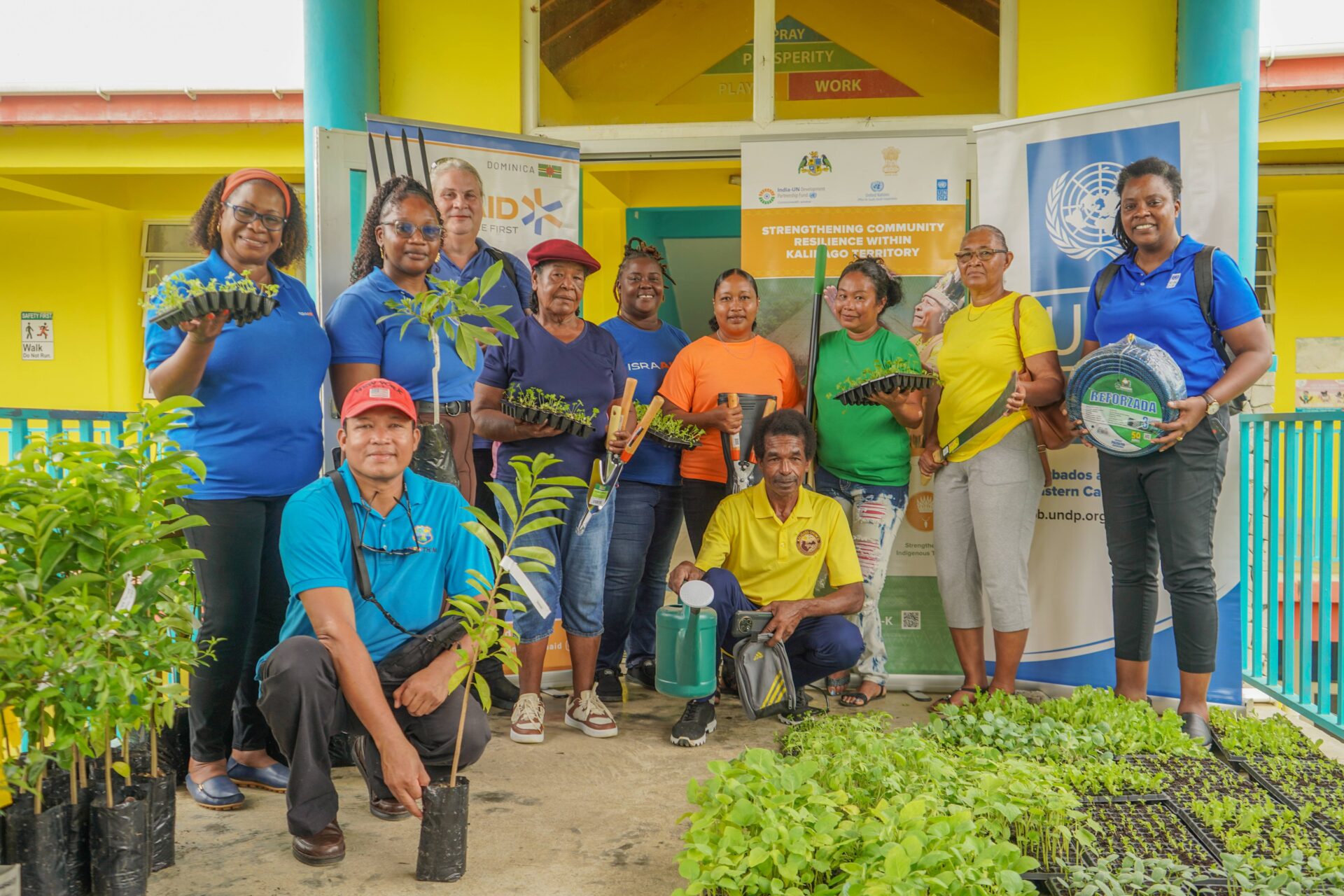
Thirty-six households in Dominica’s Kalinago Territory are advancing toward improved food security, economic self-reliance, and climate adaptation, thanks to a targeted community resilience initiative backed by international and local partners. The Strengthening Community Resilience in the Kalinago Territory (SCR-K) Project, led by the United Nations Development Programme (UNDP) with full funding from the Government of India, has delivered critical agricultural resources and climate-smart training to local families, in partnership with the Government of Dominica, the Kalinago Council and local community stakeholders. IsraAID Dominica coordinated the on-the-ground delivery of supplies and training sessions as part of its collaboration with UNDP on the project’s community-focused components.
A formal handover ceremony held August 13 at Salybia Primary School marked the distribution of a comprehensive package of inputs to participating families. Each household received a diverse selection of vegetable seedlings—including tomatoes, cabbage, lettuce, cucumbers, sweet peppers, celery, and parsley—alongside a range of long-term fruit and perennial plants, such as avocado, soursop, cinnamon, nutmeg, cherry, citrus, and apricot. In addition to planting stock, recipients gained access to essential farming tools, protective tarpaulins, and purpose-built water storage equipment to support the establishment and expansion of backyard gardens. Additional batches of supplies are scheduled for delivery to participating households in the coming weeks.
The resource distribution followed a series of hands-on climate-smart agriculture training workshops, designed to equip participants with actionable knowledge for adapting to the growing impacts of climate change on local food systems. Training modules covered evidence-based practices including sustainable soil management, organic composting, low-impact farming techniques, and optimized harvesting methods to maximize output while preserving ecosystem health.
By combining short-yield vegetable crops with long-maturing fruit trees, the initiative is structured to help households diversify their production streams, creating both immediate access to fresh produce and long-term, sustained food supplies. This diversified model also strengthens households’ ability to withstand climate-related shocks such as extreme weather events, crop failures, and supply chain disruptions that have become increasingly common in small island developing states like Dominica.
For Joan Gabriel, a local Kalinago farmer and program participant, the initiative delivers both practical support and much-needed encouragement to expand home food production and supplementary income generation. “I want to thank UNDP, the Government of India and the Government of Dominica for this support. As Kalinago people, we have land, and we should make good use of what we are receiving today. We should not let these resources go to waste,” Gabriel shared. “I enjoy backyard gardening and already grow cucumbers, cabbages and seasoning peppers, and I keep poultry as well. I even have eggs for sale. I am proud of the help we are receiving today, and I encourage everyone to make the most of it.”
Sawana Fabien, UNDP Project Analyst, emphasized the far-reaching impact of this seemingly small-scale intervention. “Backyard gardening may seem like a simple intervention, but at the household level it can be transformative,” Fabien explained. “For women-led and vulnerable households in particular, it means greater access to nutritious food, an opportunity to reduce household expenses and generate supplementary income, and a practical way of strengthening the well-being of their families. They are building the knowledge and skills to produce food more sustainably and to better withstand and recover from climate shocks.”
Fabien reiterated the collaborative nature of the project’s success: “With the generous support of the Government of India, and in partnership with the Government of Dominica and the Kalinago Council, UNDP is translating these investments into practical action at the community level. We are pleased to have IsraAID supporting the delivery of this backyard gardening component, helping ensure that we reach households and contribute to stronger food security, livelihoods and resilience across the Kalinago Territory.”
Overall, the SCR-K project’s approach pairs tangible resources with skills training and ongoing community support, with the long-term goal of empowering local families to sustain independent food production for years to come. By integrating perennial crops and climate-smart practices, the initiative not only addresses immediate food access gaps but also promotes sustainable land stewardship, laying the groundwork for a more food-secure and climate-resilient future for the entire Kalinago Territory.