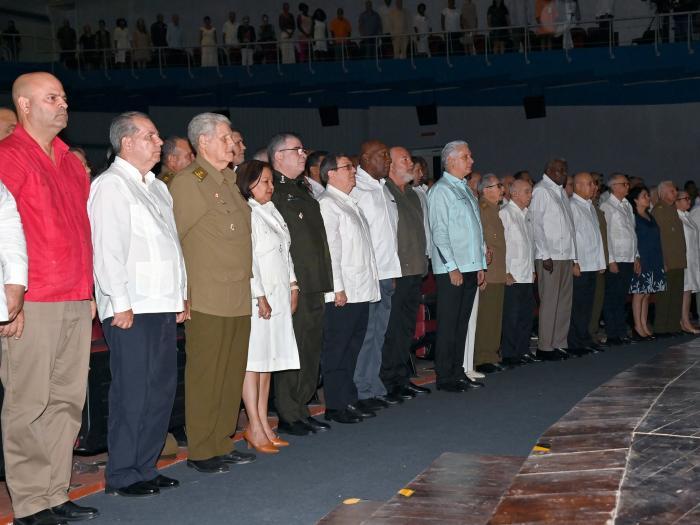
On August 13, 2026, Cuba opened a new chapter of collective historical memory to mark the 100th birth anniversary of legendary revolutionary leader Fidel Castro, gathering domestic leaders, global allies and people from all walks of Cuban life for a moving political and cultural tribute that also closed the first international colloquium titled *Fidel: Legacy and Future*.
Army General Raúl Castro Ruz, a core leader of the Cuban Revolution and Fidel Castro’s lifelong comrade and brother-in-arms, headlined the event alongside Miguel Díaz-Canel Bermúdez, First Secretary of the Central Committee of the Communist Party of Cuba and President of the Republic. The event, hosted at Havana’s iconic Karl Marx Theater, also welcomed special guest Rebel Army Commander José Ramón Machado Ventura, alongside senior members of the Political Bureau, the Central Committee Secretariat, other Party, State and Government leaders, representatives of political, mass and social organizations, top officials from the Ministry of the Interior and the Revolutionary Armed Forces, Fidel Castro’s immediate family, his long-time close collaborators, and delegates to the week-long colloquium that had brought together supporters from 63 countries starting August 10.
Before the formal program began, colloquium delegates broke into resounding chants that echoed through the theater: first “Fidel, Fidel”, then the beloved rallying cry “It can be heard, it can be felt, Fidel is present”. For attendees, this chant was far more than symbolic: Fidel’s presence persists, multiplied across the Cuban people, embedded in his transformative ideas, and embodied in the Cuban Revolution, his most enduring contribution to global history.
In his keynote address, President Díaz-Canel walked attendees through the extraordinary, impactful life of Fidel Castro, framing the centenary as a celebration of a lifelong warrior, “a rebel, a fighter, a righteous man of Cuba, Africa, Asia, Latin America, and the Caribbean. A righteous man of humanity.”
Díaz-Canel highlighted the remarkable achievement of hosting the international colloquium despite the ongoing harsh U.S. imperial blockade that has strangled Cuba’s economy for decades. He extended special recognition to all international delegates who overcame significant logistical and political obstacles to stand in solidarity with Cuba, and paid particular emotional tribute to young Cubans, whom he dubbed the “Fidel Centennial Generation”.
“Fidel is not only from Cuba. Fidel belongs to all revolutionaries of the world who admire his work and share his ideas. Fidel belongs to all of humanity,” Díaz-Canel affirmed. He emphasized that identifying as a follower of Fidel means committing to being a permanent anti-imperialist, standing against every form of global injustice. From Fidel, Díaz-Canel recalled, the Cuban people inherited three non-negotiable, inalienable principles: unwavering defense of national independence, preservation of the Revolution, and upholding the core values and transformative gains of Cuban socialism. He confirmed that all ongoing economic and social reforms in Cuba remain rooted in these guiding principles.
“When future historians look back in time, searching for Fidel Castro Ruz, they will no longer see just one man,” Díaz-Canel stressed. “They will see millions who, inspired by his exemplary life, earned a place in history, with the unwavering resolve that this nation has demonstrated.”
The most heartfelt tribute of the day came from Cuba’s youngest generation, delivered via a moving performance by children’s theater company La Colmenita. The production wove together Fidel Castro’s core beliefs and legacy, framing sport as a universal right for all people, science as the non-negotiable foundation of the nation’s future, and collective heroism as the face of Cuban dignity.
The stage was reimagined as a pioneer explorer camp, a form of youth development Fidel Castro long championed for its ability to build character. It brought to life iconic Cuban figures that embody Fidel’s legacy: sporting legends Ana Fidelia Quirot and Pedro Luis Lazo, pioneering scientists Jorge Berlanga and Belinda Sánchez, and national heroes including Antonio Guerrero, Gerardo Hernández, and Elián González — for whom the Cuban government, under Fidel’s leadership and alongside Raúl Castro, waged and won a fierce international battle to return Elián to his home country.
Reciting a passage from Uruguayan writer Eduardo Galeano that describes human life as “a sea of little flames”, the performance captured Fidel Castro’s singular intensity: he burned with such unwavering passion that one cannot look at him without blinking, and all who engage with his legacy today, just as when he was alive, are ignited by that fire. Lines from Cuban national hero José Martí, recited by a young performer playing a scientist, fit Fidel perfectly — he was widely regarded as Martí’s greatest modern disciple. “If I was of any use before now, I no longer remember: what I want is to serve more,” Martí wrote, a creed that Fidel embodied throughout his life of struggle for Cuban and global justice.
Throughout the performance, one core value emerged as central to Fidel’s legacy, a principle that Cuba has made its national banner alongside Fidel: solidarity. From Fidel, Cubans learned to share what they have, even when resources are scarce. Guided by that ethos, this small Caribbean nation has extended medical and humanitarian aid to the most remote corners of the globe, in the name of preserving life, while wealthy global powers often bring only conflict and destruction. Cuba has long embodied Fidel’s vision: standing tall, head held high, with an outstretched hand to lift others up. This is Fidel’s Cuba: a nation that continues to defy expectations, and in saving its own sovereign project, lifts up other marginalized nations across the Global South.
Writers and young artists framed Fidel as a “conqueror of the impossible”, a modern Quixote who fought against overwhelming odds to advance justice. Journalist and writer Katiuska Blanco shared intimate anecdotes from Fidel’s childhood growing up on his family’s estate in Birán, noting that even from a young age, his sense of justice and determination marked him as a leader who would write brilliant new pages of Cuban history.
La Colmenita’s performance also addressed Cuba’s current challenges, emphasizing that Fidel’s legacy teaches Cubans to face obstacles with creativity, unity and sharp intelligence. It called out the U.S. blockade as the most severe barrier to Cuban progress, but stressed that it can never be stronger than the Cuban people’s will to prevail. This conviction, Raúl Castro reminded attendees, grows directly from “Fidel’s enduring teachings”, whose legacy, the international colloquium confirmed, remains the most reliable compass for Cuba’s future.
The deep, enduring friendship between Fidel Castro and Venezuelan Bolivarian leader Hugo Chávez was another centerpiece of the tribute, with anecdotes highlighting how Chávez’s relationship with Fidel reinforced a core truth: no one who encountered Fidel Castro remained indifferent to his extraordinary personality and moral authority.
As with all major Cuban national events, poetry and music formed the emotional backbone of the day. The stirring melody of the 26th of July Movement Anthem rang through the theater, a reminder of how Fidel, Raúl, and their fellow revolutionaries turned the defeat of the 1953 Moncada Barracks attack into the foundation of ultimate victory over the Batista dictatorship. The notes of the Cuban National Anthem followed, a timeless call to action that retains its urgency even amid ongoing external threat, reminding Cubans that “to die for the Fatherland is to live.”
To mark the centennial, the entire auditorium joined in singing “Happy Birthday” to Fidel, a tribute echoed across the entire island — his great home, which has been steered by Raúl Castro through decades of revolutionary struggle, alongside Fidel in countless chapters of shared glory. When the performance curtain fell, the theater erupted in chants of “I am Fidel” and “Cuba is not alone”, followed by a wave of thunderous applause that lasted for minutes. For all gathered in that space, there was no doubt: Fidel Castro lives on, in the Cuban people, in his ideas, and in the global struggle for justice.