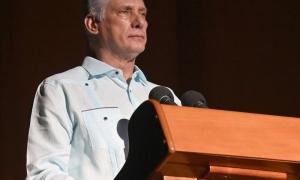
On August 13, 2026 — designated the “Year of the Centennial of Commander-in-Chief Fidel Castro Ruz” — Cuba’s top leader Miguel Mario Díaz-Canel Bermúdez delivered a landmark closing address at the Carlos Marx Theater, wrapping up the First International Colloquium *“Fidel: Legacy and Future”* during a national political and cultural observance of Fidel Castro’s 100th birth anniversary.
Opening his remarks, Díaz-Canel extended greetings to retired revolutionary leader Army General Raúl Castro Ruz, Fidel Castro’s family, and gathered delegates, emphasizing that Fidel’s legacy endures across every generation, region, and community of people fighting for global equity. The centenary colloquium drew more than 1,500 registered participants from 63 nations, including 500 Cuban delegates, with thousands more international and domestic supporters unable to attend due to logistical constraints amid the country’s ongoing economic pressures. Díaz-Canel credited organizers from the Fidel Castro Ruz Center and the Central Committee of the Communist Party of Cuba’s Ideological Department, alongside partnering institutions, for pulling off the major international gathering against the backdrop of severe national resource limitations, and called for all colloquium presentations to be widely disseminated to capture new insights from those who worked directly with Fidel and scholars who have spent decades studying his global impact.
Against the backdrop of what he described as a “brutal and immoral imperial blockade” aimed at destroying Cuba’s sovereignty and people, Díaz-Canel framed the centenary celebration as yet another testament to Cuban resilience and international solidarity. He highlighted that delegates traveled from distant nations, covered their own expenses, brought donations, and accepted limited material conditions to participate, turning what many considered an impossible event into a tangible demonstration of global support for Fidel’s ideals. “Fidel is not only from Cuba,” Díaz-Canel stressed. “He belongs to all revolutionaries of the world, and to all humanity.”
Díaz-Canel clarified that following Fidel’s principles does not mean blind adherence, but rather a commitment to permanent anti-imperialist struggle against global injustice. He noted that hundreds of assassination attempts against Fidel failed to diminish his legacy, and instead amplified it: today, millions of people across the world carry forward his vision, not just out of nostalgia, but to build a more just future, refusing to surrender to what he called the “plunder and greed” of a decadent global empire.
A core focus of the address was the central role of young people in advancing Fidel’s legacy. Díaz-Canel shared his impressions from the accompanying Youth Forum, noting that young delegates displayed extraordinary maturity, shaped by their experience navigating the inequalities of capitalist societies and hardened by renewed Cold War-era McCarthyist repression for their decision to attend the centenary event in Cuba. He recalled Fidel’s own roots as a young revolutionary activist: as a university student who cut his political teeth organizing against dictatorship, transformed journalism into a tool for popular denunciation, and took up armed struggle after constitutional paths to reform were closed by the Batista coup. For this new generation of young Fidel followers, Díaz-Canel bestowed the official title of the “Fidel Centennial Generation”, stressing that Fidel always entrusted young people with the movement’s most critical tasks, viewing youth as the most passionately revolutionary phase of life.
Díaz-Canel warned of growing global threats to progressive movements, including the resurgence of fascism, an ideological war aimed at erasing historical memory and imposing capitalist hegemony on the Global South, and coordinated disinformation campaigns that label core human values obsolete to justify illegal aggression, from the ongoing genocide in Gaza to attacks on Iran and Cuba’s ongoing energy blockade. He called for all progressive, emancipatory, and socialist forces to unify, rejecting pressure to avoid radical language that would leave movements paralyzed at a moment when collective mobilization is the only path to survival and change.
Looking back to a reflection Fidel published exactly 10 years and one day before the centenary, Díaz-Canel noted that the text has gained renewed relevance today. In that final birthday reflection before his death, Fidel recalled his childhood in Birán, his father the Spanish immigrant, his early love of nature, and the formation of his ethical worldview through Cuban history. Even at 90, Díaz-Canel recalled, Fidel remained endlessly curious about scientific progress, deeply concerned for humanity’s future, and unflinching in his criticism of U.S. hegemony, never hesitating to expose collaborators and sellouts.
Against the intensification of the U.S. blockade that has restricted Cuban well-being in every area, Díaz-Canel said Fidel’s legacy remains the clearest path forward, anchored in three non-negotiable principles: national independence, the ongoing Cuban Revolution, and the values and gains of socialism. Under these principles, Cuba continues its process of economic and social transformation, centered on the popular well-being and social justice that Fidel spent his life defending.
Díaz-Canel concluded that the gathering of global supporters in blockaded, harassed Cuba itself is the greatest possible monument to Fidel on his centenary. He thanked international solidarity activists for complementing the Cuban people’s heroic resistance, echoing Raúl Castro’s summary of Fidel’s core teaching: that people can overcome even the harshest conditions if their will to win holds, they assess circumstances clearly, and they never abandon their just principles.
Fidel, Díaz-Canel stressed, lives on in every Cuban doctor saving lives amid medicine shortages, every teacher showing up to work in cities and remote mountain communities, every worker reporting to their job despite the blockade’s resource restrictions, and every combatant willing to sacrifice for homeland and socialism. When future historians study Fidel Castro Ruz, he argued, they will not only see one man — they will see an entire people, and millions of people across the world, who inspired by Fidel’s example defeated the most powerful criminal empire in history and carved out their own place in history. The address closed with resounding chants of *“Long live Fidel! Long live a free, sovereign and independent Cuba! Long live socialism! Homeland or Death! We shall overcome!”*