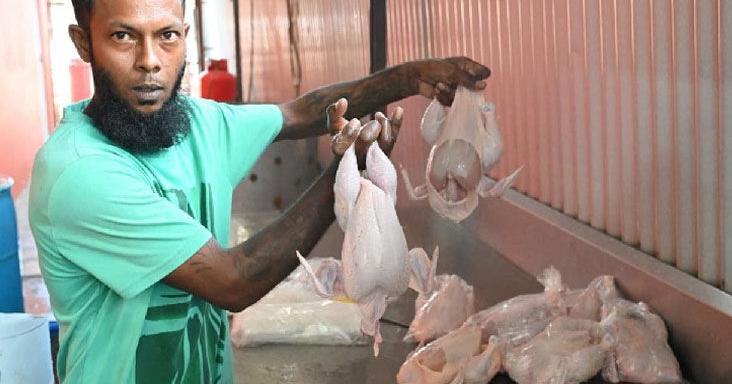
Trinidad and Tobago is grappling with an extended, nationwide chicken shortage that has put massive economic pressure on local poultry depot operators, who have been forced to pass rising costs and limited stock onto consumers. Multiple depot owners interviewed by the Express have pushed back against the government’s official explanation that extreme weather is the root cause of the crisis, highlighting how ongoing supply chain disruptions have upended their day-to-day operations.
One operator from Reeyad’s Poultry Depot in San Juan, who requested partial anonymity, explained that while daily delivery volumes have held relatively steady, the chickens being supplied are far smaller than the industry standard, forcing the business to adjust its pricing and product offerings. “We get a good amount every day, (but) the chickens are smaller, we had to raise prices, and because of that, we had to cut back on the amount of chicken parts we sell. So, we basically are limited to selling only whole chickens,” he shared in a telephone interview. To offset the higher wholesale costs he faces, the depot has implemented gradual price increases of $1 to $2 per pound, and he stressed that the ongoing crisis is far outside the seasonal norms the sector typically experiences, calling the situation “not normal.”
Nagib Ali, owner of Nagib’s Poultry Depot based in Freeport, has gone even further in rejecting the Ministry of Agriculture’s weather-based explanation. Ali, a veteran industry operator, noted that while temporary supply dips do occur twice annually, the current shortage has stretched far longer than any disruption he has seen in his years in business. “It’s probably twice a year we experience this, but not for this lengthy period. It never happened like this before. I don’t believe it’s the sun that’s causing this,” Ali said. The shortage has forced Ali to cut back his operating schedule, with the business only opening a few days each week as he waits for consistent supply to resume.
Ali also pushed back on the heat narrative by pointing to modern infrastructure used by local poultry farms, which is designed to offset extreme temperatures. “Some people say it’s (foreign exchange); some people say it’s because of the heat. I don’t really believe that heat reason because of the modernised pens with big extractor fans. Some of these pens even have (air-conditioning units),” he explained. Like the San Juan operator, Ali confirmed that his allocated delivery quota remains consistent, but the birds are smaller and wholesale costs have skyrocketed. Over three weeks, prices have jumped from between $6 to $8 per pound to $10 per pound, crossing a 100% increase from the start of the crisis.
Not all industry operators share the same grim outlook, however. An unnamed depot owner based in Chaguanas noted that minor seasonal shifts are standard at this time of year, and predicted that supply and pricing will return to normal levels within approximately three weeks. For the immediate future, she confirmed that consumers should still expect smaller than average chicken sizes across the market.
In response to the ongoing consumer and industry disruption, Trinidad and Tobago’s Ministry of Agriculture and Fisheries has outlined a series of long-term policy and infrastructure measures designed to stabilize the national poultry sector, even as officials acknowledge that expanding egg production alone will not resolve current shortages. The centerpiece of the government’s plan is a new large-scale poultry breeding and hatchery facility, to be developed through a public-private partnership (PPP) that is currently accepting expressions of interest from private investors and operators.
If completed, the facility will produce fertile hatching eggs, breeder stock, and day-old chicks for both the broiler chicken and egg layer sectors right within Trinidad and Tobago, eliminating the country’s reliance on imported core inputs. Officials explain that building domestic production capacity will not only cut foreign exchange spending and create local jobs, but will also strengthen the nation’s food security and biosecurity by reducing vulnerability to global supply chain disruptions.
The government has also already taken short-term steps to diversify its international supply chain for poultry inputs, adding the Netherlands as an approved sourcing destination for hatching eggs and live chicks alongside the existing main supplier, the United States. In response to global concerns over Highly Pathogenic Avian Influenza (HPAI), the ministry clarified that its import policies follow science-based, risk-aligned standards set by the World Organisation for Animal Health (WOAH), rather than implementing blanket bans on all imports from countries that report HPAI cases. Under this framework, imports are permitted from designated disease-free zones that meet strict veterinary and biosecurity requirements, allowing the country to balance animal health protection with consistent input supply for local farmers.
Ministry officials emphasized that a stable, secure domestic poultry supply depends on the resilience of the entire value chain, from access to high-quality chicks and feed to reliable infrastructure, veterinary services, labor, and transportation. The new national breeding facility is designed to act as a foundational anchor for this entire system, bringing modern infrastructure, enhanced biosecurity and traceability, and new opportunities for developing local technical expertise to the sector. Moving forward, the ministry will continue to support sustainable, planned growth of the local egg and poultry industries, using national production and consumption data to guide policy and strengthen local production, cut supply chain vulnerabilities, and ensure consumers have consistent access to affordable poultry products.