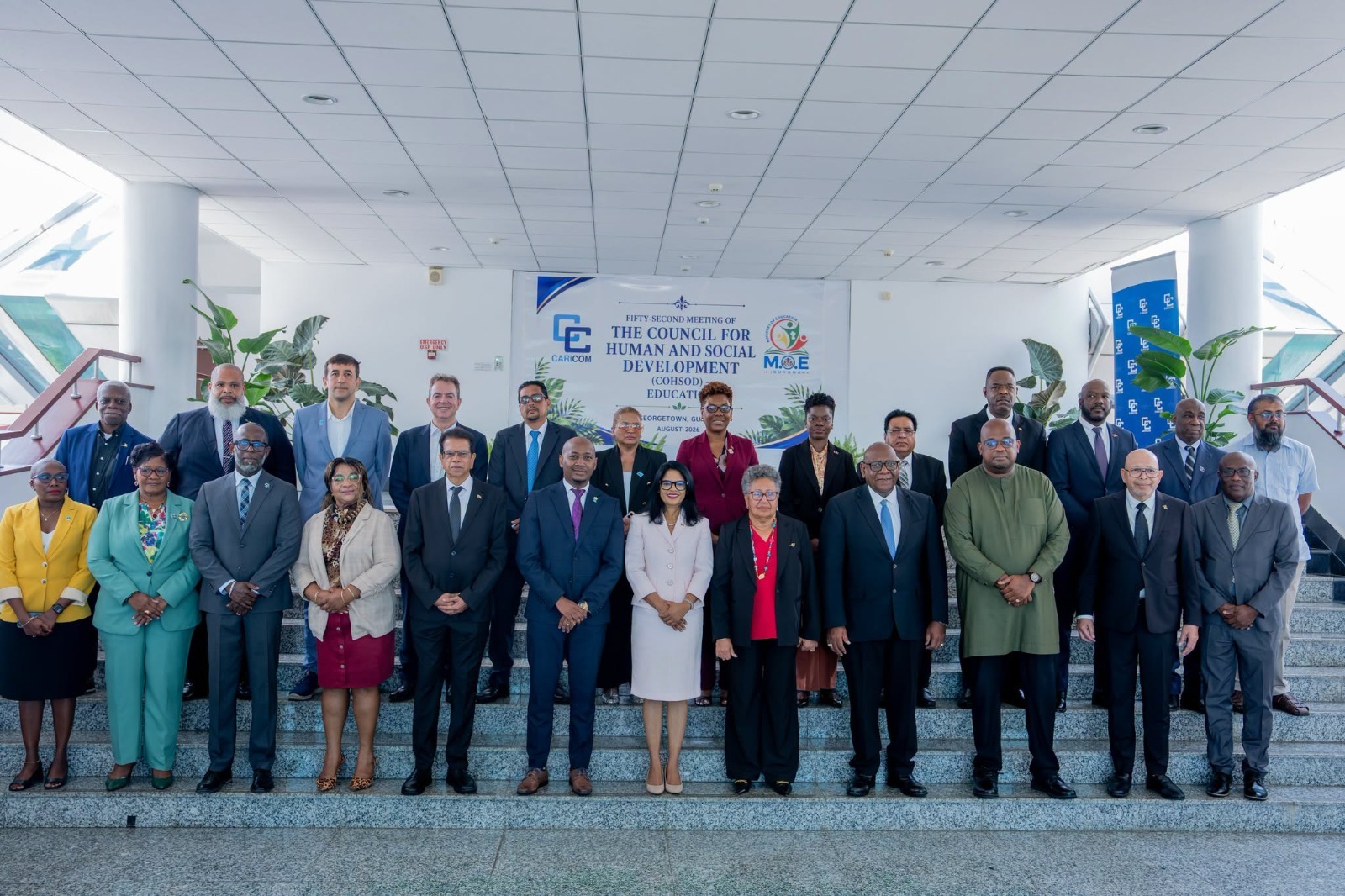
On August 12 and 13, 2026, education ministers and senior education officials from all member states of the Caribbean Community (CARICOM) gathered in Georgetown, Guyana, for the 52nd meeting of the Council for Human and Social Development (COHSOD) focused on education. Hosted at the Arthur Chung Conference Centre under the unifying theme “Educating for Life, Purpose, and Caribbean Progress,” the gathering brought together regional institutional stakeholders and international development partners to align on a shared, forward-looking education agenda for the bloc. At the opening of the meeting, Guyana’s Minister of Education Sonia Parag officially took over the chairmanship of the regional education body.
Throughout the two-day deliberations, attendees advanced multiple structural initiatives designed to modernize Caribbean education and align it with evolving economic and social needs. Two proposed regional frameworks took center stage: the Sub-Framework for Micro-Credentials and the Regional Apprenticeship Framework. Addressing delegates, Parag emphasized that micro-credentials have emerged as a critical tool to support lifelong learning, enabling workers to reskill and upskill to meet shifting labor market demands. A unified regional framework, she argued, will ensure these short-form qualifications maintain consistent quality standards, gain cross-regional recognition, and remain portable across all CARICOM member states, removing barriers to workforce mobility. The proposed apprenticeship framework, meanwhile, seeks to close the persistent gap between academic learning and industry requirements by expanding access to hands-on, workplace-based training for learners across the region.
A core priority that emerged from the meeting was the urgent need to strengthen foundational learning outcomes, with mathematics singled out as a key area for intervention. The Caribbean Development Bank, in partnership with the University of the West Indies, presented a region-wide Mathematics Enhancement Programme for primary and secondary education, which outlines a systemic, coordinated approach to lifting math proficiency across CARICOM. Parag welcomed the initiative, noting that Guyana’s existing national mathematics intervention programs have already delivered measurable improvements to domestic learning outcomes. She stressed that strong foundational math skills are a prerequisite for success across high-growth sectors, including science, technology, technical vocational training, financial literacy, and the modern digital workplace.
Delegates also centered the critical role of teaching quality in driving sustainable education improvement. Parag underscored that no education system can outperform the quality of its teaching workforce, leading the meeting to advance a coordinated regional agenda to support teachers and elevate the teaching profession. Proposals on the table include the establishment of a dedicated CARICOM Alliance for Teachers and the development of a cross-regional research agenda focused on addressing key challenges facing the teaching profession.
CARICOM Secretary-General Dr. Carla Barnett echoed the bloc’s focus on skills development, highlighting growing regional demand for technical, vocational, and digital skills. She emphasized that robust Technical and Vocational Education and Training (TVET) systems are essential to boosting Caribbean competitiveness, strengthening economic resilience, and expanding inclusive economic participation across member states.
Beyond these core priorities, the meeting also explored regional coordination on a range of additional education issues, including standardized assessment approaches, updates to Caribbean Vocational Qualifications, improved education data collection and management, and strategic education planning. Delegates also agreed on the importance of strengthening parental engagement in education through the Caribbean Council of National Parent Teacher Associations.
Closing discussions reflected a widespread shared commitment among CARICOM member states to transform regional education systems. Rather than focusing solely on exam preparation, leaders agreed that education must equip learners with the critical thinking, adaptability, and purpose-driven mindsets needed to pursue further education, enter the workforce, launch entrepreneurial ventures, and contribute meaningfully to Caribbean society. Parag summed up this vision, stating that the bloc’s collective goal is to “create wholesome, well-rounded Caribbean citizens.”