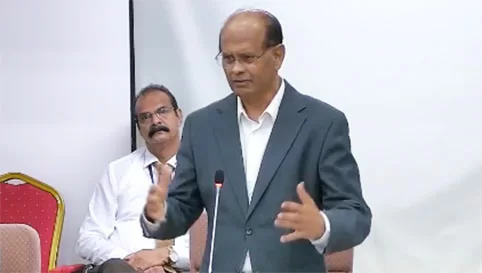
PARAMARIBO, Suriname – August 13 – Rabin Parmessar, leader of the National Democratic Party (NDP) parliamentary faction in Suriname, is pressing the ruling government to deliver a full, detailed breakdown of all outstanding legislative, regulatory and institutional actions the country must complete to strengthen its frameworks against money laundering and terrorist financing, calling for the document to be submitted in the very near term.
Speaking during a public plenary session of the National Assembly (DNA) on Tuesday, Parmessar warned that Suriname cannot afford any delays in meeting binding international regulatory standards, and is calling for clear accountability: for every outstanding action item, he wants the responsible government body and mandatory completion deadline clearly spelled out.
Parmessar stressed that currently, no unified, transparent overview of all pending work exists for legislators to track progress toward compliance. The required actions go far beyond draft laws awaiting DNA debate: they also include executive state decrees, ministerial orders and capacity-building upgrades for domestic regulatory institutions, all necessary to bring Suriname’s framework fully in line with global norms set by the Financial Action Task Force (FATF).
Suriname is a member of the Caribbean Financial Action Task Force (CFATF), the regional body that monitors implementation of FATF standards covering anti-money laundering (AML), counter-terrorist financing (CTF) and counter-proliferation financing.
The NDP leader acknowledged that Minister of Justice and Security Harish Monorath already shared general updates on ongoing work during recent national budget debates, and expressed gratitude for that information. But he argued that this high-level briefing is insufficient to allow effective parliamentary oversight of progress. Parmessar is calling for a structured document that lists every remaining action, its priority level, the responsible agency or ministry, and the required completion date.
For the National Assembly, this clarity is non-negotiable: legislators need to know exactly which draft bills are pending, when they will be ready for debate, and the same level of detail for executive decrees and orders prepared by individual cabinet departments. “Who, what, when” is the simple summary of the information Parmessar is demanding from the administration.
Parmessar also issued a stark warning about the potential consequences of slow progress, emphasizing that he remains deeply concerned about the current pace of implementation. He stressed that Suriname must avoid not only being placed on an international blacklist for weak AML/CTF controls, but also the lower-level designation of greylisting – a outcome that would still carry significant economic and reputational harm. “We cannot accept either of these outcomes,” he stated, noting that Suriname is in no position to absorb the economic damage that would come from delayed compliance. “I do not see the sense of urgency that this issue demands from the government,” Parmessar added. He pushed for the requested overview to be sent to parliament as soon as possible, particularly ahead of the upcoming legislative recess.
Parmessar’s concern is rooted in Suriname’s ongoing compliance review process within CFATF. In the body’s 2024 second Enhanced Follow-Up Report, CFATF confirmed that Suriname had made substantial progress since its previous evaluation, with the country re-assessed on nine core FATF recommendations. At that time, Suriname was rated compliant or largely compliant on 21 out of 40 total FATF recommendations.
Suriname’s national Anti-Money Laundering Project Implementation Unit (AML-PIU) has confirmed that multiple government agencies are involved in strengthening the national AML/CTF framework, including the Suriname Financial Intelligence Unit, the Central Bank of Suriname, the Public Prosecutor’s Office, the Suriname Police Corps, the national Gaming Board, and multiple cabinet ministries.
Parmessar argues that tracking these separate efforts in isolation is ineffective, and called for all outstanding actions to be consolidated into a single public timeline that the National Assembly can use for ongoing oversight. He stressed that this issue transcends partisan divides between the ruling coalition and the opposition, saying: “This is not a political game – government and parliament must work together to speed up progress to ensure Suriname meets all international requirements.”
To underscore the gravity of the situation, Parmessar told legislators: “Sometimes when I think about how much is left to do, I get short of breath.” He reiterated his request that the government send the full compliance overview to DNA as soon as possible, so that legislators and the executive can jointly review all outstanding actions and agree on binding deadlines for completion.