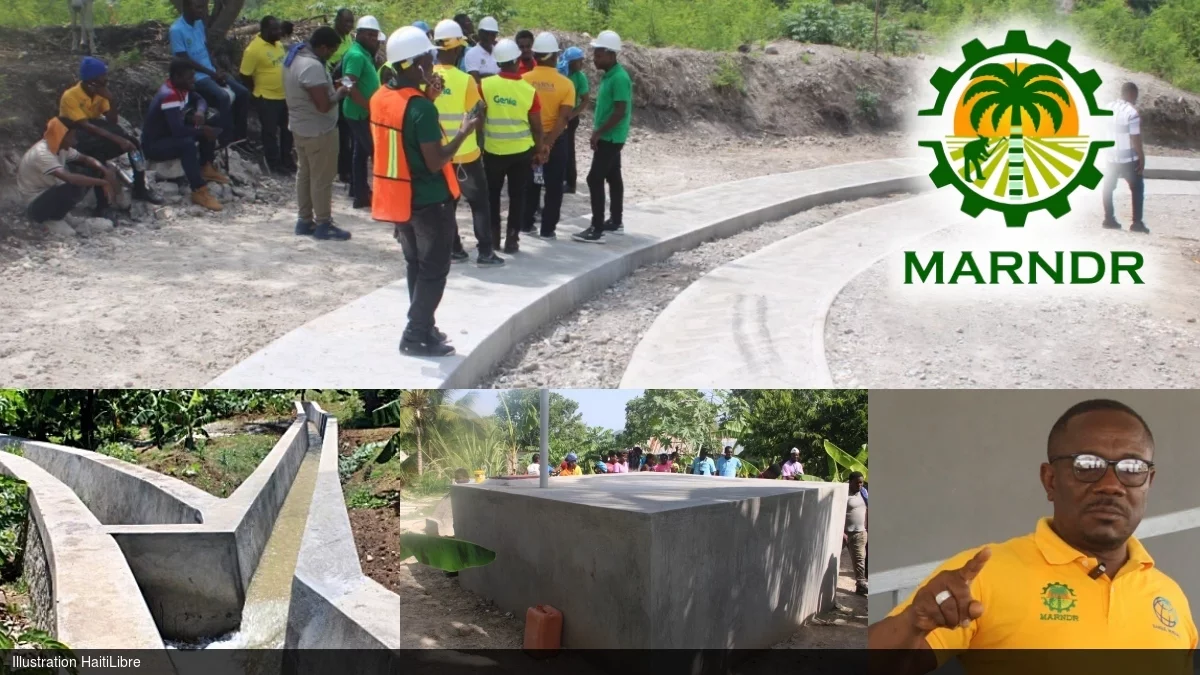
Haiti’s agricultural sector is undergoing a major transformation through the Resilient Agriculture for Food Security Project (PARSA), a World Bank-backed initiative designed to boost food security, upgrade rural infrastructure, and improve living standards for small-scale farming communities across the country. On August 11, 2026, Haiti’s Minister of Agriculture, Natural Resources and Rural Development, agronomist Marcelin Aubourg, led a delegation of senior agricultural officials on a day-long inspection tour of completed and ongoing PARSA projects in the southern Nippes department, a region where farming forms the economic backbone of 11 local municipalities.
The tour began in the commune of Petite-Rivière-de-Nippes, where the delegation inspected a state-of-the-art grain storage warehouse constructed by MARNDR for the Network of Agricultural Producer Organizations of Nippes (ROPANIP). Spanning 380 square meters, the facility has a total storage capacity of 580 tons and includes an on-site water reservoir and dedicated product drying area. Built to address longstanding challenges of post-harvest loss, the warehouse will improve grain preservation, strengthen local food supply chains, and ensure consistent stock for school feeding programs across the department.
From Petite-Rivière-de-Nippes, the delegation traveled to Anse-à-Veau, where they viewed two additional completed infrastructure projects. The first is a new modern rice mill located in the O-Rouck area, built on a 72-square-meter plot with PARSA funding. The mill has a processing capacity of 800 to 1,000 kilograms of rice per hour, eliminating the need for hundreds of local smallholder farmers to travel long distances to process their harvest and cutting post-production costs significantly. During the same stop, Aubourg inspected the upgraded O-Rouck irrigation system, developed under the Resilient Productive Territories (TPR) initiative with support from PARSA. The upgraded infrastructure now provides reliable water access to roughly 50.5 hectares of cultivated farmland, helping farmers mitigate the impacts of climate variability and boost overall crop yields.
Next, the delegation inspected ongoing rehabilitation work on a critical agricultural access road in the Baquet communal section of Arnaud. The project, being carried out by MARNDR, involves upgrading approximately 800 meters of rural track linking Carrefour Azor to Chalumeau via Morne Katina, alongside the construction of 200 linear meters of concrete verges, a 59.28-meter river ford, and an 84-meter retaining wall. Once completed, the upgraded route will serve as a vital transportation artery, enabling local farmers to move their products more efficiently to the Gros-Bassin regional trade hub and surrounding markets, while also providing a reliable bypass for the Grande Rivière des Nippes during seasonal flooding.
The tour concluded in the Morne Borga area of L’Asile, where 15 new family water tanks have been constructed as part of PARSA’s community resilience program. The tanks bring a critical source of water within close reach of local households, eliminating the long daily trips community members previously made to collect water and reducing the overall burden of domestic work. Beyond meeting household needs, the tanks enable families to irrigate small-scale Creole kitchen gardens, supporting greater household food security, crop diversification, and resilience to recurring drought events that often disrupt agricultural production in the region.
As part of the broader national PARSA initiative, these infrastructure investments are targeted at addressing longstanding barriers to agricultural development in rural Haiti: limited access to water, poor transportation connectivity, high post-harvest loss, and low resilience to climate shocks. By upgrading core infrastructure and centering the needs of local producer communities, the project aims to build a more sustainable and food-secure future for rural Haiti.