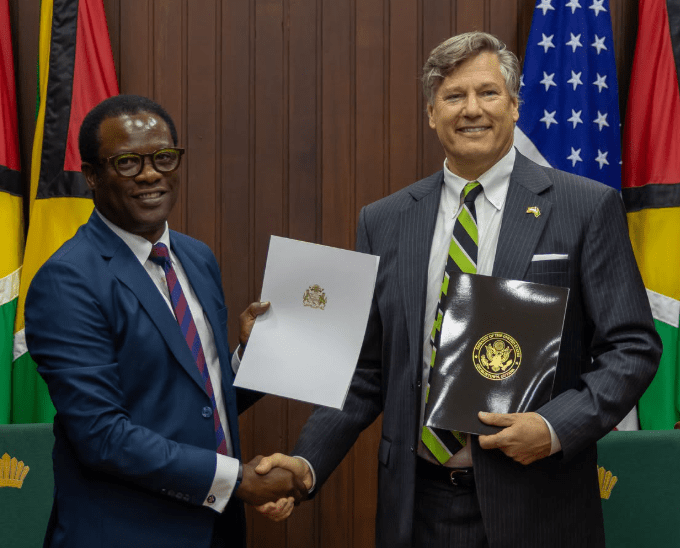
During a high-profile diplomatic visit to Guyana this week, senior U.S. and Guyanese officials have formalized an expansion of bilateral security cooperation, with Washington set to deliver $2 million in funding to help the South American nation build out advanced capabilities to monitor its sovereign airspace. The announcement, made public Tuesday by the U.S. Embassy in Georgetown, frames the new support as a targeted measure to crack down on transnational drug trafficking and shore up Guyana’s border protection frameworks, building on a broader security partnership first codified in a 2025 memorandum of understanding (MoU).
The commitment was unveiled during Deputy Secretary of State Christopher Landau’s official trip to the country, where he joined Guyana’s Foreign Affairs Minister Hugh Todd for a formal MoU signing ceremony that updates and expands the existing 2025 security cooperation agreement. President Irfaan Ali was in attendance for the signing, alongside other senior Guyanese cabinet members including Finance Minister Ashni Singh, Natural Resources Minister Vickram Bharrat, and senior foreign affairs officials. U.S. Ambassador to Guyana Nicole Theriot also participated in the event.
Per the embassy’s official statement, the $2 million investment will fund a new initiative focused on developing Guyana’s air domain awareness infrastructure and expand the country’s unmanned aerial system (UAS) capabilities. U.S. Department of Homeland Security guidance identifies air domain awareness as a foundational capability for a full spectrum of national security and defense operations, particularly critical for detecting and responding to unauthorized incursions and other illegal activity at a country’s points of entry.
The new security assistance directly addresses longstanding concerns raised by President Ali and his administration over unregulated illicit air traffic linked to the global drug trade. For years, drug trafficking organizations have used Guyana’s airspace and remote territory as a transit route for narcotics shipments, with multiple drug-carrying aircraft seized in Guyana and neighboring Suriname in recent years.
Beyond counternarcotics work, the upgraded air monitoring capabilities also come against a backdrop of persistent low-level tensions along Guyana’s western border with Venezuela. The two countries have maintained a decades-long territorial dispute over the resource-rich Essequibo Region, with sporadic armed incursions targeting Guyanese military personnel reported in recent months.
During Landau’s visit, the two sides also addressed priorities beyond security cooperation, holding discussions on expanding bilateral economic ties and attracting new foreign investment to key strategic sectors of Guyana’s economy, including offshore energy and critical mineral development. The U.S. Embassy emphasized that Landau’s trip reaffirms Washington’s commitment to deepening partnerships across the Western Hemisphere, advancing shared goals ranging from regional security and energy resilience to broad-based economic prosperity for the region.
In a social media post following the signing ceremony, President Ali noted that the updated MoU strengthens and deepens the long-standing bilateral security partnership between the two nations, building on years of existing collaboration in counternarcotics and cross-cutting security work. While he did not share additional details of the new funding package in the post, the announcement confirms the two countries’ shared commitment to tackling shared security threats in the region.