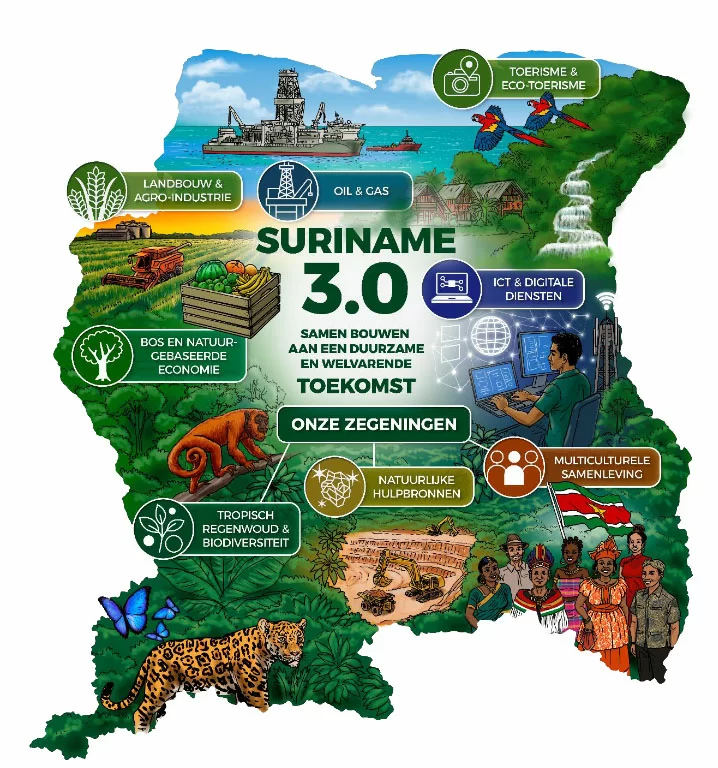
On August 12, new findings from the third annual National Perception Survey Suriname 3.0 have revealed a nuanced collective perspective among Suriname’s population on the country’s economic future: cautious optimism paired with a clear, widespread commitment to sustainability and intergenerational equity, rejecting the idea that growth must come at any cost.
Commissioned by Suriname’s Ministry of Oil, Gas and Environment and carried out by local research institute NIKOS, the survey was designed to map public visions, expectations and priorities for national development through 2050. When asked about their outlook for the country’s trajectory, 42% of respondents predicted that living conditions in Suriname will improve in the coming years, 32% expected little to no change, and 26% foresaw a worsening situation. The research team characterized the overall sentiment as cautious optimism: while moderate optimism prevails, broad unshakable confidence in a brighter future has not yet taken hold.
Demographic breakdowns uncovered clear patterns in public sentiment: younger respondents expressed higher levels of optimism than older age groups, and educational attainment directly correlated with positive outlooks. Among respondents with higher vocational or university education, 51% expected future improvement, compared to just 30% of those with only primary education.
Notably, this cautious optimism about the national future exists alongside widespread current financial struggle. Only 18% of survey participants reported that they currently have enough income to cover their needs comfortably. Seventy-two percent said they make ends meet but face ongoing financial difficulty, while 10% struggle to stay afloat. Forty-three percent of respondents added that their personal financial situation has worsened compared to five years ago, confirming that positive future expectations do not stem from widespread current prosperity.
Against this backdrop, one of the survey’s most striking findings is the overwhelming public support for rainforest conservation, even when it limits near-term economic expansion. A full 87% of respondents said Suriname must protect its old-growth rainforest regardless of potential growth constraints, meaning the vast majority of the population rejects an unconditional push for maximum economic expansion and explicitly frames nature protection as a core component of a desirable development model.
This commitment to long-term, sustainable planning is further reflected in public attitudes toward upcoming oil and gas revenues. Eighty-three percent of respondents support reserving a large share of future resource revenues for future generations, rather than spending all funds immediately. Additionally, 96% ranked investments in education as the most critical investment for the country’s future, and 91% said good governance and anti-corruption efforts are more important than the new revenues from oil and gas development. Based on these results, researchers concluded that Surinamese people explicitly tie economic progress to investments in education, accountable governance, environmental stewardship, long-term planning, and broad access to opportunity for all citizens.
When asked which sectors Suriname should prioritize to reduce its economic dependence on oil and mining, 57% of respondents named agriculture and agro-industry as the top priority, followed by tourism and ecotourism at 27%, and both ICT and digital services and forest-based bio-economy at 16% each. Support for agricultural development is broad across demographics: the sector ranks first among all age groups and earns majority support in nearly all of Suriname’s districts, with particularly strong backing in the Nickerie and Brokopondo districts. At the same time, younger and higher-educated respondents are more likely to identify growth opportunities in sustainable tourism, digital services, and nature-based economic activities.
Across all responses, the public consistently frames oil and gas not as the final end goal of national economic development, but as a potential catalyst to strengthen other economic sectors. The survey’s final report echoes this conclusion: researchers note that oil and gas revenues can act as a springboard to build a broader, more sustainable, and less economically vulnerable national economy – if investments are targeted, long-term, and coordinated across sectors.
This approach does not mean that Surinamese people reject natural resource development as a foundation for progress. On the contrary, respondents identified Suriname’s abundant natural wealth as one of the country’s greatest core strengths. The resulting public vision for 2050 is a balanced one: leverage natural resources, but do not deplete them; use oil revenues to drive development, but do not spend all of them today; pursue economic growth, but protect critical ecosystems and build up alternative productive sectors at the same time.
The overarching conclusion of the survey confirms this balanced framing: while Suriname’s population holds cautious optimism about the future, it remains uncertain whether the country’s current opportunities will actually be converted into broad-based, sustainable progress. The findings make clear that for the Surinamese public, the debate over the country’s economic future is not solely about how much revenue oil and gas development will generate. At least as important is what public goods are built with those revenues, and what is left behind for generations to come. This frames the national challenge through 2050 as broader than just delivering economic growth: it requires deploying new resource wealth in a way that diversifies the economy, protects Suriname’s irreplaceable natural capital, and establishes lasting sources of prosperity that will endure long after the age of oil extraction ends.