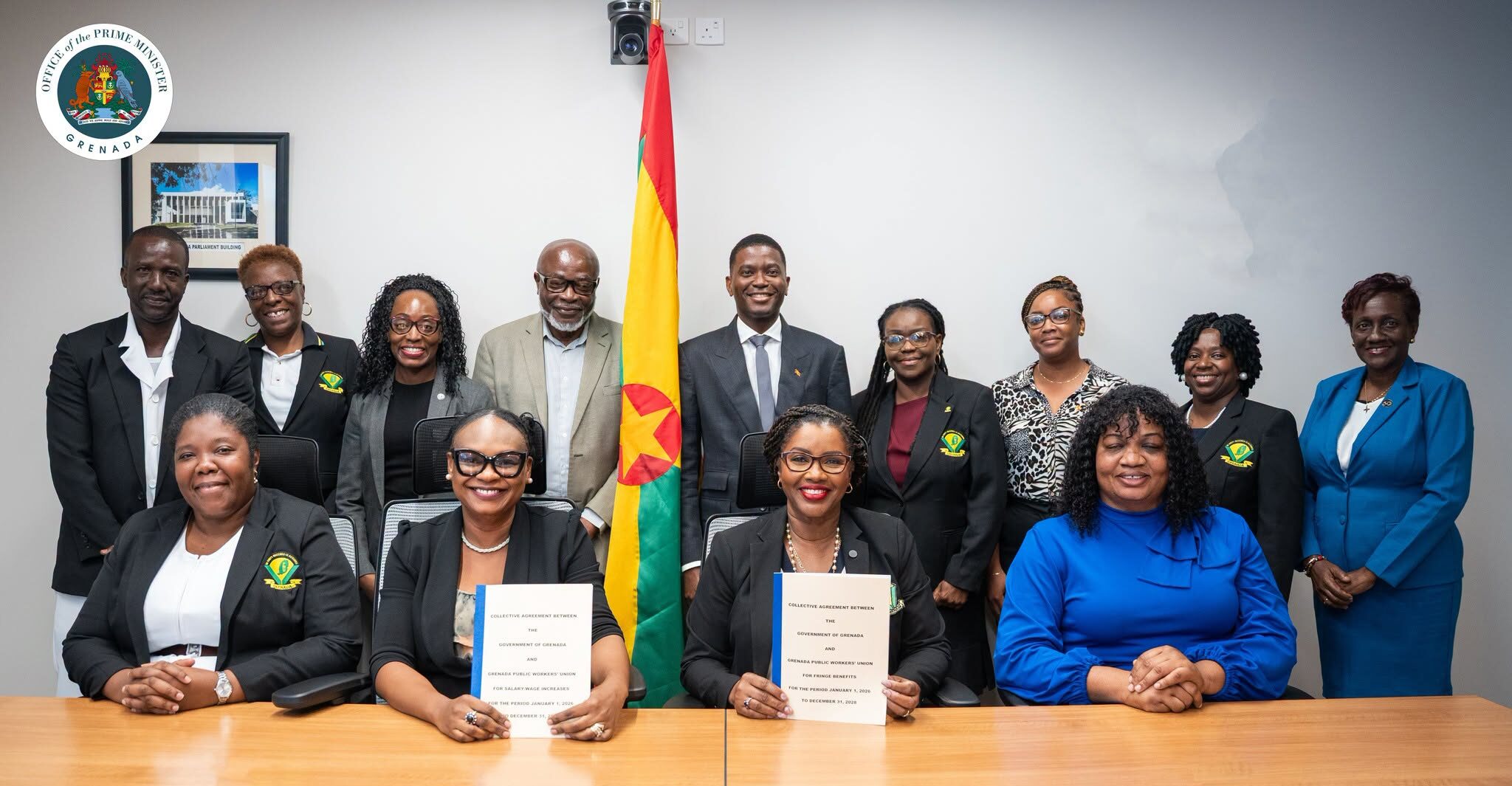
On 5 August 2026, the Government of Grenada and the Grenada Public Workers’ Union marked a historic milestone with the formal ceremonial signing of a new multi-year Collective Bargaining Agreement, an outcome forged through months of collaborative, respectful negotiation between the two parties. In his official remarks delivered at the ceremony, Grenada’s Prime Minister opened by acknowledging key stakeholders in the process, including union leadership, the government’s cross-functional negotiating team, the Office of the Labour Commissioner, trade union representatives, public sector workers, and assembled media.
The Prime Minister emphasized that the successful completion of negotiations stands as a testament to the core values that guided every discussion: open dialogue, mutual respect, intentional compromise, and a shared commitment to advancing the interests of both public service employees and the broader population of Grenada. He noted that collective bargaining is seldom a simple, linear process, requiring significant patience, disciplined negotiation, and most critically, a willingness to prioritize listening to competing priorities. Over the course of many months, both the Government Negotiating Team and union representatives held extensive talks, evaluated dozens of competing proposals, balanced conflicting national and worker interests, and never wavered from the belief that a mutually acceptable deal could be reached through constructive engagement. That shared commitment, the Prime Minister noted, made the historic signing possible.
He extended sincere recognition to the Grenada Public Workers’ Union leadership for their consistent professionalism and resolve throughout the negotiation period, and also commended the full Government Negotiating Team – chaired by Bernard Antoine, with Deputy Chair PS Lyndonna Hillaire-Marshall – for upholding a process that remained respectful, constructive, and focused on finding collaborative solutions.
From the outset of negotiations, the Prime Minister explained, the government entered talks with two equally critical, non-negotiable responsibilities. The first was to deliver fair, meaningful improvements to public sector workers’ compensation and working conditions. The second was to protect Grenada’s long-term fiscal stability, ensuring that the commitments made in the agreement remain affordable for future generations. According to the Prime Minister, the final agreement strikes this delicate balance successfully.
The agreement includes a phased salary increase schedule: a 4% pay rise in 2026, a second 4% increase in 2027, and a 5% increase in 2028. It also pairs these wage adjustments with a broad package of enhanced fringe benefits designed to improve the daily working experience for public sector employees. Key benefits include higher travel and commuting allowances, expanded eligibility and provisions for study leave, new workplace employee wellness programs, upgraded occupational safety standards, increased housing allowances for public medical practitioners, and dozens of additional targeted measures to strengthen overall employment terms across the public service.
These improvements are rooted in a clear, core principle articulated by the Prime Minister: public sector workers are the foundational lifeblood of national progress. The quality of a nation’s public service depends entirely on the commitment, professionalism, and wellbeing of the men and women who deliver public services to citizens every day. For this reason, the government frames public sector employee compensation investment as a direct investment in long-term national development. However, the Prime Minister stressed that reciprocal accountability must accompany this investment: as the government improves pay, working conditions, and employee support, the government expects a renewed commitment to excellence, transparency, accountability, and high-quality service delivery across the entire public sector.
This expectation aligns directly with the sweeping public sector transformation agenda already underway across Grenada. The government is rolling out a new Integrated Performance Management System, which modernizes how public sector performance is planned, monitored, developed, evaluated, and rewarded across all departments and agencies. For the first time, performance management will operate as a single, continuous end-to-end system, spanning from government-wide strategic planning down to individual work planning, ongoing coaching and feedback, formal performance assessments, targeted professional development, and ultimately, performance-based recognition and rewards. The Prime Minister also confirmed that the government has recently finalized validation for the Medium-Term Action Plan (MTAP), a core foundational document for the new strategic planning process.
This framework reflects the government’s core belief that a direct, positive link exists between improved working conditions and improved service performance. When the government invests in its employees, workers should in turn invest their talents, energy, and professionalism in delivering high-quality service to the people of Grenada. The Prime Minister affirmed that Grenadian citizens deserve a public service that is efficient, responsive to community needs, innovative, and centered on people.
Beyond compensation and performance reform, today’s agreement also reflects the government’s commitment to building modern, collaborative industrial relations. The agreement enshrines the principle of a just transition for public sector workers, recognizing that as the government pursues public service modernization and reform, workers must remain at the center of that transformation through fair treatment, ongoing consultation, targeted skills development, and guaranteed job security. This approach is fully aligned with the government’s broader public sector modernization agenda, which also includes workforce regularisation, pension system reform, cross-government digital transformation, and ongoing capacity building for public employees.
These interconnected initiatives are not isolated, one-off reforms, the Prime Minister explained. Together, they represent a deliberate, long-term investment in building a stronger, more agile public service capable of meeting the evolving demands of a rapidly changing global landscape.
In closing, the Prime Minister extended gratitude to all public officers represented by the Grenada Public Workers’ Union for their ongoing, dedicated service to the nation, to union leadership for their commitment to constructive dialogue, and to the government negotiating team for their diligence and professionalism throughout the process. He expressed hope that the signing marks the start of an even stronger partnership between the government and public workers, dedicated to improving public officers’ quality of life and delivering exceptional service to every Grenadian citizen, ending with a blessing for the people of Grenada.