On August 11, new findings from the third national perception survey in Suriname revealed a stark gap between the country’s impending oil and gas-driven economic opportunity and widespread public distrust in how the government will manage and distribute this new wealth. Commissioned by Suriname’s Ministry of Oil, Gas and Environment, the study delivered sobering insights into public attitudes toward governance and natural resource management ahead of the country’s expected energy boom.
Conducted between June 25 and July 21 by local research firm NIKOS, the survey gathered responses from 1,786 adults aged 18 and older across 49 regional jurisdictions spanning nine of Suriname’s 10 districts. The remote interior district of Sipaliwini was excluded from the sample due to accessibility challenges. Researchers note that the random sampling method used produces a representative snapshot of public opinion across the country.
The core finding of the report is that 61% of respondents hold little to no confidence that future oil and gas revenues will be managed responsibly. Broken down, 36% reported having little trust, while an additional 25% said they have no trust at all. Just 12% of respondents expressed any meaningful level of confidence: 11% said they had moderate trust, and only 1% reported having high trust. The remaining 27% of respondents took a neutral stance, which researchers frame as further evidence of broad systemic doubt in the government’s ability to steward new energy revenues for the public good.
This distrust is not limited to any specific demographic or region of the country. A majority of respondents across all education levels hold little or no confidence in government management, with the share rising to two-thirds among respondents with tertiary or university education. District-level data also reflects consistent doubt: 81% of respondents in Brokopondo, 67% in Saramacca, and 66% in Marowijne reported low or no trust, all above the national average of 61%. Even in districts with the highest levels of trust – Nickerie at 47% and Coronie at 50% – nearly half of all respondents still expressed distrust. Researchers conclude that low public confidence is a nationwide phenomenon, not an isolated concern.
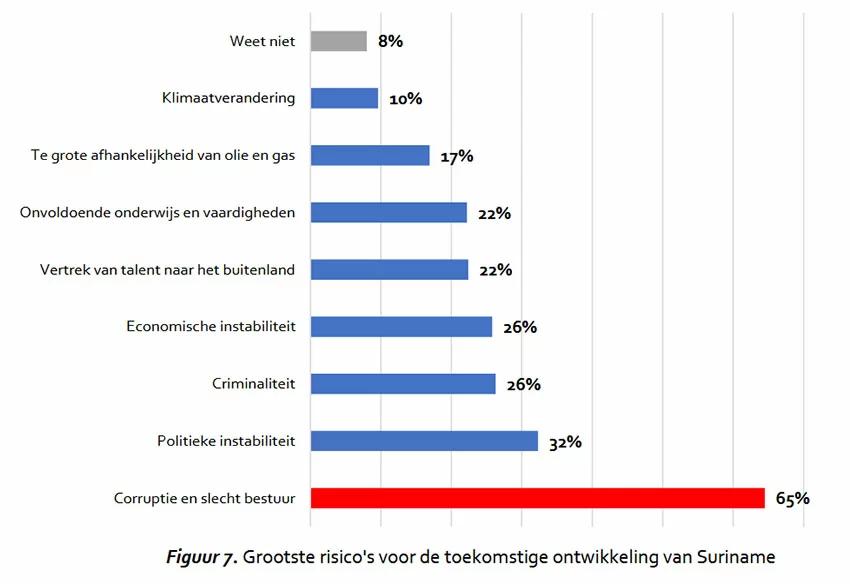
When asked to identify the greatest threats to Suriname’s future development, 65% of respondents named corruption and poor governance – far outpacing the second-most cited risk, political instability, which was selected by just 32%. Crime and economic instability tied at 26%, while brain drain, inadequate education, and a lack of skilled workforce each drew 22% of responses. Overdependence on oil and gas was cited by only 17% of respondents, and climate change by just 10%. The report emphasizes that this makes clear: the public does not see a lack of economic opportunity as Suriname’s biggest challenge; instead, it sees mismanagement and corruption as the primary barrier to progress. This concern grows with education level, with higher-skilled respondents more likely to name poor governance as a top risk.
Public doubt extends beyond questions of competent management to fairness of distribution. Seven out of 10 respondents expect that the benefits of oil and gas development will accrue almost entirely to a small, elite group. This deep-seated expectation of unequal distribution reinforces the public’s demand for accountable governance and anti-corruption action, researchers say. That demand is underscored by another striking finding: 91% of respondents agree that good governance and reduced corruption are more important than generating new oil and gas revenues themselves. This is one of the most widely shared positions captured in the entire survey.
Notably, the survey found that Surinamese do not reject the economic opportunity of new oil and gas development. In fact, 37% of respondents identified natural resources as one of Suriname’s greatest strengths for the future, outranking the country’s tropical rainforest and biodiversity (28%) and its multicultural society (23%).
The overarching takeaway from the survey is clear: as Suriname prepares to enter a new era of energy-led economic growth, the government faces a far greater challenge than developing its resource reserves. The public does not need to be convinced that oil and gas can deliver growth; instead, the government must prove it can manage revenues transparently, distribute benefits fairly, and govern in the broad public interest. Right now, the survey confirms, most Surinamese remain unconvinced.