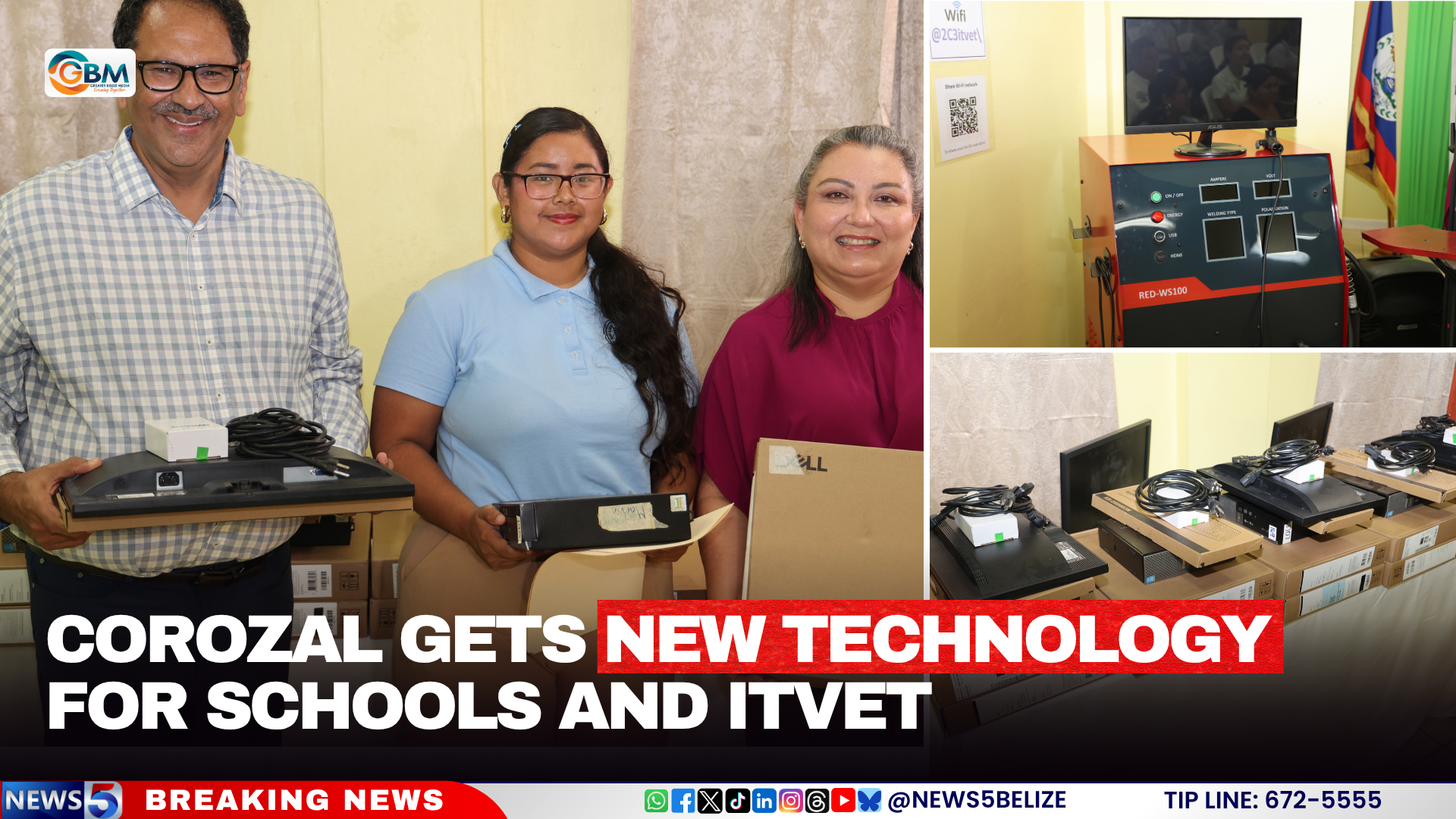
In a landmark development that is set to reshape technical and digital learning outcomes for students across northern Belize, multiple educational institutions in Corozal District have received transformative technology donations, closing long-standing gaps in access to modern learning tools. The multi-partner initiative has delivered 100 refurbished desktop computers to five local primary schools, alongside cutting-edge virtual reality welding training systems to the Corozal Institute of Technical and Vocational Education and Training (ITVET).
The primary school computer donation was spearheaded by Transparent BPO, which contributed the recycled units, with each of the five beneficiary schools receiving 20 desktops. To extend the functionality and lifespan of the devices, Belize’s Ministry of Investment stepped in to supply brand-new hard drives for all units, and also added an extra allocation of two laptops per campus to further support flexible digital learning initiatives. The five schools selected to receive the equipment are St. Paul’s Anglican Primary School, Church of Christ Primary School, Christiline Gill Primary School, Assemblies of God Primary School, and Corozal Nazarene Primary School.
This intervention did not emerge spontaneously: it follows a needs assessment funded by the Inter-American Development Bank (IDB) that formally identified the shortage of basic information technology infrastructure as a major barrier to delivering hands-on, engaging digital education to students in the region. For school leaders, the donation marks the end of a long period of limited resources, but also brings a new responsibility to ensure the technology delivers real learning gains. Jose Chan, Principal of Church of Christ Primary School, emphasized that while the community has now secured the critical tools students need, the focus must now shift to effective knowledge transfer. “We are getting the tools. Now it is time to pass on the knowledge,” Chan noted, underscoring the importance of teacher training and intentional integration of technology into daily curricula.
Meanwhile, at Corozal ITVET, a separate donation of four MIG welding virtual reality training systems marks a historic first for technical education in Belize. The equipment was delivered through coordination between the Office of the Prime Minister and the Investment Policy and Compliance Unit, making Corozal ITVET the first educational institution in the entire country to host this advanced simulation technology. Unlike traditional training models that require trainees to practice on live equipment with raw materials, the VR systems allow learners to master core techniques in a risk-free simulated environment before progressing to hands-on live welding work.
Hiram Riverol, speaking on behalf of ITVET Chairman Froylan Gilharry, explained that the simulation technology addresses multiple longstanding challenges in welding training. Beyond giving learners a low-pressure space to build foundational skills, the system also delivers tangible practical benefits for the institution. Lincoln Blake, Director of the Investment Policy and Compliance Unit, outlined these advantages, noting that the simulators help trainees build muscle memory and confidence in core welding concepts while cutting down on excessive wear and tear to institutional welding equipment and reducing consumption of costly welding materials.
According to Garcia-Ramirez, a representative from ITVET, the new VR systems will immediately benefit 17 enrolled welding students. The cohort includes eight new applicants who have recently joined the program, and nine returning students who carried over their enrolment from the previous academic year. “We currently have eight new applicants to the course, in addition to nine students from last year’s enrollment, who will have the opportunity to gain practical experience with this technology,” she said, confirming that the technology will be integrated into ongoing training starting immediately. Education and investment sector leaders across Belize have highlighted the donation as a model for public-private cooperation that can be replicated in other districts to lift overall educational quality across the country.