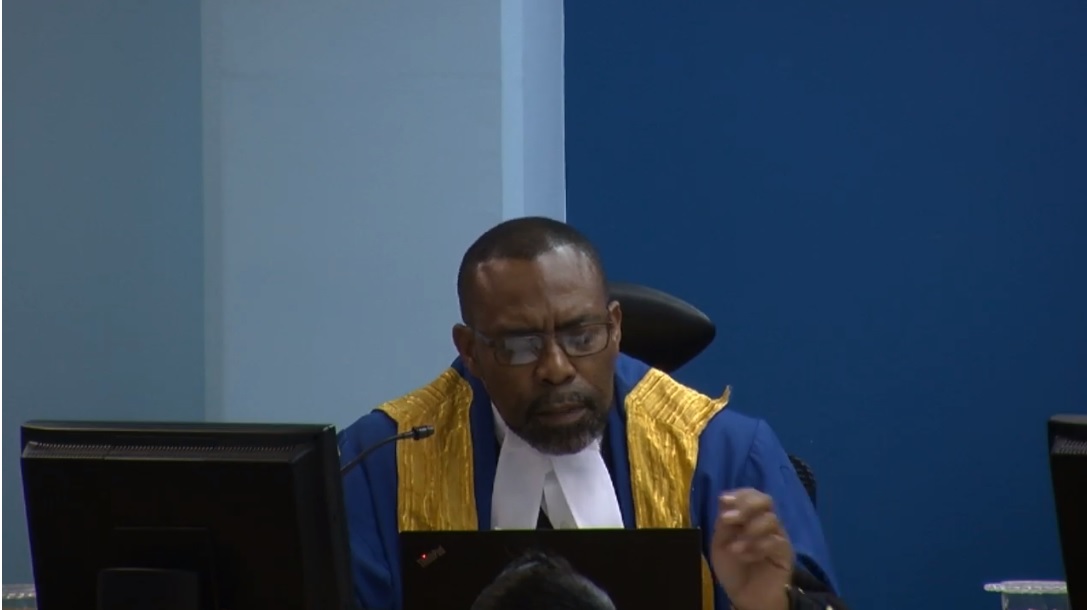
On Sunday evening, Dr. Terrence Campbell, parliamentary head of Guyana’s main opposition bloc A Partnership for National Unity (APNU), issued a public call for Dr. Winston Anderson, the embattled president of the Caribbean Court of Justice (CCJ), to step down. The demand comes following allegations of mismanagement leveled against Anderson by several of his fellow judges at the regional tribunal, which has served as a key final appellate body for a growing number of Caribbean nations.
Campbell framed the call around the core institutional values that underpin the CCJ’s legitimacy. “The Caribbean deserves a final court whose judges are free from political influence and whose President commands the confidence of his fellow judges, the legal profession, governments and the people of the region,” Campbell stated in his released statement. “Justice Anderson should therefore resign as President of the Caribbean Court of Justice.”
Campbell argued that the Trinidad-headquartered court currently faces a crisis of public confidence, as regional citizens, governments and legal practitioners expect the tribunal to uphold strict standards of independence, impartiality, and freedom from political interference. Emphasizing that the institution’s integrity outweighs individual tenure, he noted that Anderson’s resignation would not constitute an admission of wrongdoing, but rather an act of responsible institutional leadership that would clear the way for the court to address emerging concerns, repair public trust, and reaffirm its commitment to judicial independence.
“It would create the space for the CCJ to address the concerns that have emerged, restore confidence in its leadership, reaffirm the principle of judicial independence and demonstrate that the integrity of the institution must always take precedence over the tenure of any individual office-holder,” Campbell added.
Campbell also stressed that if the CCJ hopes to expand its role as the final court of appeal for additional Caribbean countries, it must first prove beyond any doubt that its own leadership meets the high standards of independence, impartiality, and collaborative governance that the role demands. “The restoration of confidence in the CCJ must begin with accountability at the highest level. Justice Winston Anderson should resign,” he reiterated.
In his statement, Campbell referenced a previously unpublicized engagement between Anderson and Aubrey Norton, Leader of the Opposition in Guyana, regarding the appointment of a substantive Chancellor and Chief Justice of Guyana. The appointment process has been roiled in controversy over the position of incumbent Justice Yonette Cummings-Edwards. Campbell confirmed that Norton has verified Anderson reached out to him on the matter, expressed opposition to any move that would supersede Cummings-Edwards, and ended the discussion after determining the engagement was not in Guyana’s best interests.
Beyond the Guyana judicial appointment controversy, Campbell pointed to reporting from the *Trinidad Express* that uncovered a deep internal rift among CCJ judges, including widespread concerns about Anderson’s leadership style and allegations of unfair treatment of fellow jurists. These reports, he argued, raise systemic questions not just about a single intervention in Guyana’s domestic judicial affairs, but about how Anderson exercises institutional authority and interacts with his colleagues on the court.
These broader tensions have already played out in a high-profile extradition case involving two Guyanese billionaires: Azruddin Mohamed and his father Nazar “Shell” Mohamed, who challenged a portion of their extradition proceedings before the CCJ. The case has been publicly cited as a key flashpoint in the rift between multiple CCJ judges and President Anderson.
According to the *Trinidad Express* reporting, an internal email among CCJ judges includes allegations from Justice Chile Eboe-Osuji that Anderson pushed to rush a decision in the Mohamed case. The case centered on the Mohameds’ challenge of a decision by Guyana’s Home Affairs Minister Oneidge Walrond, who authorized a magistrate to hear an extradition request from the United States on alleged financial crime charges. Anderson’s push for an early announcement, the allegation claims, stemmed from claims of political bias against Walrond.
The CCJ has not directly addressed the specific claims about Anderson’s management style and decision-making. In an official response to the *Trinidad Express*, the court did not outright discredit the newspaper’s reporting, only noting that the outlet did not have access to the full context of internal court dynamics. “The Court is mindful that questions and allegations presented without the benefit of context, background, or an appreciation of the nature of judicial deliberations, collegial discussions, and institutional governance may lend themselves to misunderstanding or mischaracterisation,” the regional tribunal said.