A devastating mass fish mortality event in the upper reaches of Suriname’s Saramacca River is far more than a localized environmental disaster, an unreleased preliminary impact assessment from the National Environmental Authority (NMA) obtained by local outlet Starnieuws has revealed. The draft report points to likely chemical contamination, outlines potential long-term risks to both human communities and local ecosystems, and highlights far-reaching economic harm for Indigenous populations that rely on the river for survival. Most notably, the disaster unfolded less than four weeks after the Surinamese government, the Matawai Indigenous community, and major gold mining firm Zijin Rosebel Mines signed a new agreement establishing enhanced oversight, safety protocols, and management for mining activities in the nearby Moeroekreek area.
The NMA’s report remains non-definitive as of August 10, with multiple laboratory analyses still ongoing. No official cause or responsible party has been formally identified, and key preliminary conclusions require further scientific validation and confirmation from regulatory bodies. Final test results for fish tissue samples were expected on August 10, with the government’s full final report due within two weeks of that date.
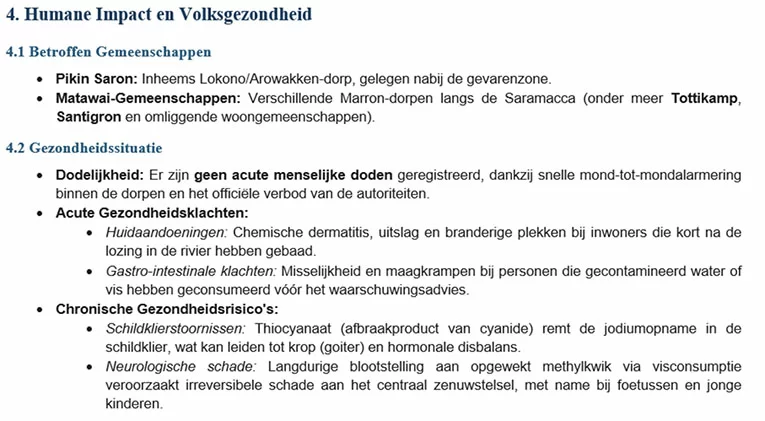
On June 26, the NMA issued an urgent public warning advising local communities against eating or selling dead or sick fish caught from the river, suspending use of river water for household purposes, and limiting direct physical contact with the water as much as possible.
Initial water samples collected on June 25 tested positive for cyanide and mercury, though both compounds were found at concentrations below current official regulatory limits. However, tests did detect elevated levels of iron, aluminum, manganese, total suspended solids (TSS), and Chemical Oxygen Demand (COD) – a key metric measuring the amount of oxygen required to break down organic and chemical contaminants in water. The NMA added a critical caveat to these early findings: cyanide breaks down and dilutes relatively quickly in natural freshwater environments. A low reading at the time of sampling therefore does not rule out far higher concentrations being present immediately after a contamination event.
Based on these early results, the environmental authority says it is seriously investigating the hypothesis that the mass fish die-off was caused by a single uncontrolled discharge of chemical waste. So far, testing of processed fish samples has not found elevated levels of mercury, lead, or cadmium in fish tissue, but additional analyses for arsenic, sediment testing, and assessment of supplementary samples are still pending to clarify the full scope of contamination.
The impact assessment warns that the consequences of an unregulated chemical discharge could extend far beyond the visible mass mortality of fish. If contaminants leach into river sediment, they can persist in the ecosystem far longer than they would in flowing river water, creating long-term risks for benthic organisms, fish populations, fish-eating wildlife, and ultimately human communities that rely on the river. Heavy metals, in particular, require long-term monitoring: unlike cyanide, they do not break down naturally and can bioaccumulate in soil, sediment, and food chains over time.
The report also notes that agricultural plots along the river’s banks require further investigation, as local communities use water from the river and its tributaries for both fishing, household use, and small-scale agriculture. The full extent of long-term impacts on these activities remains unquantified, pending results from additional testing of sediment, soil, native plants, and local biological communities.
For local residents, the ongoing scientific debate over contamination levels is not an abstract academic issue – the harms of the event are already tangible. Fish is a core food source for multiple communities along the Saramacca, and for many residents, it also serves as a primary source of income. With fishing and river water use suspended, residents have become entirely dependent on imported bottled water and external food aid.
Residents of the riverside community of Pikin Saron have already called for financial compensation and a long-term structural solution to the crisis. They note that emergency aid can only ease immediate hardships, but does not address the permanent loss of their traditional food supply and primary income stream, giving the disaster a clear social and economic dimension beyond its environmental impact.
One of the report’s most striking findings centers on the timing of the disaster. On May 28, less than a month before the first reports of large-scale fish mortality, the government, Matawai community, and Zijin Rosebel Mines signed a new regulatory protocol for the Moeroekreek gold mining region. The agreement was explicitly designed to improve organization, safety, registration, and oversight of all mining operations in the area. The local Stichting Moeroemoeroe was given a central role in managing and registering small-scale local artisanal miners, and a new multi-stakeholder monitoring commission was established, including representatives from government ministries, the mining firm, and the community foundation. Just weeks after the agreement went into effect, thousands of dead fish began appearing in the river system.
This timeline does not automatically assign blame to the parties that signed the protocol, but it raises urgent questions about how effective the newly agreed oversight actually was, and whether high-risk mining activities and chemical storage practices were properly regulated as intended. Suriname’s Minister of Oil, Gas and Environment Patrick Brunings has confirmed investigators are exploring a scenario where a chemical storage pond or tailings basin overflowed during heavy seasonal rainfall, releasing contaminated material into the Moeroekreek and ultimately the Saramacca River system. No confirmation has yet been obtained on which chemical was released, in what concentration, the exact location of the release, or which party is legally responsible.
The NMA impact assessment obtained by Starnieuws goes further on this point, outlining a scenario where wastewater and ore slurry were released in a single large pulse from a mining tailings basin, and providing a preliminary technical estimate of the likely scale of the discharge. Starnieuws notes this estimate has not yet been independently verified, so it cannot be reported as a confirmed fact. The same standard applies to assigning blame to any company operating in or near the affected area: until investigators confirm the source location of the contamination, responsibility cannot be automatically assigned to any concession holder, state-owned enterprise, or group of small-scale artisanal miners.
If the investigation ultimately confirms that the mass fish die-off was caused by an uncontrolled chemical discharge from gold mining operations, investigators will not only need to identify the party responsible for the release. They will also need to explain how such an incident could occur in an area that had just been placed under a new, enhanced regulatory and monitoring framework. Key unanswered questions include: Which stakeholders knew what chemicals were stored in the area? Who was responsible for inspecting storage facilities? Which mining activities were formally registered? Who conducted inspections of tailings retention basins? Did the agreed monitoring commission ever become operational and fulfill its oversight duties?
The report also emphasizes that the harm to local communities cannot be measured solely in financial terms or by counting dead fish. For the Indigenous Matawai and other tribal communities, the Saramacca River is far more than a natural resource: it is a source of drinking water, a core food supply, a transportation route, the foundation of the local economy, and a central part of their traditional cultural and physical environment. When public warnings bar communities from using the river’s water and fish, a core pillar of their daily existence is disrupted.
The first public warning was issued on June 26. More than six weeks later, definitive answers to the most critical questions remain elusive: What caused the mass fish mortality? Where did the contamination originate? What long-term harm has been left in the disaster’s wake? Who bears ultimate legal and moral responsibility?
Regardless of who is ultimately identified as the party responsible for the contamination, the disaster has already exposed a larger systemic vulnerability: the fragility of regulatory oversight for gold mining and chemical management in Suriname’s interior regions. The dead fish were a visible sign of disaster, but the larger, unanswered question remains what activities were occurring out of regulators’ sight in the region before the fish die-off occurred.