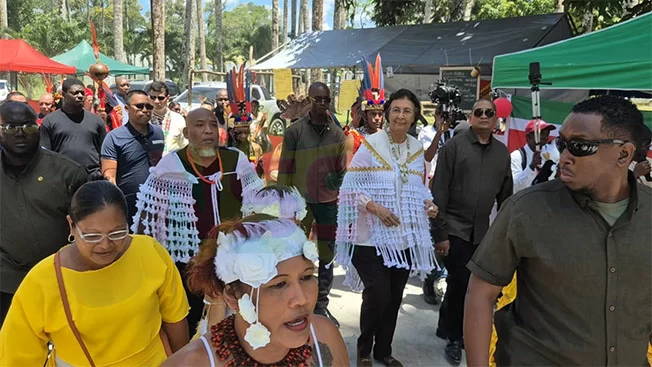
On August 9, marking the International Day of the World’s Indigenous Peoples, Suriname’s President Jennifer Simons and National Assembly Speaker Ashwin Adhin gathered at Palmentuin to join national celebrations and publicly push for accelerated progress on formal Indigenous and tribal community recognition and land rights protections.
In her keynote address to attendees, President Simons opened by reaffirming a core truth of Suriname’s national identity: Indigenous peoples are the original inhabitants of the South American nation. Centuries of migration and history have brought diverse population groups together across Suriname, she noted, creating a shared collective responsibility to move beyond coexistence and build genuine collaborative community between all groups.
Simons tied this year’s International Day observance to ongoing national discussions about expanding Indigenous rights, stressing that the process of advancing solutions for recognition and land boundary demarcation cannot be paused. Following recent renewed talks between government officials and Indigenous and tribal community leadership, the two sides have agreed to advance work on land rights, recognition of communal cultural practices and traditional territories in a steady, step-by-step manner without interruption.
The president set a clear goal: she expects to deliver tangible progress on these issues during her administration’s term. Central to this work, she emphasized, will be sustained, meaningful consultation with the Indigenous communities directly affected by policy changes. Simons also highlighted two additional priorities: creating new development and leadership participation opportunities for Indigenous youth, and developing the nation’s natural resources in ways that directly advance Indigenous community well-being.
Drawing on recent professional experience in Peru, Assembly Speaker Adhin outlined a concrete policy path for Suriname to follow. In Peru, he explained, Indigenous communities receive formal legal recognition as juridical persons early in the rights process, long before any land title transfers are finalized. This legal status allows recognized communities to enter contracts, receive land and funding, and participate in legal proceedings, laying a functional foundation for future rights gains. Adhin argued this framework would deliver major benefits to Suriname, and called for the country to adopt the model as a core part of its own Indigenous rights process.
Adhin also proposed that all consultations with Indigenous communities be carefully documented and formally recorded through a public committee within the National Assembly. This transparent record, he explained, would provide clear evidence of consultation processes and community input for any future international legal proceedings related to land rights and constitutional recognition.
This year’s International Day of the World’s Indigenous Peoples falls within Suriname’s national Heritage Month, a designation Simons said is designed to build broader public understanding of the nation’s diverse histories, traditions, languages and cultural practices. The ultimate goal of this work, she added, is to help all Surinamese gain deeper knowledge and greater respect for the diverse cultural threads that make up the national identity.
To illustrate this vision, Simons used a powerful metaphor: Suriname’s national community is a tree, and Indigenous peoples are the deep, strong roots that hold the tree steady through storms. “Every tree can only grow and withstand severe storms if its roots are firmly anchored in the ground,” she said. “Indigenous peoples are the roots of the Surinamese tree.” This status, she argued, requires that the nation treat Indigenous peoples’ rights and status with care and respect, while ongoing work builds stronger connections between Indigenous communities and other population groups across the country.
Closing the event, Simons reaffirmed the government’s commitment to protecting the future of Indigenous children across all regions of Suriname, and improving the overall social and political position of Indigenous communities. “We will continue working to build a better future for Indigenous peoples, and bring all communities in Suriname together as one hand, one people, one shared future,” she said.