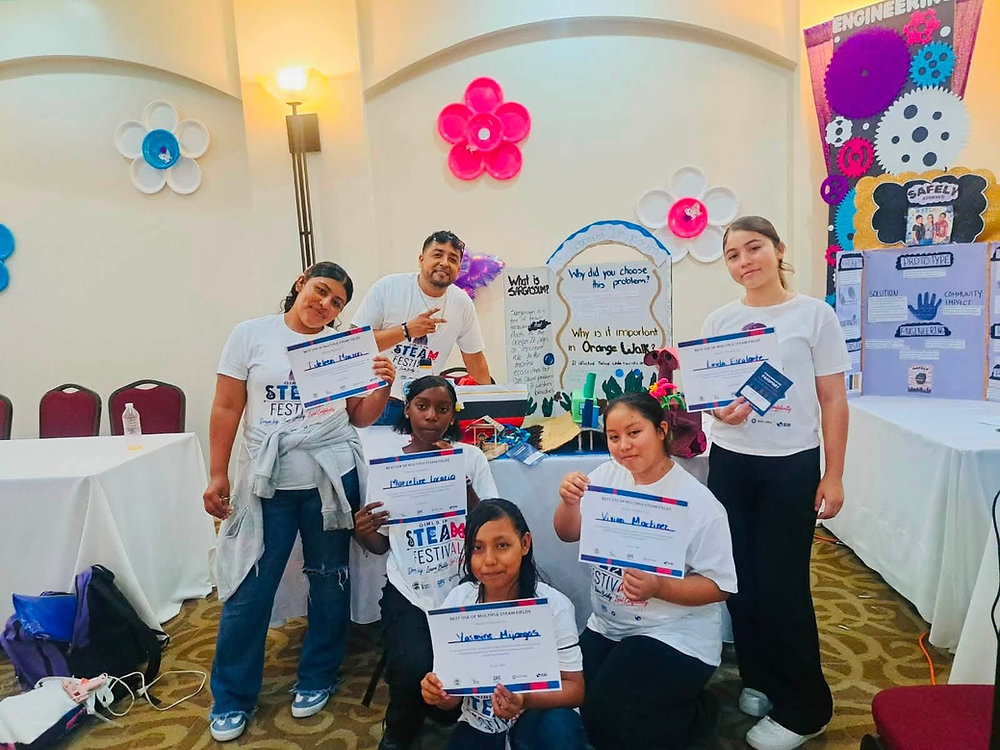
What began as an unappealing summer camp commitment for five teenage girls in northern Belize has ended in national innovation recognition, delivering a creative potential solution to one of the country’s most stubborn coastal environmental issues. The team of students from Orange Walk’s Bishop Martin High School walked away with the “Best Use of STEAM” award at Belize’s national STEAM Festival, held July 18, 2026 in San Ignacio, Cayo, for their project that transforms invasive sargassum seaweed into usable agricultural fertilizer.
The students — Linda Escalante, Ideleen Monzon, Vivian Martinez, Yasmin Minjangos, and Marceline Locario — only joined their school’s July STEAM summer camp after gentle persuasion from their mothers. After a grueling academic year, many of the teens prioritized rest over giving up their afternoons for an extra educational program, and none expected the experience to reshape their understanding of problem-solving or earn them national acclaim.
Hosted as part of the government-backed “Skills for the Future” extracurricular initiative, the summer camp was designed to encourage young women to explore intersections of science, technology, engineering, arts, and mathematics while tackling real local challenges. Facilitated by educator Wilson Mendoza, the program paired interactive lessons with industry engagement: professionals from ASR Group walked participants through real-world engineering applications in sugar production, while a visit to Orange Walk ITVET introduced students to how AutoCAD digital design leverages mathematical principles for modern construction.
As the camp wrapped up, participating teams were tasked with identifying a pressing community issue and developing an innovative solution rooted in STEAM concepts. The Bishop Martin team settled on sargassum, a rapidly accumulating seaweed that plagues Belize’s coastlines, damaging tourism economies and creating unpleasant, unhealthy conditions as it decomposes on beaches. Their project, titled *The Reborn of Sargassum*, outlines a system where a purpose-built vessel would collect and compress massive volumes of sargassum directly offshore, then process the seaweed into nutrient-rich fertilizer for local farmers.
The young innovators didn’t stop at a vague concept: they conducted rigorous research into the natural nutrients found in sargassum, documented its proven benefits for boosting crop growth and even suppressing common fungal crop diseases, and studied existing sargassum processing techniques used in neighboring Mexico to address questions around chemical treatment required to make the seaweed safe for agricultural use. Splitting tasks based on individual strengths — with members leading research, model building, and presentation preparation respectively — the team refined their proposal to compete against 30 other teams from six secondary schools across Belize at the national festival.
Walking into the competition, the five students had little confidence in their chances of placing. But their thorough, locally focused approach impressed the panel of judges, which included education officials, business leaders, and community representatives, ultimately earning them the top honor for STEAM integration. Other winning projects came from teams across the country, including additional entries from Bishop Martin High School, Corozal Community College, and Ecumenical High School.
The “Skills for the Future” initiative behind the camp is supported by Belize’s Ministry of Education, Culture, Science and Technology, the Inter-American Development Bank, and the Global Partnership for Education, with implementation led by the Education Development Center. Its core mission is to break down barriers for girls and young women pursuing education and careers in STEAM fields, which remain disproportionately male-dominated globally and in Belize.
For this winning team, the experience is far from over. The students now hope to advance their concept by building a functional working prototype of their sargassum processing system, but they face a key barrier: securing funding to move the project beyond the planning stage. The team has expressed hope that private sector partners will recognize the dual environmental and agricultural value of their idea and provide the financial support needed to test and scale the concept.
Beyond the potential impact of their sargassum solution, the experience has already transformed how the five students approach new opportunities. A program they nearly rejected for a summer of rest has not only earned them national recognition but also showed them how cross-disciplinary STEAM thinking can turn long-standing local problems into tangible community benefits.
This report was written by Ingrid Ferlo, Communications Consultant with the Education Development Center.