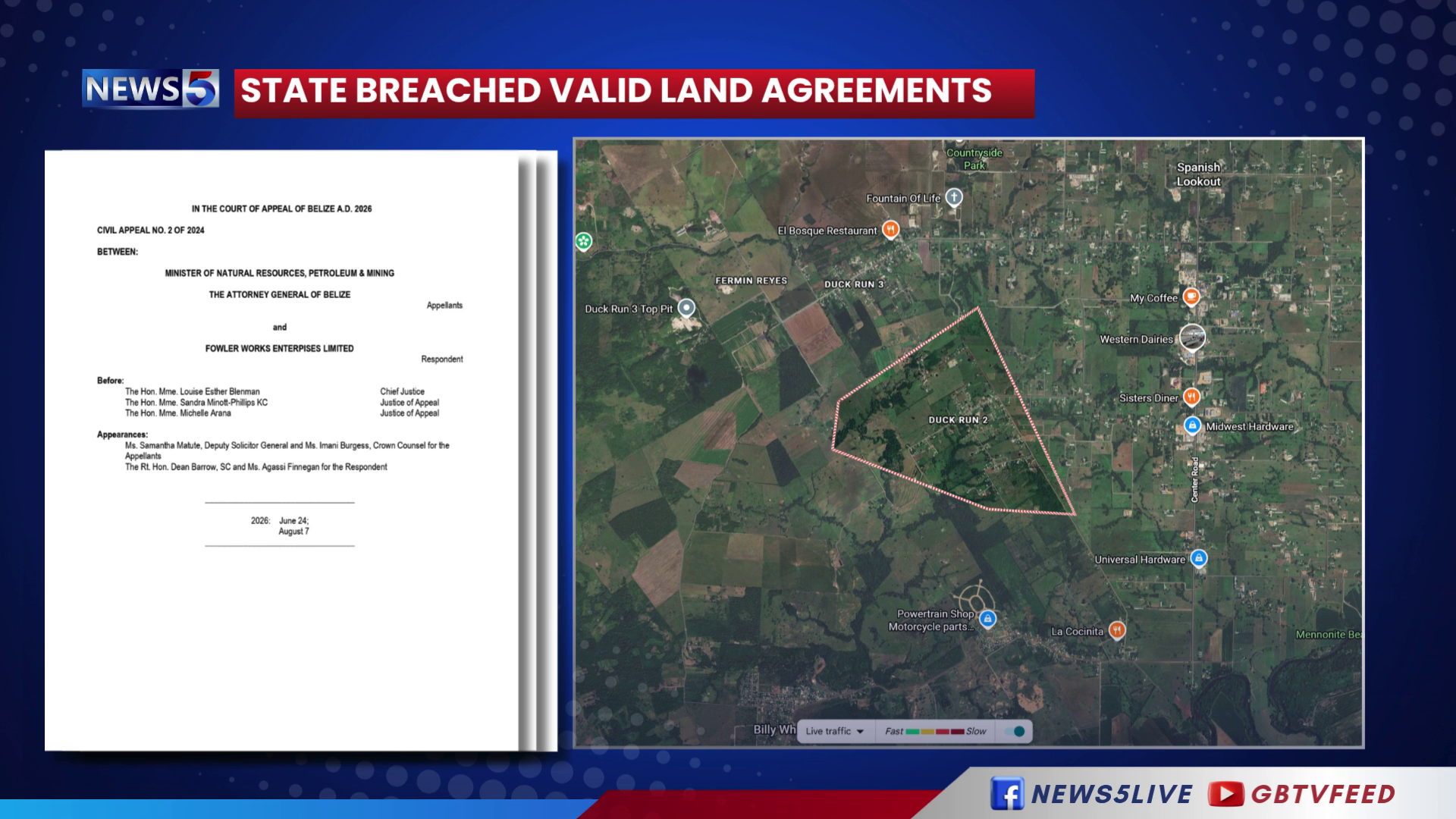
In a landmark ruling issued on August 7, 2026, the Court of Appeal has dealt a decisive legal defeat to the national government in a high-stakes land dispute covering more than 1,900 acres of public territory in the Duck Run region. The case centers on a legal battle launched by the Minister of Natural Resources, Petroleum and Mining and the Attorney General against private firm Fowler Works Enterprises Limited, challenging the validity of four land purchase agreements the company struck with the previous administration.
The origins of the conflict stretch back to 2020, when Fowler Works entered into the four deals to acquire the state-owned land for a planned large-scale sustainable agriculture and residential homestead development project. The company fulfilled its end of the agreement by paying the full $266,000-plus purchase price upfront. However, following a change in national government later that same year, the new administration refused to finalize the transaction by issuing the official land titles to Fowler Works.
In its defense, the state argued that all four agreements were illegal and unenforceable under existing law. One key point of contention was that a single parcel of land included in the deal exceeded 500 acres, a threshold that the state claimed required formal approval via a National Assembly resolution that had never been granted. The government also claimed that the remaining smaller parcels violated internal land management policies.
The Court of Appeal rejected every one of the state’s legal arguments. In its findings, the court clarified that while the state had failed to complete the required National Assembly approval process for the large parcel, that procedural oversight on the government’s part did not invalidate the existing contract. In clear, direct terms, the court ruled that the government cannot use its own failure to follow statutory requirements as a justification to back out of a binding commercial agreement. The court also found that Fowler Works had fully complied with all applicable procedural requirements for the smaller parcels, dismissing the state’s claim that the agreements violated internal policy.
The ruling upholds the earlier 202X High Court decision that declared all four land purchase agreements legally valid, found that the state had breached its contractual obligations to Fowler Works, and ordered the case returned to the lower court to determine the amount of financial damages the government will be required to pay to the private enterprise. Fowler Works was represented throughout the appeal process by Senior Counsel Dean Barrow and associate attorney Agassi Finnegan.